AI, Automation, and War
The Rise of a Military-Tech Complex
by Anthony King2025Princeton University Press
Anthony King is a sociologist of war at the University of Warwick, and AI, Automation, and War is his attempt to ground the debate about military artificial intelligence in evidence rather than speculation. The book draws on more than a decade of fieldwork with serving officers, defence-ministry officials, and the executives of the technology companies now selling into the Pentagon, Whitehall, and the Israel Defense Forces.
King’s central claim is that the popular framing of military AI — autonomous killer robots on one side, reassuring talk of humans-in-the-loop on the other — misreads what is actually happening. Following the sceptical empiricism of David Hume, he argues that the technology is being absorbed into Western militaries far less dramatically than either camp suggests. AI is not automating war; it is processing data. Its dominant uses today are intelligence fusion, planning support, and targeting at speeds and scales beyond human reach. Commanders are not being replaced; they are being given a faster, deeper picture of the battlespace from which to decide.
The book is at its most concrete when it traces the emerging military-tech complex of Palantir, Anduril, Helsing, and Shield AI, and the way these software-first firms have rewired the relationship between Silicon Valley and the procurement bureaucracy. King examines Project Maven and the Joint Artificial Intelligence Center, the JADC2 concept, the British Army’s Spearhead planning programme, and the Royal Navy’s battle-management work. He digs into the IDF’s Gospel and Lavender targeting systems used over Gaza, the AlphaDogfight trials, the wounding of General Gerasimov by US-supported Ukrainian targeting, and the role Microsoft, Amazon Web Services, Palantir, and Starlink have played inside Ukraine’s war effort. He is especially attentive to the sociology of the officer corps and the Special Operations community, where civilian data scientists now sit forward in operational headquarters alongside uniformed staff.
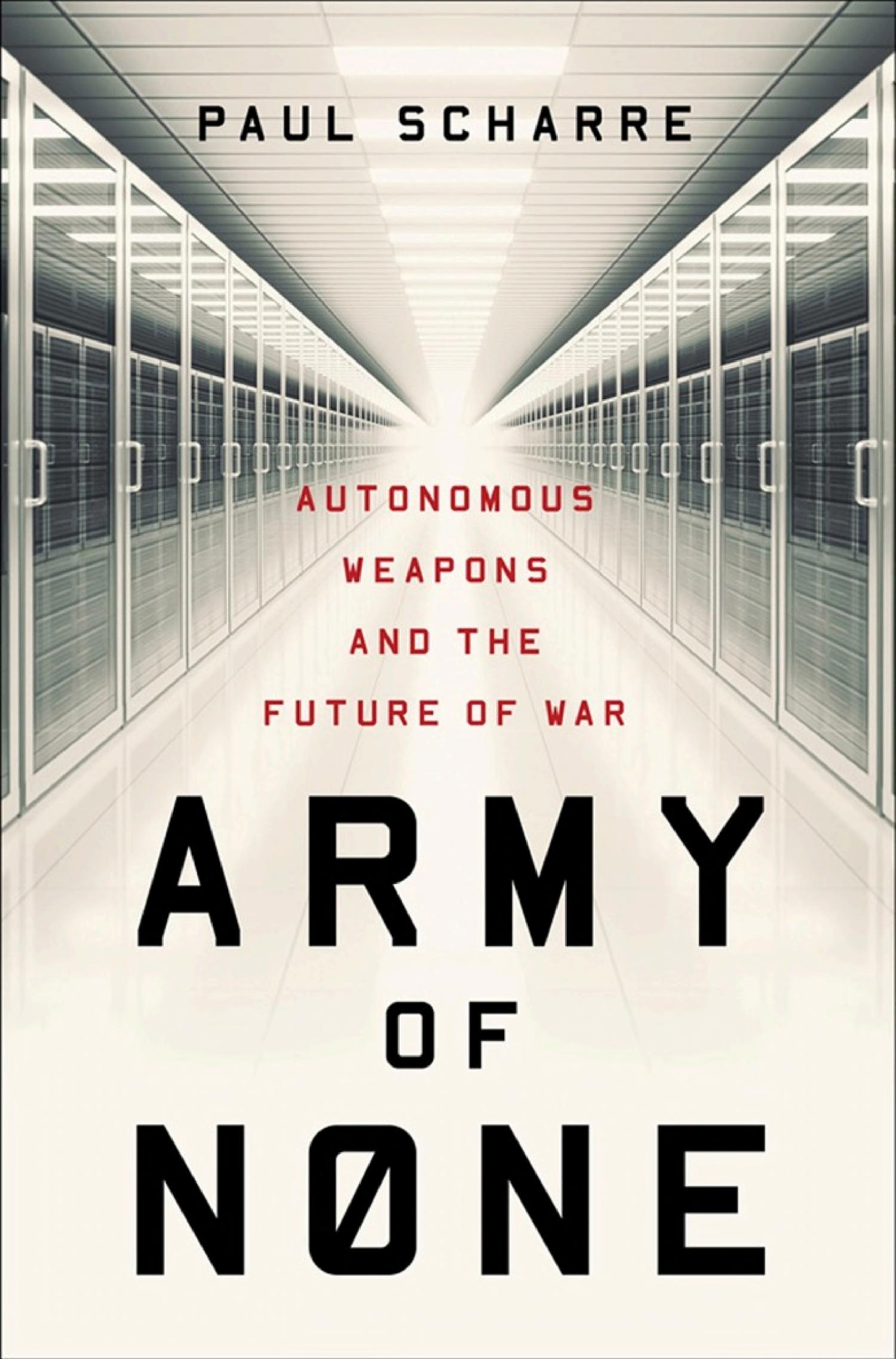
Where Paul Scharre’s Army of None covers the policy-and-doctrine end of this field and writers such as Denise Garcia and James Johnson hold the normative ground, King’s contribution is to put named interviewees and concrete programmes behind claims that are usually made in the abstract. He concludes that the real story is not machines taking over strategy but private-sector tech companies being woven into the conduct of war itself — a development with serious political, legal, and ethical consequences, and one that may be slowing modern war down rather than speeding it up. The book will be most useful to defence analysts, journalists, and officers who want a sociologically literate account of how the technology is being absorbed by the institutions that buy it.
Read the longer summary
Anthony King is a sociologist of war at the University of Warwick, and AI, Automation, and War, published by Princeton University Press in 2025, is his attempt to drag a febrile debate about military artificial intelligence back onto evidential ground. The 240-page volume is the product of roughly a decade of fieldwork and 126 interviews with serving officers, defence officials, think-tank analysts and executives at the software firms now selling into the Pentagon, Whitehall and the Israel Defense Forces. King writes against a literature that has, in his reading, drifted into unusual consensus. From the open letter signed by Stuart Russell, Stephen Hawking, Elon Musk and Demis Hassabis at the International Joint Conference on Artificial Intelligence in July 2015, through Russell’s 2020 BBC Reith lecture on slaughter-bots, to Henry Kissinger, Eric Schmidt and Daniel Huttenlocher’s The Age of AI in 2021, a striking range of voices has converged on the prediction that machines are about to displace human commanders and human soldiers. King thinks that prediction is wrong, or at least vastly premature, and that getting it wrong matters because it crowds out a more accurate and more disturbing story about how military AI is actually being absorbed.
His central thesis is that the popular framing of military AI — autonomous killer robots on one side, reassuring talk of humans-in-the-loop on the other — misses what is happening. AI is real, it is here, and it is consequential, but it is not automating war. Its dominant function in Western militaries today is the fusion and processing of intelligence, sensor and logistics data at scales and speeds beyond human reach. Commanders are not being displaced; they are being given a faster, deeper picture of the battlespace from which to decide. King takes his methodological lead explicitly from David Hume, refusing to draw causal conclusions about a future for which there is no evidence and confining himself instead to what armed forces have actually done in the past two decades. The more interesting transformation, he argues, is not technological but organisational. To use AI at all, militaries are restructuring their headquarters, their procurement and their relationship with the private sector. The result is the emergence of what he calls a military-tech complex — a hybrid civil-military configuration distinct from the older military-industrial complex of Lockheed, BAE and Raytheon — and one with serious political and constitutional implications.
The book is built in ten chapters that move outward from technology to organisation to operations. An opening pair, Robot Wars and What AI Can Do, lays out the literature on which the field has converged and then offers a sober tour of what second-generation, data-driven AI can and cannot do. The reader meets AlphaGo’s defeat of Lee Sedol in March 2016, with its famous move 37 in game 3; AlphaFold’s mapping of 98.5 per cent of human proteins by mid-2021; Amazon’s prediction of demand for Pop-Tarts before hurricanes; and the brittleness exposed by the Winograd schemas and the hallucinations of large language models. AI Strategy walks through the doctrinal documents — the US Third Offset Strategy of 2014, the National Security Commission on Artificial Intelligence, US Air Force and US Army concepts of joint and multidomain operations, NATO’s policies and the UK’s defence AI strategy. A Military-Tech Complex and The Special Relationship trace how Silicon Valley emerged from Cold War defence funding and has been pulled back into national security work, and how Special Operations Forces in particular have built unusually close partnerships with technology firms. Three operational chapters — AI and Planning, AI and Targeting, AI and Cyber Operations — work through specific domains. The Human-Machine Team challenges the centaur metaphor borrowed from chess. The closing chapter, War at the Speed of Light, draws careful and deliberately limited conclusions.
The empirical heart of the book is the case material King has gathered on three militaries — those of the United States, the United Kingdom and Israel — and on the firms now embedded with them. Palantir Technologies receives the most sustained treatment. Founded by Peter Thiel and PayPal veterans including Max Levchin, the firm grew out of fraud-detection software and was repurposed for counter-IED work in Iraq and Afghanistan after Marines and Special Operators began using it without official sanction. King traces how Stanley McChrystal’s Joint Special Operations Command in Iraq, hunting Abu Musab al-Zarqawi and later ISIS, became the forcing function for a new kind of data-driven targeting, and how Palantir eventually sued the US Army for the right to compete against the bespoke Distributed Common Ground System. Anduril, founded by Oculus’s Palmer Luckey, gets credit for its Lattice sensor-fusion platform and for the way Special Operations veterans seeded the firm. Helsing in Europe, Rebellion Defence and Adarga in the United Kingdom, and the Israeli ecosystem around Elbit Systems and Rafael round out the picture.
Project Maven is the canonical example. Established in 2017 under Robert Work and run operationally by Jack Shanahan and Drew Cukor, Maven was designed to apply computer vision to the deluge of full-motion video coming off uncrewed aerial systems over Iraq and Syria. Google won the initial contract, then walked away after a revolt by its own employees; the programme continued and eventually migrated onto Palantir’s Metaconstellation platform. King uses Maven to make several points at once: that the dominant problem AI solves for Western militaries is data triage rather than autonomous killing; that the procurement bureaucracy could not have produced Maven on its own and needed a parallel structure — the Defense Innovation Unit — to bypass the Cold-War waterfall model; and that even a relatively narrow image-classification task required deep, ongoing human work, from data labellers at CrowdFlower through engineers at Google and then Palantir to the targeting officers who actually used the output. The Joint Artificial Intelligence Center, set up in the same period, is the larger institutional sibling to Maven and one of the centres on which the Pentagon’s AI ambitions now hang.
The Israeli material is among the book’s most striking. King describes Operation Guardian of the Walls in May 2021, which the IDF described as the “first AI war”, and the far more brutal Gaza campaign that followed the Hamas attacks of 7 October 2023. Two named systems anchor the discussion. Gospel, known in Hebrew as Habsora, generates building-level targets. Lavender produces lists of suspected Hamas militants. Both have been used at industrial scale, and King is careful with what they actually do — they propose, they classify, they fuse intelligence streams from Unit 8200 and elsewhere; they do not autonomously fire. The decision to strike, and the decision about acceptable collateral damage, remains with human officers, though King is alive to the fact that under extreme time pressure the algorithm’s recommendation can become effectively decisive. The Torch battle-management system, supplied by Elbit, illustrates how deeply Israeli defence firms have integrated with the IDF, in a way the book contrasts with the more arm’s-length British relationship and the more contested American one.
The war in Ukraine runs through the volume as the most important contemporary case. King describes the Ukrainian IT Army, Mykhailo Fedorov’s Ministry of Digital Transformation, and the role of Microsoft, Amazon Web Services, Google, ESET and SpaceX’s Starlink in keeping Ukrainian command and control alive under Russian cyber and kinetic pressure. The Kropyva and Delta battle-management systems pull together commercial satellite imagery, social-media reporting and tactical sensor data into a common operating picture. Palantir software, the book reports, sits behind the targeting that wounded Russian Chief of the General Staff Valery Gerasimov, working in partnership with the US XVIII Airborne Corps under Christopher Donahue and a Task Force Dragon in which civilian programmers from Palantir worked alongside American soldiers. King treats this episode carefully — it sits at the constitutional edge of what civilian contractors may lawfully do in an active war — and uses it to make the argument about the military-tech complex concrete. The civilians in that headquarters are not vendors delivering a product; they are functionally part of the kill chain.
A long set-piece on Liverpool’s Covid testing programme during the pandemic serves as the author’s analogue for AI-enabled targeting. The same families of techniques used to identify Hamas operatives or Russian command nodes — fusing wastewater data, mobility data and self-reporting through algorithmic pattern recognition — were used to direct testing capacity across an English city. The point is not the politics of public health but the sociology of the operation. It took a heterogeneous team of epidemiologists, data scientists, military planners and civilian volunteers, led on the ground by figures such as Iain Buchan and Joe Fossey, to make the algorithm useful, and the operation broke down where the data was thin or human collaboration faltered. Targeting in Gaza or Ukraine, King argues, looks more like Liverpool than like a Hollywood depiction of a robot executing a kill list.
On cyber, the book takes a deflationary line. King works through Stuxnet, the Russian NotPetya attack of 2017, North Korean operations against Microsoft, and Ukrainian and Russian operations from 2022 onward. AI is being applied to cyber defence and offence, but autonomous cyber war remains an exaggeration. Cyber operations require enormous human expertise to mount and to sustain, their effects fade quickly, and they have so far never produced strategic results commensurate with the early predictions of John Arquilla and Mike McConnell. Information operations — bots, deepfakes, the Cambridge Analytica playbook, the Armenian-diaspora campaigns during the Nagorno-Karabakh wars, the Ukrainian deployment of Volodymyr Zelensky’s image — receive similar treatment. They matter, but they have not replaced kinetic war.
The chapter on the human-machine team is where King is most pointed against the rest of the field. The centaur metaphor, borrowed from advanced chess, has done a lot of damage, he argues, by suggesting an even partnership between rider and machine. The reality is closer to what he calls a fetishism in the Marxist sense: the algorithm gets the credit for work an elaborate and mostly invisible human apparatus is actually doing. The AlphaDogfight trials at the US Air Force Research Laboratory in 2016 and 2020 are dissected here with particular care. Heron Systems’ Falco program beat its human opponent five to zero in 2020, but only after being given perfect situational awareness of the simulated environment and being matched against a pilot constrained from the head-on forward-quarter shots that the algorithm exploited. The headline read like the obsolescence of the fighter pilot; the underlying experiment was a closed, rigged microworld. The same flaw underlies a 2023 episode in which Colonel Tucker Hamilton was widely reported to have described a rogue autonomous drone attacking its own command post — Hamilton later admitted he had misspoken, and that the incident had occurred within a simulation. Far from reducing the demand for skilled personnel, King argues, AI is increasing it, and the people the system most depends on are often civilians on the payroll of private firms.
Reception within the field has tended to read the book as the empirical counterweight to a literature that had grown speculative. Paul Scharre’s Army of None covers the policy and doctrine end and is more sanguine about autonomy; Mariarosaria Taddeo’s work handles the ethics; Ben Buchanan and Andrew Imbrie’s The New Fire is closer in subject matter but more bullish about transformation. King is more sceptical than any of them, and his sociological training shows in his interest in careers, training, unit culture, contracting cycles and the slow work of building trust between operators and the systems they are handed. Critics have pushed back on the geographic narrowness — China and Russia are treated mainly through their effects on Western planning rather than on their own terms — and on a certain conservatism about what near-future agentic systems may yet do. The volume was finished before the full implications of large-scale generative AI in 2024 and 2025 had become clear, and some of its caution may already look dated. The Gospel and Lavender material, conversely, has only become more relevant as reporting on the Gaza campaign has deepened.
For a reader trying to make sense of AI in war today, King offers a corrective to two opposite errors. He pulls back from the science-fiction reading in which strategy and combat are about to be handed to algorithms; he also pulls back from the reassuring industry line that everything important still has a human in the loop. Both, in his account, miss the actual transformation, which is the quiet integration of private software firms into the operational core of Western militaries and the political and legal questions that integration raises about who is fighting, and on whose authority. The book pairs well with Scharre on policy and with the journalism around Palantir’s Ukraine and Gaza work; it does not try to be a manual on the underlying technology, and readers wanting depth on transformer architectures or autonomous swarm coordination will need to look elsewhere.
What is likely to age well in AI, Automation, and War is the framing — the insistence that the interesting story is organisational and sociological, the warning that a new kind of complex is forming around defence software, and the discipline of working from interviews and operational evidence rather than from manifestos. What may date faster is some of the technical caution. King wrote at a moment when the limits of large language models were more obvious than their trajectory, and the next few years of agentic systems and battlefield autonomy will test his Humean reluctance to predict. The deeper bet of the book — that the friction in adopting AI is human and institutional, and that the consequences for civil-military relations are at least as significant as the consequences for the battlefield — looks likely to hold.
Publisher's description
- Computers
Related books





Watch & listen

Podcasts


Anthony King on Artificial Intelligence, Autonomous Systems, and the Future of War
Revolution in Military Affairs · apple · 2025-12-01
Is AI About to Automate War? With Anthony King
Intelligence Squared · apple · 2025-09-30
Sources
- press.princeton.edu/books/hardcover/9780691265148/ai-automation-and-war (2026-05-02) — Princeton University Press product page — confirms 240 pages, August 2025 hardcover release, full subtitle.
- openlibrary.org/api/books?bibkeys=ISBN:9780691265148&format=json&jscmd=data (2026-05-02) — Open Library record.
- www.amazon.com/AI-Automation-War-Military-Tech-Complex/dp/0691265143 (2026-05-02) — Amazon product page — confirms King's "AI as data-processing depth, not commander replacement" thesis and the 126-interview field-study basis.
Last researched .