
Shield AI
Hivemind autonomy software, V-BAT VTOL drones, and AI fighter pilots for GPS-denied combat.
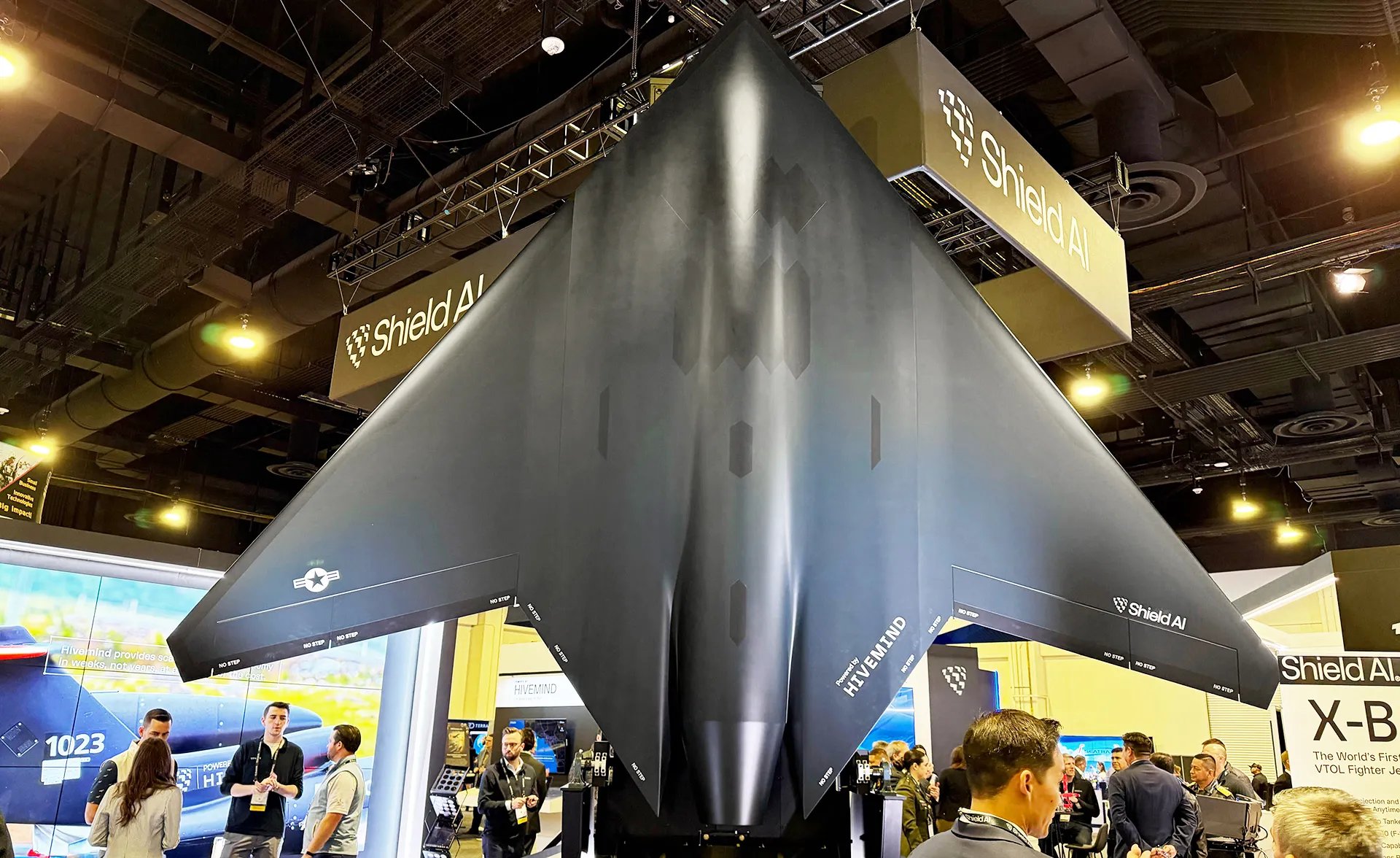
Shield AI was founded in 2015 in San Diego by brothers Brandon and Ryan Tseng, alongside Andrew Reiter. Brandon, a former US Navy SEAL, set the company’s early direction toward small autonomous aircraft that could clear buildings and tunnels ahead of human operators; Ryan, an electrical engineer, led the technical side. The company is now run by chief executive Gary Steele, who joined in 2025 after running Splunk and Proofpoint, with Brandon Tseng serving as president and Ryan Tseng as executive chairman. Headcount has grown past 1,000.
The product line revolves around Hivemind, an autonomy stack designed to fly aircraft without GPS, without communications links, and without a human in the loop. Hivemind has been demonstrated on F-16s through the Air Force’s VENOM and X-62A VISTA programmes, on the MQ-20 Avenger, and on Shield AI’s own airframes. The Nova and Nova 2 quadcopters were the firm’s first deployed systems — small, ruggedised drones that map and search buildings and tunnels autonomously, used by US Special Operations Command and by the Israel Defense Forces. The V-BAT is a vertical-takeoff fixed-wing aircraft acquired with the 2021 purchase of Martin UAV; it carries electro-optical and infrared sensors and a synthetic-aperture radar, and serves as the air vehicle for several US Army and US Marine Corps programmes. In October 2025 the company unveiled the X-BAT, an AI-piloted VTOL fighter jet aimed at the next generation of uncrewed combat aircraft.
Customers include US Special Operations Command, the US Air Force, US Marine Corps, US Navy, the Coast Guard, and a growing list of international operators. The V-BAT is used by Ukrainian forces — Shield AI began deliveries in 2024, and by mid-2024 V-BATs had flown more than 130 combat sorties under intense Russian electronic warfare, with the autonomy software credited for keeping the aircraft on mission when GPS and command links were jammed. The company has supplied V-BAT to the Japan Coast Guard and is competing for the US Marine Corps’ Long Range Reconnaissance programme of record.
Funding has tracked the expansion. A Series F round in 2024 valued Shield AI at roughly $2.7 billion and brought total capital raised past $1 billion; a strategic round in 2025 led by L3Harris and Hanwha Aerospace pushed the valuation toward $5 billion. Backers include Riot Ventures, Andreessen Horowitz, US Innovative Technology Fund, and Disruptive.
The firm sits in a narrow band of defence companies that build both the airframe and the autonomy that flies it, putting it in close competition with Anduril and a step away from European peers such as Helsing. Where Anduril has built its identity around Lattice as a battle-management platform and a sprawling product catalogue, Shield AI has bet on a single proposition — that the autonomy itself is the product, and that the same software can fly a quadcopter through a tunnel, a V-BAT over the Black Sea, or an F-16 in a dogfight.
Products
Drones
Nova / Nova 2
Autonomous quadcopter for indoor and tunnel reconnaissance; deployed by US and Israeli forces.
V-BAT
VTOL fixed-wing aircraft; 130-plus combat sorties in Ukraine since June 2024 under heavy electronic warfare.
Nova
Small autonomous quadcopter designed to clear and map buildings indoors without GPS or operator input.
Introduced 2018
V-BAT
Single-engine ducted-fan VTOL UAV used for ISR and increasingly as a Hivemind-piloted autonomous platform.
Introduced 2016
V-BAT Teams
Multi-aircraft V-BAT swarming capability where Hivemind coordinates several UAVs as a single autonomous team.
Introduced 2023
Aircraft
X-BAT
AI-piloted VTOL fighter jet, unveiled October 2025.
Software
Hivemind
Autonomy stack that has flown F-16s, MQ-20s, and V-BATs in GPS- and communications-denied environments.
Hivemind
AI pilot software stack that lets drones and aircraft operate autonomously in GPS- and comms-denied environments.
Introduced 2018
Hivemind Pilot (F-16)
AI agent trained to fly and dogfight in a full-scale F-16 — demonstrated against human pilots in DARPA and USAF trials.
Introduced 2023
Gallery
Media
Articles
Shield AI's new CEO says the $5.6B defense tech startup is at an inflection point
Fortune · 2025-12-21
Shield AI projecting more than $540M in revenue this year as valuation more than doubles to $12.7 billion
Fortune · 2026-03-26
Shield AI's V-BAT already has a weapons deal — so why is co-founder Brandon Tseng still arguing against armed drones?
DroneXL · 2026-02-27
Sources
- en.wikipedia.org/wiki/Shield_AI (2026-05-02) — Encyclopedic summary citing primary reporting — confirms 2015 founding, the three co-founders, San Diego HQ, ~1,000 employees in 2025, the Nova / V-BAT / X-BAT / Hivemind product line, the March 2025 CEO transition to Gary Steele, and the January 2025 Kyiv-office opening to support Ukraine's V-BAT fleet.
- fortune.com/2026/03/26/shield-ai-revenue-series-g-funding-12-billion-valuation/ (2026-05-02) — Fortune reporting on the March 2026 Series G — $1.5 billion at $12.7 billion post-money valuation led by Advent International, with $540 million-plus in projected 2025 revenue.
- shield.ai/shield-ai-raises-240m-at-5-3b-valuation-to-scale-hivemind-enterprise-an-ai-powered-autonomy-developer-platform/ (2026-05-02) — Official announcement of the March 2025 $240M round at $5.3 billion valuation, focused on Hivemind Enterprise.
- fortune.com/2025/12/21/shield-ai-ukraine-defense-tech-gary-steele/ (2026-05-02) — Fortune profile — confirms the V-BAT logging 130-plus sorties in Ukraine since June 2024, the SA-11 Buk-M1 location task in a jammed environment, and Steele's role.