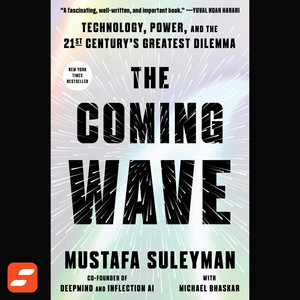
The Coming Wave
by Mustafa Suleyman2023Crown Publishing Group, The
Mustafa Suleyman, co-founder of DeepMind and Inflection AI and now head of Microsoft AI, writes The Coming Wave as a warning from inside the industry he helped build. Co-written with researcher Michael Bhaskar, the book argues that artificial intelligence and synthetic biology are converging into a single technological wave that states are not equipped to contain.
The central claim is what Suleyman calls “the containment problem.” Powerful technologies have always proliferated, but this wave compresses the timeline. Once a model can be trained, copied, and run on consumer hardware, the gap between a frontier lab and a determined individual collapses. Suleyman frames the choice ahead as a narrow path between two failure modes: catastrophe, where the tools enable engineered pandemics, autonomous weapons, and economic disruption beyond what democracies can absorb; and dystopia, where governments react by building surveillance states intrusive enough to prevent misuse. He treats neither outcome as inevitable, but rejects the optimism that markets or goodwill will route around the danger.
Much of the book is a tour through what is actually arriving. Suleyman traces the trajectory of large language models, recounts the AlphaGo and AlphaFold milestones from his DeepMind years, and pairs them with developments in CRISPR, gene synthesis, and falling DNA-sequencing costs. He examines drone swarms in Libya and Ukraine, the spread of open-weight models, the economics of GPU supply, and the role of Taiwan and the chip export controls. A chapter on what he calls “the modern Faustian bargain” walks through the historical pattern of states losing control of dual-use tools, from gunpowder to the printing press to nuclear material. He sketches a ten-part containment agenda covering technical safety, audits, choke points in the supply chain, international treaties, reformed corporate governance, and a more capable state. The argument is not that any single measure works, but that defence has to be layered.
Where the book sits in the field is distinctive because of who is writing it. Most AI books are by outside critics or academic researchers; Suleyman is a builder making the case for restraint on his own industry, and he is candid about the commercial incentives that pull against it. Compared with Bostrom’s Superintelligence or Russell’s Human Compatible, The Coming Wave spends less time on long-horizon alignment and more on the near-term political economy of proliferation. Compared with the popular accounts of the AI boom, it takes synthetic biology equally seriously, which is unusual. It is most useful for policymakers, defence planners, and general readers trying to understand why people inside the labs are asking governments to move faster than the technology.
Read the longer summary
Mustafa Suleyman finished writing The Coming Wave in mid-2023, a moment when ChatGPT had just spent its first nine months in public release and the term “frontier model” had not yet hardened into industry jargon. The book arrived from Crown in September of that year and immediately became one of the few accounts of artificial intelligence by someone who had built the field rather than reported on it. Suleyman co-founded DeepMind in 2010 with Demis Hassabis and Shane Legg, sold the lab to Google in 2014, ran applied AI inside Google until 2022, and then started Inflection AI with Reid Hoffman before being absorbed into Microsoft as the chief executive of its consumer AI division in early 2024. The book is his attempt to translate two decades of working at the centre of the technology into a public argument about what it will do to states, economies and the basic legibility of human life. He wrote it with the British editor and Canelo co-founder Michael Bhaskar, though the voice and authority belong to Suleyman.
The central argument is built around a single word that gives the book its operative concept: containment. Suleyman argues that the wave is two technologies bound together, artificial intelligence and synthetic biology, and that each has four properties which make it different from earlier general-purpose technologies. They are asymmetric, in that small inputs can produce vastly disproportionate effects. They are hyper-evolutionary, improving faster than any prior technology and accelerating each other. They are omni-use, meaning the same model that writes poetry can write phishing emails, the same gene-editing toolkit that cures cancer can manufacture pathogens. And they are increasingly autonomous, capable of acting in the world without continuous human supervision. Put together, these properties mean that the wave cannot simply be regulated like cars or contained like nuclear weapons through a handful of state-controlled facilities. The combination of cheapness, capability and proliferation is, in Suleyman’s framing, historically new. From this he draws a sharp conclusion: every previous general-purpose technology has eventually proliferated, and there is no reason to think AI and synthetic biology will not, but the consequences of their proliferation are different in kind. Containment, the deliberate retention of meaningful human control over the trajectory of the wave, is therefore the central political problem of the twenty-first century, and it is probably not achievable in the form most governments are currently attempting.
A second argument runs underneath the first and is harder to ignore once Suleyman names it. He calls it the pessimism aversion trap. Educated, comfortable people in stable democracies, he writes, are trained out of taking catastrophic scenarios seriously. To say that a technology might collapse the nation-state, or that a teenager with a laptop and a benchtop DNA printer might one day synthesise a pandemic, sounds, in polite company, hysterical. The social cost of being wrong about catastrophe is high; the social cost of being too sanguine is, until the catastrophe arrives, almost zero. Suleyman, a Labour-adjacent Londoner who served on Tony Blair’s faith-and-multiculturalism unit before founding DeepMind, is not by temperament a doomer, and the book is at pains to position him as a reluctant alarmist. But the pessimism aversion trap is the structural reason he thinks containment will fail by default. The wave will arrive sooner than people expect, do more than they expect, and be defended on the way down by the same arguments that have always defended technological optimism.
The book is organised in four parts and twelve chapters. The first part, Homo Technologicus, sets the historical frame. Suleyman walks through the spread of fire, the wheel, the printing press, the steam engine, electricity, the internal combustion engine, and the computer, arguing that the pattern is consistent: technology that confers advantage proliferates, costs fall, and political institutions adapt downstream rather than ahead. He treats this not as a counsel of complacency but as a warning, because the timescales are collapsing and the leverage available to a single actor is rising. The second part, The Next Wave, describes the two technologies. The AI chapters draw heavily on his own career, walking the reader through AlphaGo’s defeat of Lee Sedol in March 2016, AlphaFold’s solution to the protein-folding problem in 2020, the transformer architecture, the rise of large language models, and the emergence of generative systems whose capabilities surprised even their builders. The synthetic biology chapters are less personal but more vivid, covering CRISPR-Cas9, gain-of-function research, the cost curve of DNA sequencing and synthesis, and the prospect of designer pathogens. Robotics, quantum computing and new energy systems are sketched as adjacent waves but treated as supporting cast.
The third part, States of Failure, is the bleakest section and the one most relevant to anyone interested in defence and geopolitics. Suleyman argues that the wave will hollow out nation-states in two directions at once. From above, it concentrates power in a small number of frontier labs and the governments that host them, primarily in the United States and China, generating asymmetries that smaller states cannot match. From below, it disperses capability to non-state actors, criminals, sects and lone operators, allowing them to do things that previously required the resources of a great power. He describes the resulting condition as a fragility cascade, where states are squeezed between concentrated rivals abroad and proliferating threats at home, lose their monopoly on violence and information, and find themselves unable to deliver the basic bargain on which democratic legitimacy rests. The chapters draw on Russian and Iranian information operations, the use of consumer drones by the Islamic State in Mosul as early as 2016, the deployment of Turkish Bayraktar TB2s and Russian Lancet loitering munitions in Ukraine, the early Anduril and Shield AI demonstrations in California, and the Chinese fusion of military and civilian AI under the doctrine known in Beijing as military-civil fusion. The Ukrainian battlefield is treated as a live preview rather than an outlier: a war in which both sides field thousands of drones a month, in which targeting cycles compress from hours to minutes, and in which the cost of destroying a multi-million-dollar tank has fallen to that of a hobbyist quadcopter.
The fourth part, Through the Wave, sets out Suleyman’s containment framework. It is built as ten concentric layers, beginning with the most technical and ending with the most diffuse. Safety research at the model level. Independent auditing regimes. Choke points on the supply chain, particularly advanced semiconductors and the lithography equipment built by ASML in Veldhoven. The cultivation of a culture among AI researchers that takes its own risks seriously, modelled loosely on the Asilomar conference that biologists convened in 1975. Aligned incentives at the corporate level. Smarter governments capable of legislating at the speed of the technology. International treaties. Alliances, both diplomatic and commercial. Mass movements that demand accountability. And finally what he calls coherence, the political and cultural will to hold the previous nine layers together. He is candid that none of these layers is sufficient on its own and that several of them, particularly international treaty-making, have a poor track record. The framework is best read as a set of necessary conditions rather than a route map. He cites the Biological Weapons Convention of 1972, the Nuclear Non-Proliferation Treaty of 1968, and the Montreal Protocol of 1987 as the historical analogues he is reaching for, while conceding that the wave is harder to contain than any of those because the inputs are commoditised, the actors are too numerous to count and the dual-use line is hopelessly blurred.
Concrete examples carry much of the book’s weight, and Suleyman is unusually willing to name specific systems and programmes. He writes about DeepMind’s early reinforcement learning work on Atari games, the AlphaGo Master and AlphaGo Zero generations that followed Lee Sedol, the Gato general-purpose agent, OpenAI’s GPT series, Anthropic’s Claude, and the diffusion models behind Stable Diffusion and Midjourney. On biology, he discusses Verve Therapeutics’ single-shot cardiovascular gene therapies, the use of Cas9 in the He Jiankui scandal of 2018, the cost of synthesising a complete poliovirus genome from mail-order oligonucleotides, and the gain-of-function controversies surrounding work on H5N1 influenza in the 2010s. On defence, he covers the Pentagon’s Project Maven, the long-running debate over the Third Offset Strategy associated with Robert Work and Ash Carter, China’s New Generation Artificial Intelligence Development Plan published in July 2017, the role of the Chinese-American chipmaker Nvidia, and the United States’ October 2022 and October 2023 export controls on advanced semiconductors aimed at Beijing. He returns repeatedly to Ukraine as the first conflict in which AI-enabled and AI-adjacent systems are present at industrial scale on both sides of the line.
The book has been widely reviewed and is now part of a small canon of mainstream books that policy makers cite when they want to sound up to date. The Financial Times, the Economist, the New York Times and the Guardian all gave it long, mostly positive notices when it appeared, treating it as the most readable account by a practitioner since Stuart Russell’s Human Compatible in 2019. The Bulletin of the Atomic Scientists used it as the spine of a longer essay on dual-use technology. Inside the field, the reception has been more mixed. Critics on the safety-engineering side, including some researchers at the Centre for the Governance of AI in Oxford and at the Future of Life Institute, argue that Suleyman understates how far model-level technical alignment is from solved and that his containment framework leans too heavily on institutions that have already failed to slow proliferation in other domains. Critics on the political-economy side, including the economist Daron Acemoglu and the AI Now Institute’s Meredith Whittaker, argue almost the opposite, that the framing of an unstoppable wave is itself disempowering, that the technology is not autonomous but corporate, and that calling it a force of nature obscures the firms and governments that are in fact making choices. Suleyman has addressed both lines of criticism in interviews and in his subsequent role at Microsoft, where his portfolio includes Copilot and the consumer-facing applications of OpenAI’s frontier models.
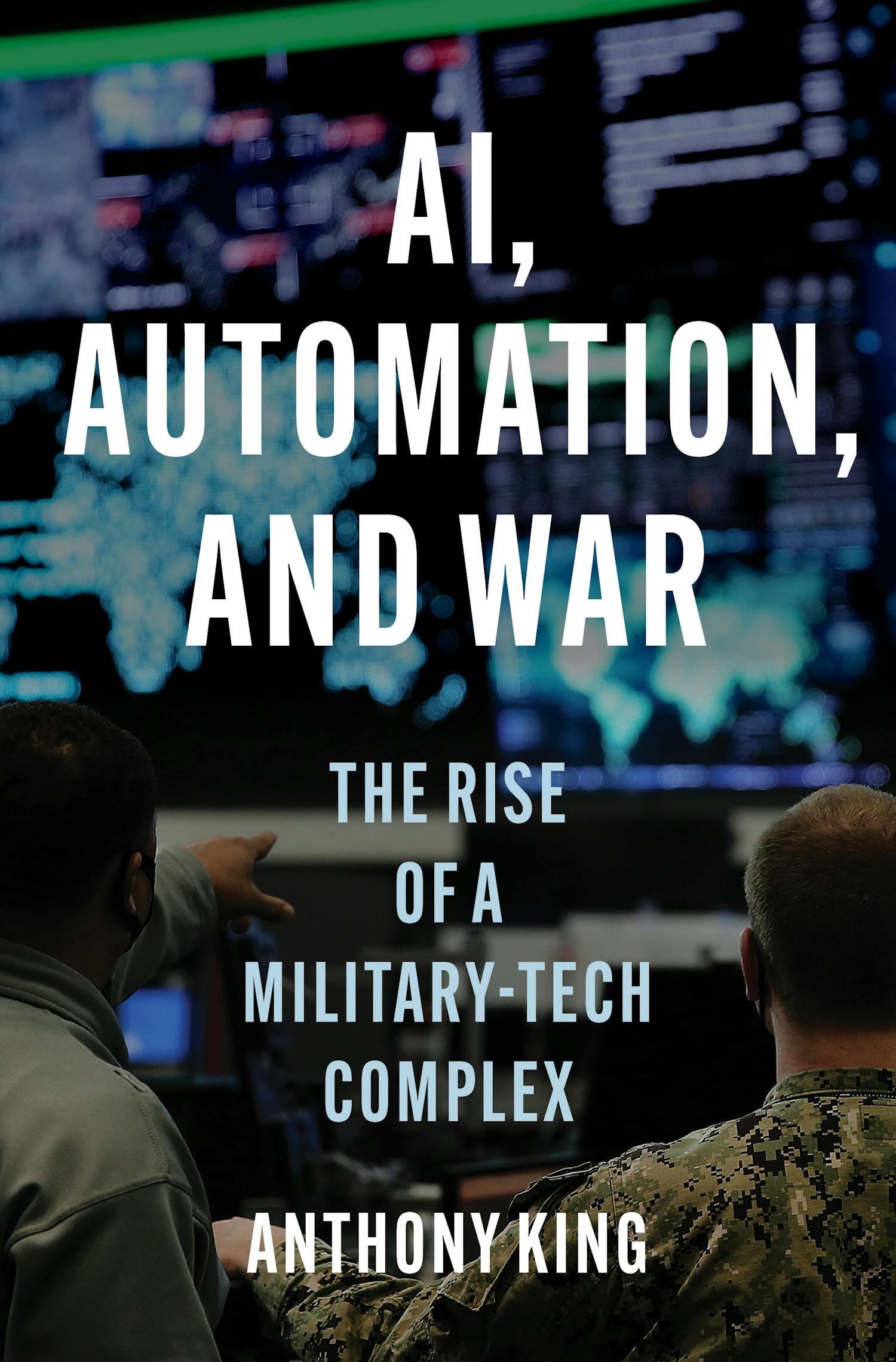
Read against the wider shelf, the book sits at a particular angle. It is more accessible than Stuart Russell’s Human Compatible and more pessimistic than Kai-Fu Lee’s AI Superpowers. It is less technical than Max Tegmark’s Life 3.0 and less philosophical than Nick Bostrom’s Superintelligence. On the warfare side, it pairs naturally with Paul Scharre’s Army of None and Four Battlegrounds, which cover the same ground in more operational detail, and with Christian Brose’s The Kill Chain, which makes the procurement-reform argument that Suleyman gestures at. Readers interested in the synthetic-biology half would do well to read it alongside Kevin Esvelt’s gene-drive papers and Jennifer Doudna and Samuel Sternberg’s A Crack in Creation. As an introduction it is hard to beat, because the author has personally been in the rooms he is describing and is willing to name names. As a policy manual it is best read as a provocation, a set of questions that any serious AI strategy has to answer rather than a set of answers that any government can pick up and implement.
What will age well in this book is the diagnostic. The case that AI and synthetic biology are converging, that their joint effect on the nation-state is unprecedented, and that polite optimism is the dominant failure mode of educated discourse on the subject is, if anything, sharper a year and a half after publication than when it was written. What will age less well is some of the specific technical horizon. The pace at which frontier models have improved between GPT-4 and the latest generations of Claude, Gemini and Llama means that several of the timelines Suleyman implies as ambitious are already conservative. The framework for containment, too, will read differently as the export-control regime against China matures, as the European Union’s AI Act comes into force, and as the next set of frontier labs decide whether to remain inside or outside the diplomatic architecture that is now being built around them. The Coming Wave does not pretend to settle these questions. It states them, harder and earlier than most, and leaves the work of containment to the governments, companies and citizens it warns are running out of time.
Publisher's description
- Technology & Engineering
Related books
Watch & listen


Podcasts


The Coming Wave Summary | Mustafa Suleyman
Best Book Summaries 📚 by StoryShots · apple · 2026-04-17
Discussion: The Coming Wave by Mustafa Suleyman
Everyday Data with Patricia & Zac · apple · 2026-02-27
972: Mustafa Suleyman | The Coming Wave of Artificial Intelligence
The Jordan Harbinger Show · apple · 2024-04-02
'The Coming Wave' and 'Artificial' offer different perspectives on AI
NPR's Book of the Day · apple · 2023-11-03
The Coming Wave
The Lawfare Podcast · apple · 2023-09-05
Last researched .