
Skydio
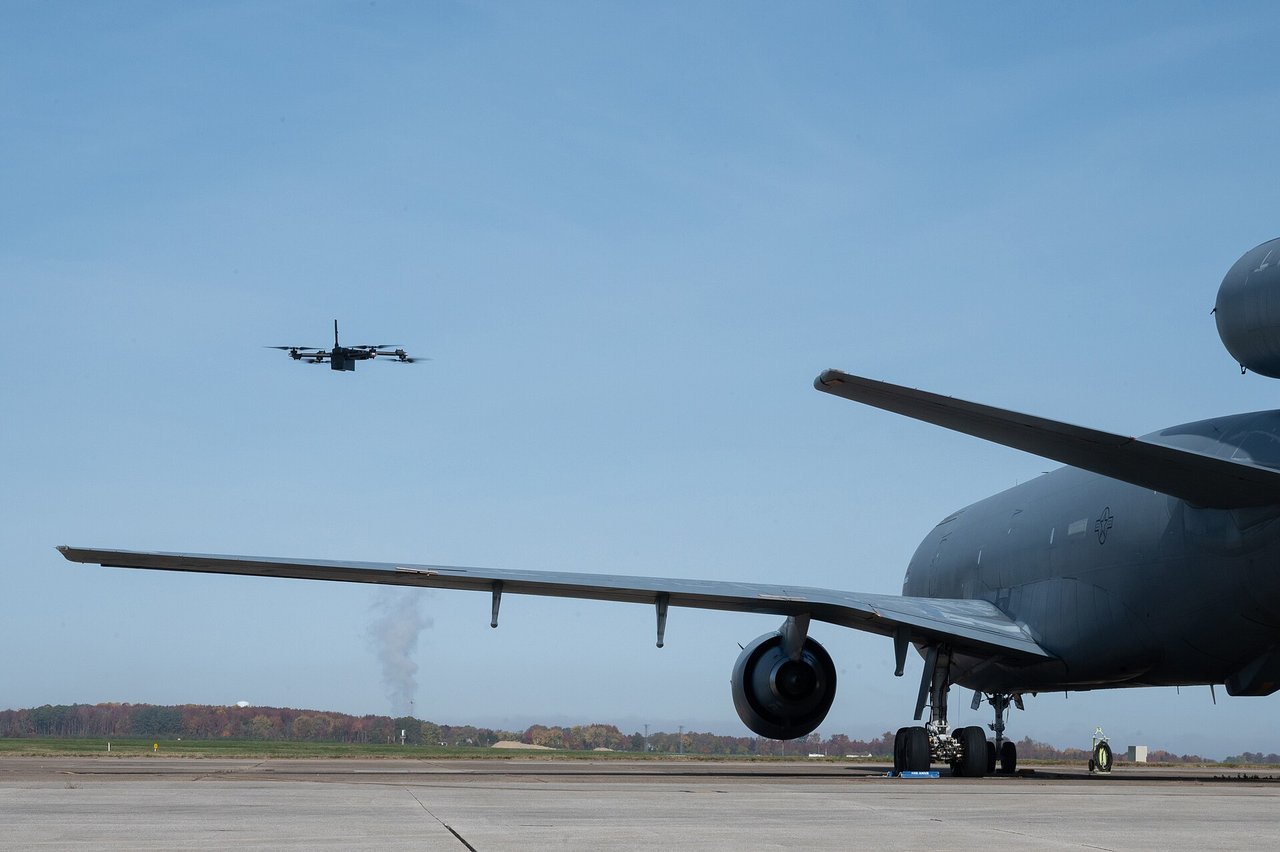
AI-piloted reconnaissance UAVs — X10D for the field, with 22,000 drones already in US military use.

Skydio was founded in 2014 in the Bay Area by three engineers who had worked on Google’s Project Wing — Adam Bry, Abe Bachrach, and Matt Donahoe — drawing on research into autonomous flight from MIT’s robotics lab. Bry, who flew competitive radio-controlled aircraft as a teenager, has remained chief executive throughout the company’s pivots from hobbyist quadcopters to enterprise inspection work to a defence-focused product line. The company is headquartered in San Mateo, California.
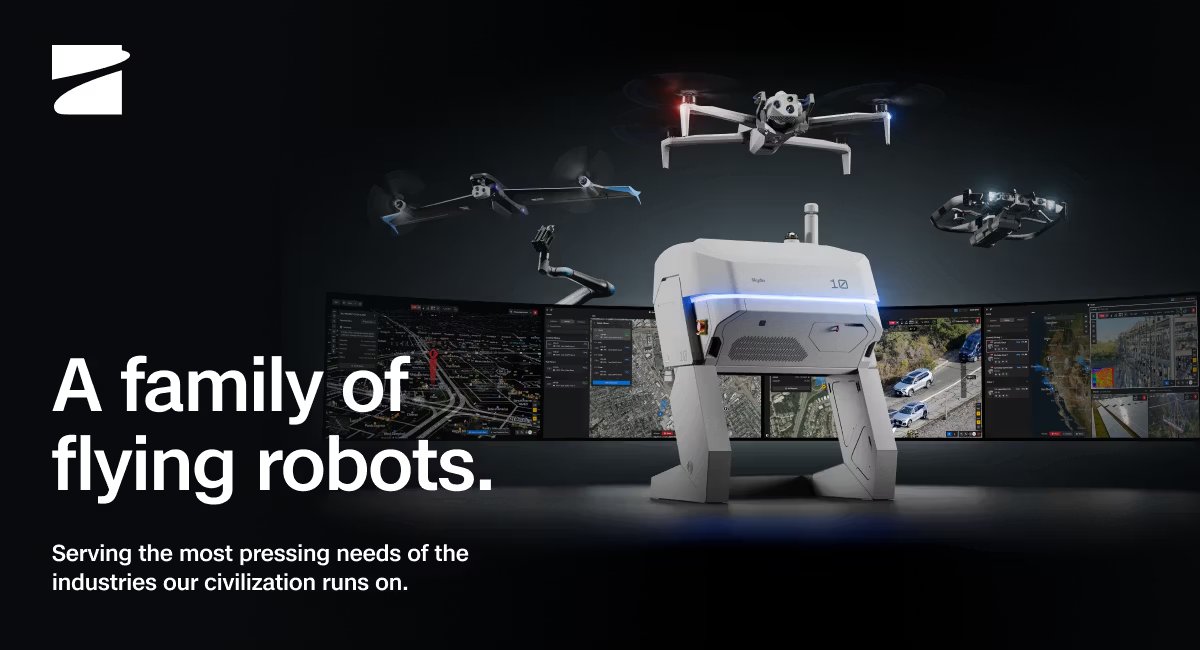
The product line today is anchored on the X10, released in September 2023, and its hardened defence sibling the X10D. Both are modular quadcopters built around onboard AI for obstacle avoidance and autonomous waypoint flight, with interchangeable payloads spanning visible-light cameras, thermal sensors, and a 64-megapixel telephoto. The earlier X2 and X2D, introduced in 2020, remain in field use as the workhorse generation that preceded the X10. Skydio also produces a docking station that lets drones launch, fly a route, and recharge without an operator on site — the basis for what the company calls “remote operations.” The consumer-grade Skydio 2 and 2+, the products that first made the company’s name on the strength of their cinematic follow-me autonomy, were wound down in 2023 when Skydio exited the consumer market entirely to focus on government and defence customers.
The user base now spans the US Department of Defense, UK Ministry of Defence, Israeli Defense Forces, Canadian Armed Forces, the Indian military, and Ukrainian forces fighting Russia. Skydio’s tagline references roughly 22,000 of its drones in US military service. The company won a key award under the US Army’s Short Range Reconnaissance programme, one of the Pentagon’s flagship efforts to field a domestically built small quadcopter as an alternative to Chinese hardware, and its drones are also widely used by US police and fire departments — Skydio reports more than half of US states operate them in public-safety roles.
Skydio has raised more than $740 million across multiple rounds; its 2023 Series E, led by Linse Capital, valued the company at around $2.2 billion. Investors include Andreessen Horowitz, Accel, IVP, and Axon Enterprise, the maker of Tasers and police body cameras, which has folded Skydio drones into its public-safety portfolio.
In October 2024, China imposed sanctions on Skydio for supplying drones to Taiwan, cutting the company off from its sole supplier of drone batteries. The disruption forced Skydio to ration cells to existing customers and accelerate a search for non-Chinese suppliers — a vivid demonstration, as Bry put it in a public letter, that decoupling from Chinese hardware supply chains is harder in practice than in policy. The episode has reinforced Skydio’s positioning as the leading American answer to DJI in a market where the question of who builds the world’s drones has become explicitly geopolitical.
Products
Drones
Skydio X10 / X10D
Modular autonomous quadcopter (September 2023); the X10D is the defence variant, deployed by US, UK, Israeli, Canadian, Indian, and Ukrainian forces.
Skydio X2 / X2D
Earlier military / corporate quadcopter (2020); the workhorse before the X10 generation.
Skydio 2 / 2+
Consumer-class quadcopter (2019 / 2022); production wound down in 2023 when Skydio exited the consumer market.
RQ-28A
US Army designation for the Skydio X2D under the Short Range Reconnaissance programme.
Introduced 2022
Skydio 2+
Earlier-generation autonomous quadcopter that established Skydio's obstacle-avoidance reputation.
Introduced 2021
X10
Flagship enterprise quadcopter with onboard AI navigation, obstacle avoidance and night-vision payloads.
Introduced 2023
X10D
Ruggedised AI-piloted reconnaissance quadcopter built for defence and frontline ISR missions.
Introduced 2024
Skydio X2
Folding enterprise quadrotor with AI obstacle avoidance for infrastructure inspection and public safety.
Introduced 2021
X2D
Compact short-range reconnaissance quadcopter widely fielded by US Army units under the SRR programme.
Introduced 2021
Software
Skydio Autonomy Engine
On-board AI stack delivering real-time 360° obstacle avoidance and subject tracking across the full Skydio fleet.
Introduced 2019
Skydio Enterprise
Fleet management and mission-planning platform for operating and monitoring Skydio drone fleets at scale.
Introduced 2021
Controversies
China sanctions Skydio after Taiwan fire-department approval.
China's first response to Skydio's Taiwan dealings — sanctioning the company shortly after the US approved Skydio sales to Taiwan fire departments. The Ministry of Commerce followed up on 4 March 2025 by placing Skydio on its formal export-control list, restricting Chinese-sourced components.
Gallery
Sources
- en.wikipedia.org/wiki/Skydio (2026-05-02) — Encyclopedic summary — confirms 2014 founding, the three co-founders, San Mateo HQ, $100M 2023 revenue, the $230M Series E at $2.2B and $170M extension, the Skydio R1 / 2 / 2+ / X2 / X2D / X10 / X10D product timeline, more than 50% military business by November 2024, ~22,000 drones in US military use, the February 2022 US Army SRR win, the August 2023 consumer exit, the October 2024 + March 2025 China export-control sanctions.