Hivemind
AI pilot software stack that lets drones and aircraft operate autonomously in GPS- and comms-denied environments.
Softwareby Shield AIIntroduced 2018
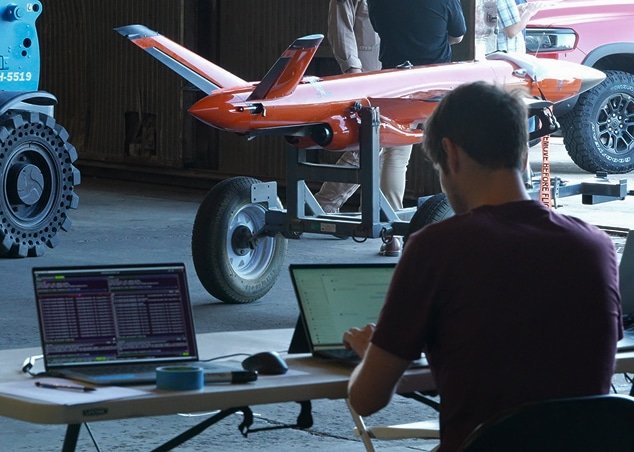
Photo: Shield AI
Hivemind is the autonomy software stack built by Shield AI, a San Diego company founded in 2015 by former Navy SEAL Brandon Tseng and his brother Ryan Tseng. First fielded in 2018 on a quadrotor used to clear buildings in Mosul, Hivemind has since become the company’s flagship product — a platform-agnostic AI pilot designed to fly aircraft and drones without GPS, without human teleoperation, and without a continuous radio link to an operator. Shield AI markets it as the brain that turns existing airframes into autonomous ones; the V-BAT vertical-takeoff drone is its most visible host, but the same stack has been demonstrated on quadcopters, jet-powered targets, and crewed fighters.
The technical premise is that GPS and datalinks are the first things to fail in a contested environment, so the autonomy has to be self-sufficient at the edge. Hivemind fuses onboard sensors — cameras, IMU, lidar where fitted — with reinforcement-learning-trained policies that handle perception, navigation, and tactical behaviour locally. Aircraft running it can map indoor spaces, follow terrain, find and identify objects, and coordinate as a swarm by sharing intent rather than full telemetry. Shield AI has steadily pushed the stack onto larger and faster platforms: in 2023 it flew Hivemind on a Kratos MQM-178 Firejet, in 2024 on a General Atomics MQ-20 Avenger, and in 2024 it joined the U.S. Air Force’s VENOM programme to put autonomy onto F-16s, building on earlier AI-pilot work conducted on the X-62A VISTA testbed.
Operators are concentrated where the GPS-denied premise actually matters. The U.S. Department of Defense fields V-BAT with Hivemind across several services, and Shield AI has confirmed deliveries of V-BATs into Ukraine, where Russian electronic warfare routinely denies satellite navigation along the front. Israel has also operated V-BAT, and Shield AI has disclosed contracts with Coast Guard and special-operations customers. The company raised funding in 2024 at a valuation reported above five billion dollars, almost entirely on the strength of Hivemind’s roadmap.
Development is continuous rather than versioned. Each new airframe integration — fighter jet, target drone, loitering munition — extends the same underlying autonomy. Hivemind sits in a small but rapidly contested niche alongside Anduril Industries’s Lattice and Skydio’s autonomy stack; what distinguishes it is the explicit framing as a pilot replacement rather than a mission-management layer, and the willingness of the U.S. Air Force to put it on a manned fighter testbed.