Products Shahed Aviation Industries
Shahed-136
Iran's piston-engined delta-wing one-way attack drone, licence-built in Russia as Geran-2 and the template for the cheap long-range strike drone.
DroneAdversary capabilityby Shahed Aviation IndustriesIntroduced 2021 · Updated 2026
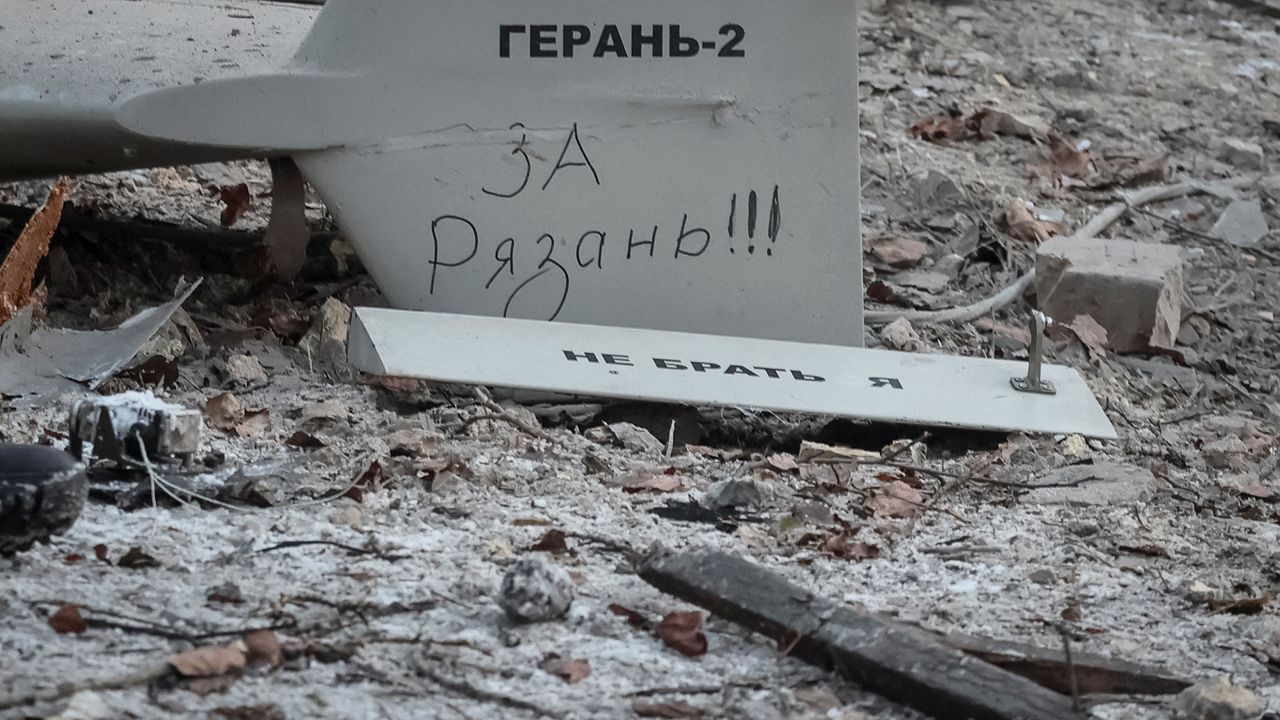 Remains of a downed Geran-2 drone in Kyiv, 14 December 2022.
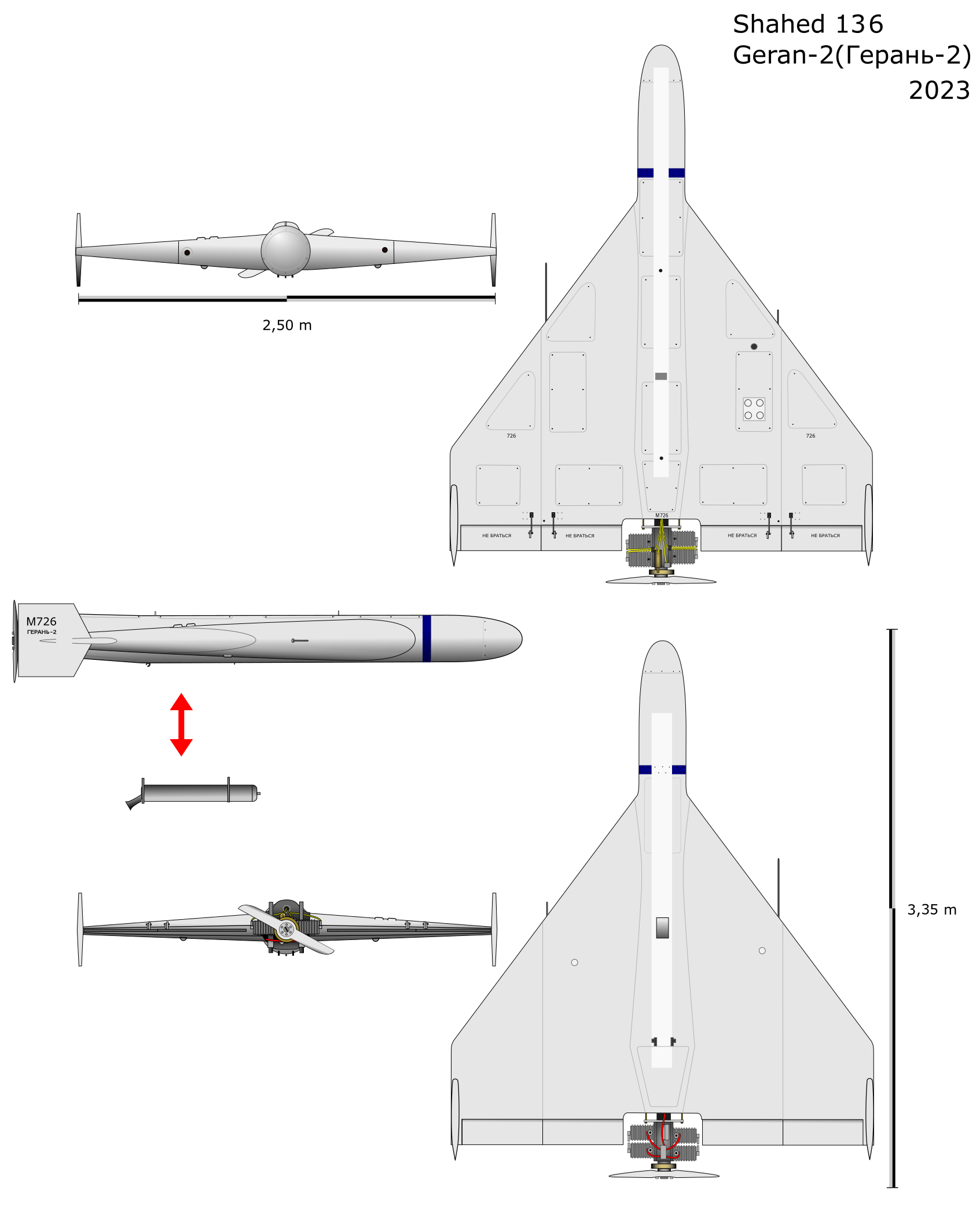 Shahed-136 — three-view technical drawing.
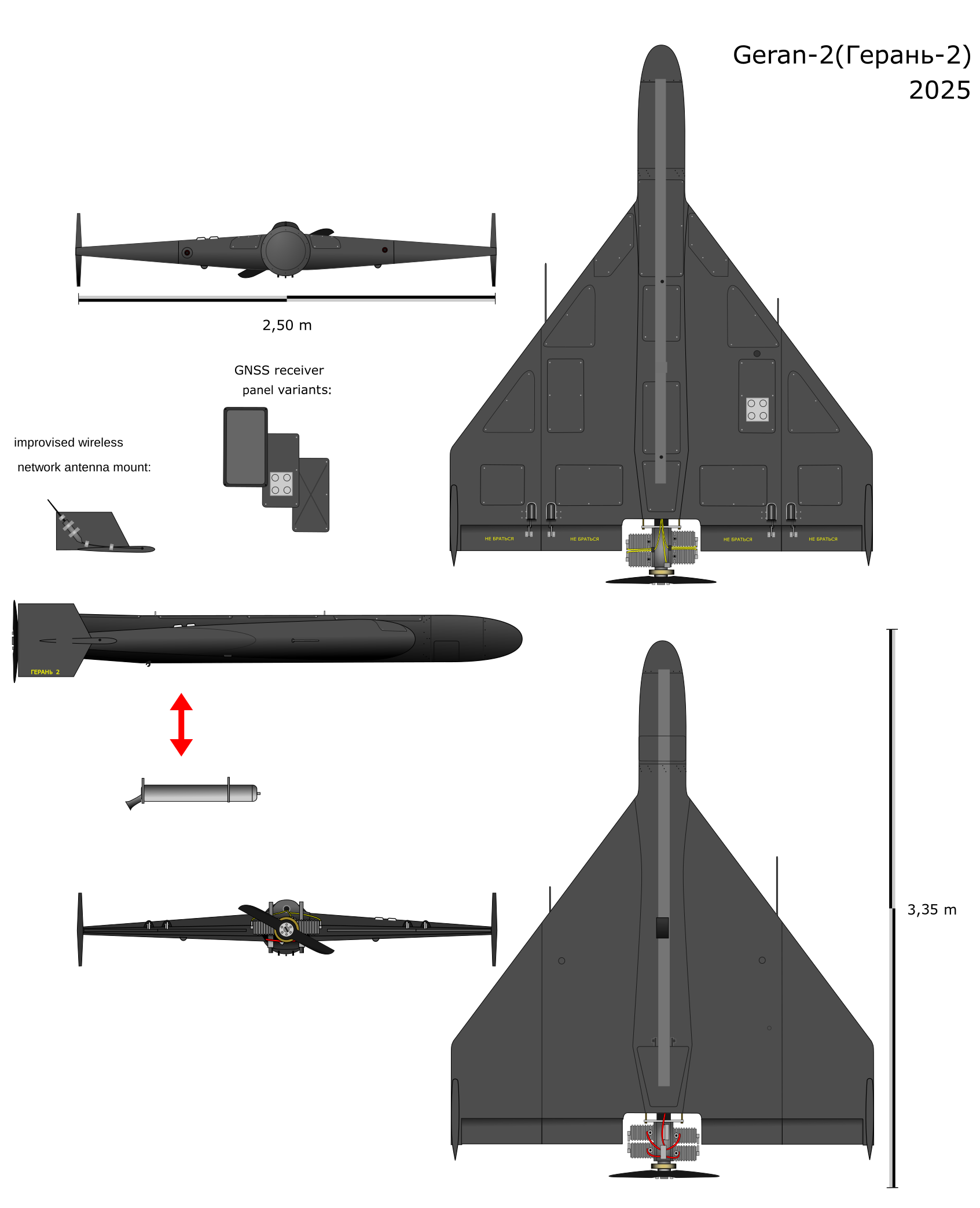 Geran-2 — three-view technical drawing of the Russian licence-built variant (2025 production).
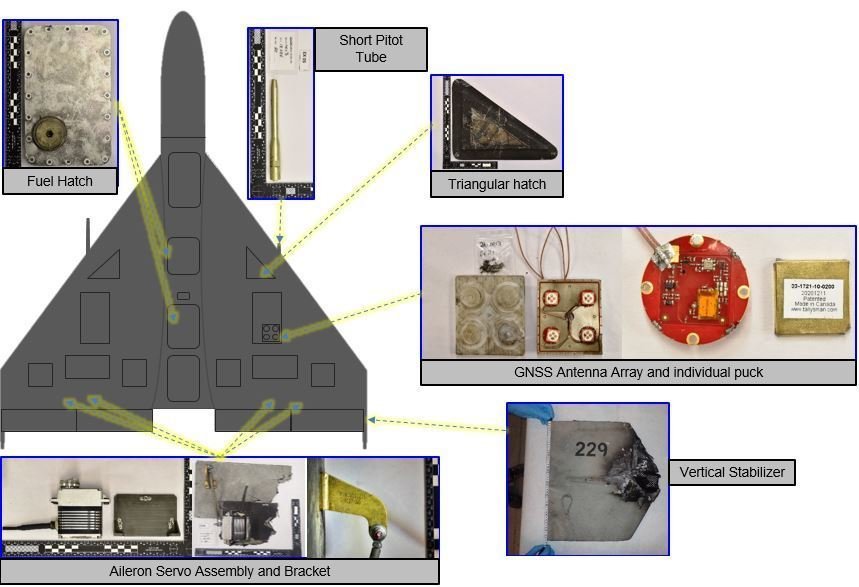 Shahed-136 debris fragments recovered after the November 2022 attack on the tanker Pacific Zircon
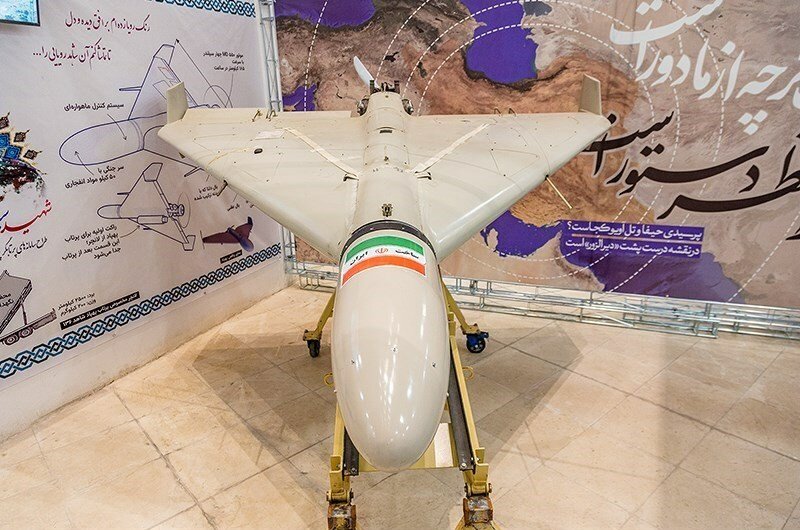 Shahed-136 on display at an IRGC Aerospace Force exhibition, Qom, 2023
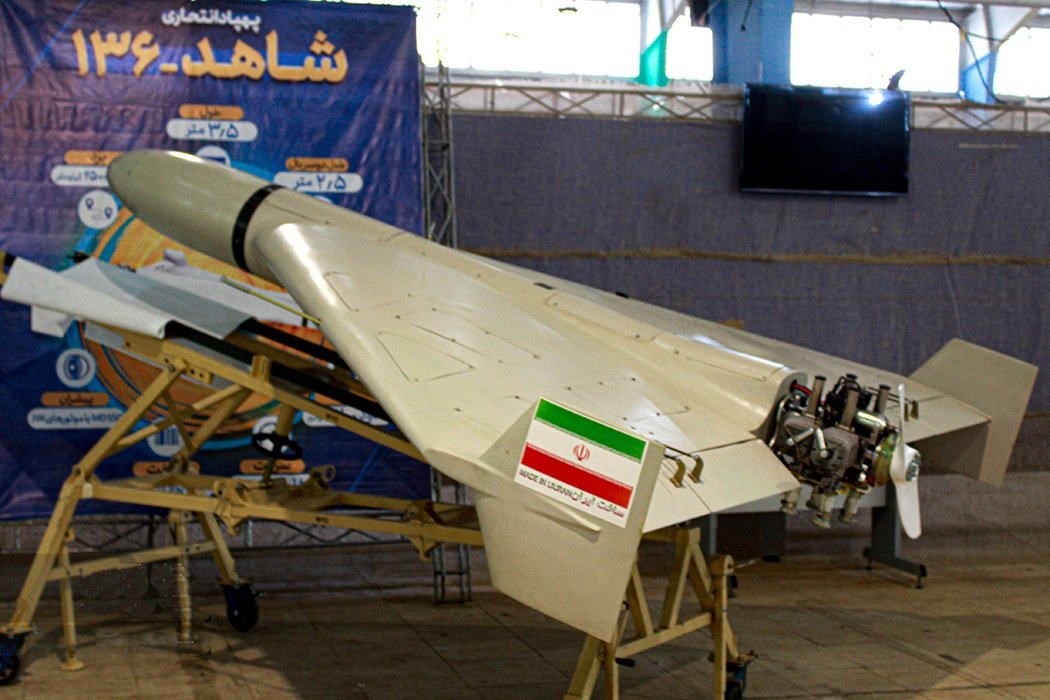 Shahed-136 at an IRGC Aerospace Force exhibition, Kermanshah, 2023
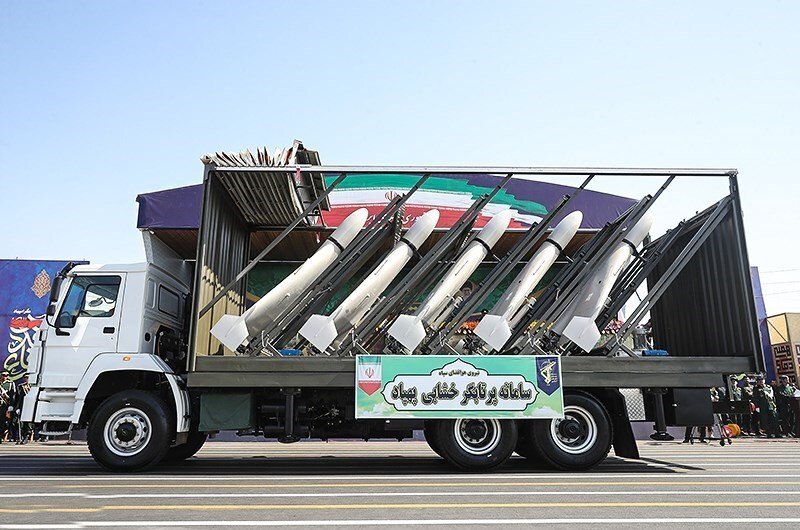 Shahed-136 drones on trucks in the Sacred Defence Week parade, Tehran, 2023
Photos: Wikimedia Commons (CC BY-SA). · Wikimedia Commons. · U.S. Navy · Mohammadreza Jabbari / Wikimedia Commons · Behrouz Ahmadi / Wikimedia Commons · Amin Ahouei / Wikimedia Commons
Videos


Overview
The Shahed-136 is an Iranian one-way attack drone: a delta-wing airframe about 3.5 m long with a 2.5 m span, a small piston engine driving a pusher propeller, and a warhead of roughly 50 kg. It is designed by Shahed Aviation Industries and built by the state-owned HESA. Iran released the first public footage in December 2021 (Wikipedia).
By aviation standards it is crude. What made it important is that it showed a slow, cheap, mass-produced drone could fly hundreds of kilometres and still force a defender to spend far more stopping it than it cost to build. Russia adopted the design as the Geran-2 and built it at Alabuga in larger numbers than Iran ever did. By 2025 the United States had fielded its own copy. Most Shahed-type drones now flying over Ukraine are Russian-built, and their Russian modifications are covered on the Geran-2 page. This page covers the Iranian original, what it is made of, and where it has been used.
Airframe and performance
The layout is a cropped delta with vertical stabilisers at the wingtips and the engine at the rear. The drone is launched from a rail with a rocket booster that drops away after take-off, so several can be fired from one truck or a simple ground rack. Reference figures are about 200 kg take-off mass and a cruise speed of about 185 km/h. Range estimates vary widely: Janes and the IRGC quote 2,500 km, while other analysts give figures from about 970 km upward (Wikipedia). The War Zone uses round numbers of about 100 knots, 2,000 km and a 40 kg warhead.
Navigation is basic. A commercial-grade inertial unit, corrected by civilian GPS and GLONASS, flies the drone along pre-set waypoints to fixed coordinates, where it dives onto the target. Iranian-built examples had no seeker and no operator in the loop. SIM cards and 4G modems found in some wreckage, and an Iridium satellite SIM recovered after a 2023 attack in the Gulf of Oman, suggest that some versions report their position or can be re-tasked in flight.
Inside the drone
Much of what is publicly known about the Shahed-136’s internals comes from wreckage recovered in Ukraine and examined by Conflict Armament Research (CAR), Ukrainian intelligence and independent analysts.
Engine. The MD-550 is a four-cylinder two-stroke derived from the German Limbach L550E. In April 2023 CAR named the maker as Oje Parvaz Mado Nafar (“Mado”) of Qom province. Its evidence was Mado markings on spark-plug caps and serial-number sequences that matched Mado’s own, the same sequences UN investigators had recorded in earlier attacks on Saudi Arabia and Abu Dhabi. According to Euromaidan Press’s account of the findings, Iran obtained Limbach engines covertly in 2006, and the company that became Mado announced a domestic UAV engine in 2009.
Electronics. CAR’s first study, in November 2022, covered the Shahed-131, Shahed-136 and Mohajer-6. It found more than 500 components from over 70 manufacturers in 13 countries, and about 82% of them were made by US-based companies, mostly in 2020 and 2021 (Boston Globe). A separate Ukrainian teardown of one Shahed-136, reported by CNN, found that 40 of 52 removed components appeared to come from 13 American companies. Parts named in public reporting include a Texas Instruments TMS320 processor, a Polish-made fuel pump and a Chinese voltage converter (Wikipedia).
CAR’s later work showed how short the supply chain was. A voltage converter found in April 2023 was marked as made between 9 and 15 January 2023, only weeks before the drone was launched. CAR also identified Sarmad Electronic Sepahan Co. as an Iranian producer of two component types, a company that was not on any sanctions list at the time.
Warhead. Leaked Alabuga documents analysed by the Institute for Science and International Security (ISIS) describe the baseline Iranian warhead, the “BCh-50”. The assembly weighs 53.5 kg and combines 2.5 kg of fragmentation high explosive with a 25.5 kg shaped charge. Russian factories later added heavier and thermobaric options.
Airframe. Iranian-built fuselages used a lightweight honeycomb core. When CAR examined Russian-built drones in July 2023, it found fibreglass over woven carbon fibre and a Russian Kometa satellite-navigation module. That was the first physical evidence that the drone had become a Russian product (Euromaidan Press).
From Iran to Russia
Russia first launched Shahed-136s at Ukraine in September 2022, painted with the name “Герань-2”. According to leaked documents, Iran sold Russia 6,000 drones at about $193,000 each and agreed to transfer production to Alabuga in Tatarstan. Russia expected local production to bring the unit cost down to about $48,000 (Wikipedia). Iran has denied supplying drones for use in Ukraine.
Russian production soon outgrew the Iranian programme. ISIS counted 54,538 Shahed-type launches against Ukraine in 2025, including decoys such as the Gerbera, which is built to look like a Shahed on radar (ISIS). Russia has also moved to jet-powered successors, the Geran-3 among them, much as Iran did with the Shahed-238, a turbojet version shown in an IRGC documentary in 2023 (Janes).
Use in the Middle East
The Shahed-136’s record outside Ukraine is less fully documented but goes back further. The US military believes Iran-aligned groups used it against the US base at Al-Tanf in Syria in August 2022. The IRGC used it against Kurdish opposition groups in northern Iraq in September and October 2022. It was suspected in an attack on the bulk carrier Symi in the Indian Ocean in November 2023 (Wikipedia). In the 13 April 2024 attack on Israel, Iran launched Shahed-136s alongside ballistic and cruise missiles, and most were intercepted.
The largest use outside Ukraine came in the 2026 Iran war. On 4 March 2026 AFP reported that Gulf countries had been targeted by more than 1,000 drones, mainly Shahed-136s. Reported targets included a hotel, a French base and the Ras Tanura refinery, which partly shut down. Gulf states defended mainly with NASAMS and Avenger, whose missiles cost several hundred thousand dollars each. The same article noted that, unlike Ukraine, they had no acoustic detection network and no low-cost interceptor drones.
The Houthis in Yemen field a drone called the Wa’id, which Asia Times describes as their version of the Shahed-136. Official statements on Red Sea attacks seldom name the drone type, so linking individual attacks to the Shahed-136 is an assessment rather than a confirmed identification.
Countermeasures
Ukraine has had more experience against the Shahed than any other country, and its answer has been to make each interception cheaper. A national network of thousands of microphones detects the drone’s engine sound and plots its track (The War Zone). Mobile teams use machine guns and modernised flak guns aimed with consumer cameras and tablets (Forbes). Since 2024, inexpensive interceptor drones such as the Sting have become the main tool. A July 2025 report credited them with about nine in ten Shahed kills (Militarnyi). Russia’s responses to these defences, including anti-jam navigation, higher speed and mesh-networked video links, are documented on the Geran-2 page.
A design others copy
The clearest sign of the drone’s influence is that others now copy it. In December 2025 US Central Command stood up Task Force Scorpion Strike, armed with LUCAS one-way attack drones made by Arizona-based SpektreWorks. A US official told The War Zone that LUCAS “pretty much follows the Shahed design”. CENTCOM gave its price as about $35,000 per drone. A weapon first known as Iran’s low-cost answer to air defence is now part of the US arsenal as well.
Combat experience
Iran published the first footage of the Shahed-136 in December 2021. The US military believes Iran-aligned groups used it against the Al-Tanf base in Syria in August 2022, and the IRGC used it against Kurdish groups in northern Iraq that autumn (Wikipedia). From September 2022 Russia launched Iranian-supplied Shahed-136s at Ukraine under the name Geran-2, then built them itself at Alabuga.
Iran used the type in its 13 April 2024 missile and drone attack on Israel, in which most drones were intercepted. In the 2026 Iran war it launched Shahed-136s at Gulf states and US bases: an AFP analysis on 4 March 2026 put the drones fired at Gulf countries at more than 1,000, mainly Shahed-136s.
Effectiveness
Warhead upgrades
| Warhead | Type | Mass | Since | Notes |
|---|---|---|---|---|
| BCh-50 ("Warhead 50") | fragmentation-HE plus shaped charge | 53.5 kg assembly; 2.5 kg OF and 25.5 kg shaped-charge explosive | 2022 | The Iranian-designed baseline warhead supplied with Shahed-136s to Russia under the 2023 Alabuga contract, per leaked documents source |
Variants
- Geran-2 (Russian licence build)2022
Iranian imports under a Russian name from September 2022; Russian-built from 2023 with a carbon-fibre/fibreglass fuselage and the Kometa anti-jam satellite-navigation module source
- Jet-powered Shahed-136 / Shahed-2382023
Turbojet-powered derivative shown in an IRGC documentary trailer in September 2023 and unveiled in November 2023 source
- LUCAS (US reverse-engineered copy)2025
SpektreWorks delta-wing one-way attack drone that a US official said "pretty much follows the Shahed design"; about $35,000 each; fielded by CENTCOM's Task Force Scorpion Strike from December 2025 source
Countering it
As reported publicly; each line links its source.
- Acoustic sensor networks — Ukraine tracks Shaheds with thousands of networked microphones that triangulate the engine noise source
- Interceptor drones — Ukrainian interceptor drones were credited with about nine in ten Shahed kills in a July 2025 report source
- Gun air defence — Old flak guns upgraded with consumer cameras and tablets for low-altitude engagements source
- Missile-based short-range air defence (Gulf) — Gulf states defending against Shaheds in March 2026 relied mainly on NASAMS and Avenger, whose missiles cost several hundred thousand dollars each, and lacked Ukraine's acoustic networks and low-cost interceptor drones source
Sources
- en.wikipedia.org/wiki/HESA_Shahed_136
- euromaidanpress.com/2023/04/28/german-technology-stolen-by-iran-almost-20-years-ago-found-in-shahed-drones/
- www.conflictarm.com/
- euromaidanpress.com/2023/08/13/russia-has-likely-already-started-producing-its-domestic-version-of-shahed-drones-car/
- www.bostonglobe.com/2022/11/22/world/iranian-weapons-built-with-western-semiconductors-despite-sanctions
- babel.ua/en/news/88479-cnn-the-united-states-has-launched-an-investigation-into-how-american-parts-ended-up-in-iranian-drones
- isis-online.org/isis-reports/detail/alabugas-shahed-136-geran-2-warheads-a-dangerous-escalation/
- isis-online.org/isis-reports/a-comprehensive-analytical-review-of-russian-shahed-type-uavs-deployment-against-ukraine-in-2025
- www.janes.com/defence-news/news-detail/irgc-documentary-shows-jet-powered-shahed-136-uav-variant
- www.twz.com/air/u-s-deploys-shahed-136-clones-to-middle-east-as-a-warning-to-iran
- www.nst.com.my/amp/opinion/columnists/2026/03/1389763/gulf-defences-unprepared-iranian-drones
- asiatimes.com/2023/12/biden-ignores-houthi-drone-attacks-at-his-peril/
- www.twz.com/land/thousands-of-networked-microphones-are-tracking-drones-in-ukraine
- militarnyi.com/en/news/9-out-of-10-shaheds-shot-down-in-ukraine-attributed-to-interceptors-backed-by-former-google-ceo-report/
- www.forbes.com/sites/sebastienroblin/2022/12/11/to-stop-killer-drones-ukraine-upgrades-ancient-flak-guns-with-consumer-cameras-and-tablets/