Roadrunner-M
Warhead-carrying interceptor variant of the Roadrunner — a reusable launch profile paired with a high-explosive payload once a target is committed.
Missile / loitering munitionby Anduril IndustriesIntroduced 2023 · Updated 2026
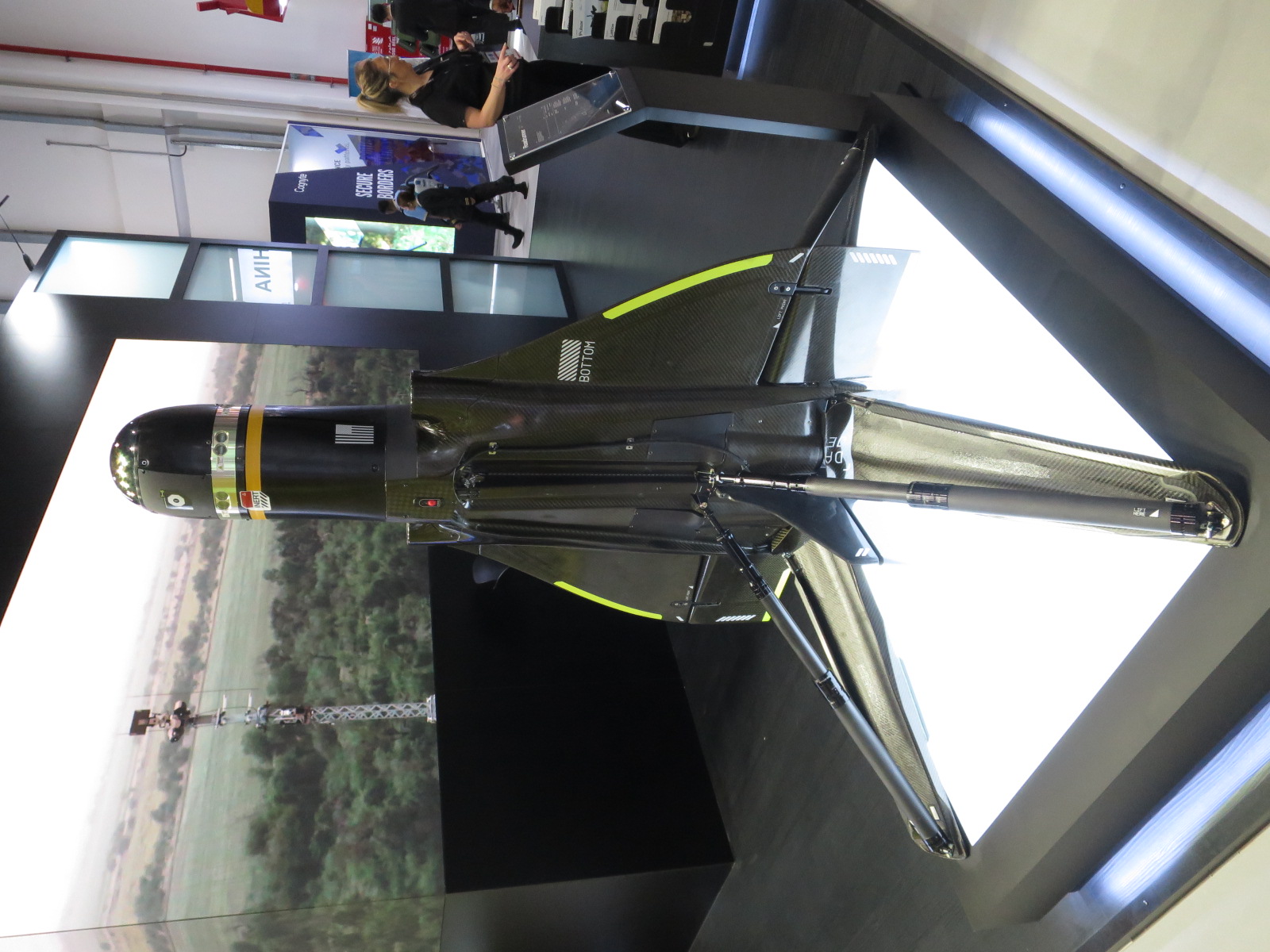
Photo: Mztourist, CC BY 4.0 (Wikimedia Commons).
Videos

Roadrunner-M is a vertically launched, jet-powered interceptor built by Anduril Industries and unveiled in December 2023 as the warhead-carrying variant of the company’s wider Roadrunner family. It sits in the awkward category between a surface-to-air missile and a loitering munition: a reusable launch and recovery profile that a missile would not normally allow, paired with a fragmentation warhead that turns the platform into an expendable hard-kill effector once a target is committed. Its role is the close-in defeat of Group 2 and Group 3 unmanned aircraft, cruise missiles, and loitering munitions — the threat band that has dominated headlines from the Red Sea to Ukraine and that has exposed how expensive conventional air defence has become relative to the systems it is shooting down.
The system flies on twin turbojets and launches vertically from a containerised cell, climbing fast enough to chase down high-subsonic threats and manoeuvre against jinking targets. Onboard autonomy handles the intercept geometry, with terminal guidance computed in flight rather than radioed in from a ground station. Roadrunner-M is tied into Anduril’s Lattice command-and-control mesh, which fuses radar, electro-optical, and acoustic cueing from the surrounding sensor network and assigns engagements to launchers automatically. The base Roadrunner, which carries no warhead, can be recovered and refuelled if it is launched and not used — a design choice meant to let an operator commit early to an unknown contact without burning through inventory on every false alarm. Only the -M expends itself, and only when a target is confirmed.
The United States is the disclosed operator. U.S. Special Operations Command has procured the system, and Anduril has spoken publicly about fielded units defending forward sites, though the company has not broken out deployment counts. Combat use has not been formally acknowledged. Pricing has been described by Anduril executives as a fraction of the legacy interceptors it competes with, an argument aimed squarely at the cost-exchange problem that older air-defence inventories face against cheap drones.
Development is active. Anduril has continued to iterate on payload, seeker, and software since the initial reveal, and the Roadrunner line is positioned alongside the company’s Pulsar electronic-warfare family and Anvil counter-UAS interceptor as a layered counter-air offering. In a field crowded by Raytheon’s Coyote and a growing class of European interceptors, Roadrunner-M’s distinguishing pitch is the reusable launch profile of its sibling and the software stack behind both.
Sources
- www.anduril.com/news/anduril-unveils-roadrunner-and-roadrunner-m (2026-06-22) — Official Anduril announcement of Roadrunner and Roadrunner-M (December 2023).
- breakingdefense.com/2023/12/anduril-unveils-vtol-roadrunner-munition-to-counter-drones-cruise-missiles/ (2026-06-22) — Breaking Defense — Group 3 UAS / cruise-missile targets, reusable recovery and propulsion.
- www.designation-systems.net/dusrm/app4/roadrunner.html (2026-06-22) — Reference covering the ~$250M order, the planned Arleigh Burke integration and reported field evaluation since early 2024.
- www.armyrecognition.com/news/army-news/2026/us-approves-1-98-billion-counter-drone-sale-to-kuwait-including-anduril-roadrunner-and-anvil (2026-06-22) — Army Recognition on the June 2026 State Department notification of a $1.98B counter-drone package to Kuwait including Roadrunner-Munition.