Lattice OS
AI-powered command-and-control platform that fuses sensor data and orchestrates autonomous systems across air, land and sea.
Softwareby Anduril IndustriesIntroduced 2018 · Updated 2025
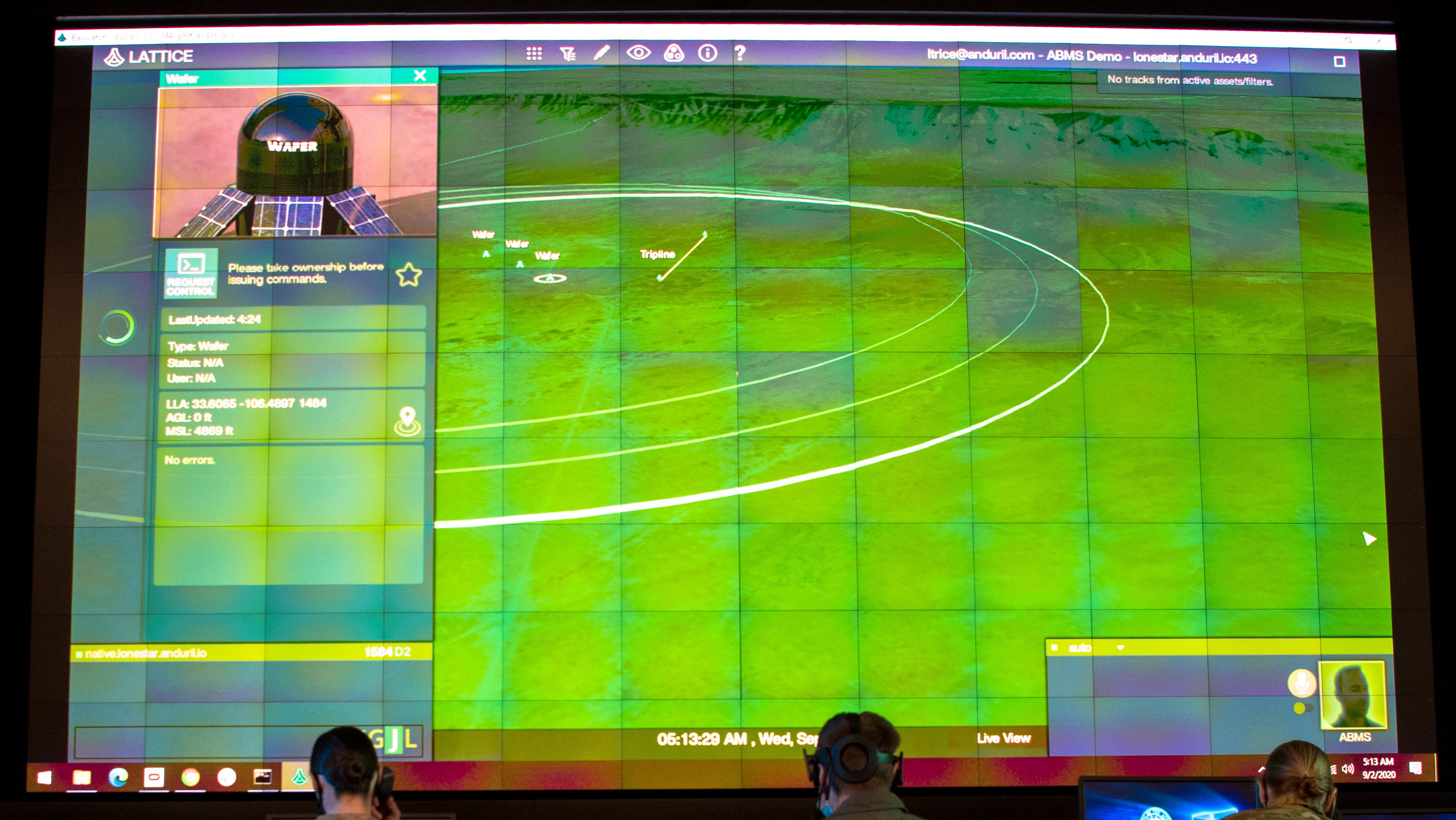
Photo: U.S. Air Force / Senior Airman Daniel Hernandez, 1st Combat Camera Squadron — public domain (Wikimedia Commons).
Videos

Lattice OS is the software layer beneath nearly everything Anduril Industries ships. First fielded around 2018 at U.S. Customs and Border Protection sentry-tower sites along the southern border, it has since grown into the command-and-control backbone tying the company’s drones, counter-UAS interceptors, undersea vehicles, and third-party hardware into a single operating picture. Anduril markets Lattice as a mission autonomy platform; in practice it is the fusion-and-tasking software that lets a single operator monitor and direct a fleet of unmanned systems.
The platform takes feeds from radars, cameras, electro-optical sensors, RF detectors, and acoustic arrays, runs them through machine-learning classifiers, and presents a deconflicted track picture to an operator. A mesh networking layer, branded Lattice Mesh, distributes that picture across nodes so the system keeps functioning when individual radios, gateways, or command posts drop offline. Above the fusion layer sits the autonomy stack: operators set rules of engagement and intent, and Lattice tasks the available platforms — Ghost UAVs, Sentry towers, Anvil and Roadrunner interceptors, Dive-LD undersea vehicles — to execute. An open software development kit lets third-party manufacturers plug their hardware into the same picture, a deliberate move to position Lattice as infrastructure rather than a closed ecosystem.
The U.S. Department of Defense is the dominant customer. Lattice has been integrated into Special Operations Command counter-UAS programmes, U.S. Indo-Pacific Command experimentation, and Air Force base-defence work. In 2023 it was positioned as a key autonomy-software contributor to the Pentagon’s Replicator initiative, the effort to field thousands of attritable autonomous systems within two years. The United Kingdom has used Lattice in counter-drone trials, and Australia is pairing it with the Ghost Shark extra-large autonomous undersea vehicle being developed under AUKUS. Customs and Border Protection continues to operate the Sentry tower network the platform was originally built for.
Combat exposure has come mainly through counter-drone work, where Lattice cues Anvil and Roadrunner interceptors against incoming threats at U.S.-protected installations overseas. Anduril does not publicly itemise engagements. The company has steadily widened the platform’s scope — adding undersea command, integrating partner aircraft, and serving as the autonomy layer behind Fury, the unmanned fighter Anduril is building for the U.S. Air Force’s Collaborative Combat Aircraft programme. It competes most directly with Palantir’s Maven Smart System and TITAN, and with the software stacks emerging from Shield AI and Northrop Grumman as the Pentagon shifts procurement toward open, software-defined autonomy.
Sources
- en.wikipedia.org/wiki/Anduril_Industries (2026-06-22) — Encyclopedic overview — confirms Lattice as the unifying C2 software, sensor fusion across cameras/radar/RF, the CBP Autonomous Surveillance Tower programme, and the 2017 founding.
- www.anduril.com/lattice/mission-autonomy (2026-06-22) — Official Lattice for Mission Autonomy product page — one operator commanding teams of heterogeneous autonomous systems.
- www.anduril.com/lattice/lattice-sdk (2026-06-22) — Official Lattice SDK page — REST/gRPC APIs, language SDKs, Lattice Mesh.
- defensescoop.com/2025/03/26/anduril-socom-contract-award-autonomy-software-86m/ (2026-06-22) — DefenseScoop on the $86M, three-year SOCOM mission-autonomy systems-integration award (March 2025).
- defensescoop.com/2025/11/11/army-ibcs-maneuver-anduril-lattice-counter-uas/ (2026-06-22) — DefenseScoop on the US Army selecting Lattice for IBCS-Maneuver counter-UAS fire control, with live-fire intercepts at Yuma.