Sentry Tower
Autonomous solar-powered surveillance tower with AI-driven sensor fusion for border security and base perimeter defence — Anduril's founding product.
Hardwareby Anduril IndustriesIntroduced 2018 · Updated 2026
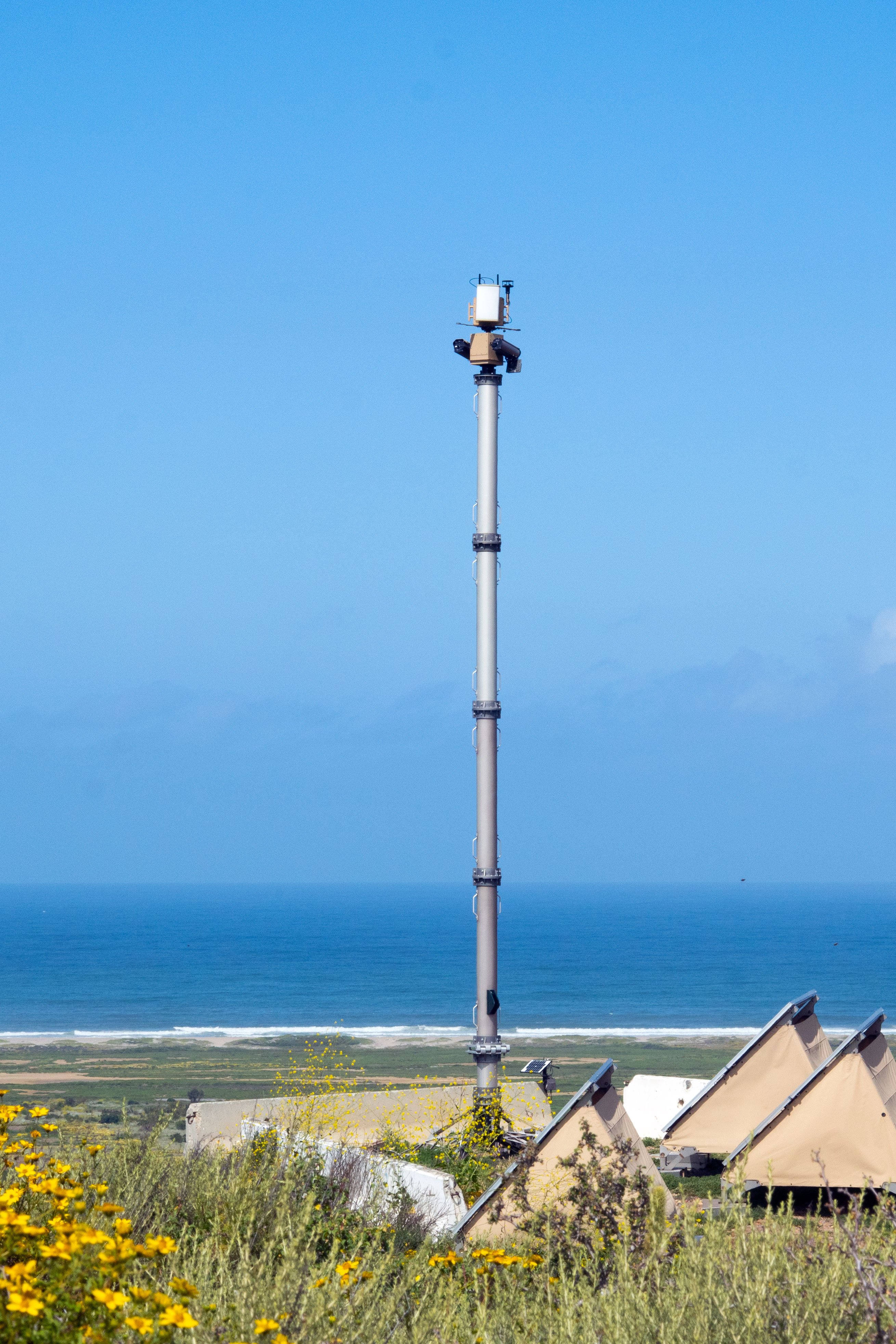
Photo: Toyonbro, CC0 1.0 (public domain dedication, Wikimedia Commons).
Sentry Tower is Anduril Industries’ autonomous surveillance pylon, a fixed sensor mast designed for persistent monitoring of borders, bases, and other static sites. First fielded in 2018, it was the system that introduced Anduril Industries — founded a year earlier by Palmer Luckey — to its first government customers, and it remains one of the company’s most widely deployed products.
Each tower stands roughly thirty-three feet tall and is largely self-contained: solar panels and battery storage handle power, and a satellite or cellular link handles backhaul, allowing units to be installed in places without grid or fibre. The sensor stack combines an electro-optical and infrared camera with a radar, all fused on the tower itself by an onboard processor running Anduril’s Lattice software. Rather than streaming raw video back to an operations centre, the tower classifies what it sees locally — distinguishing a person from a vehicle, an animal from a small drone — and pushes only the events that matter to a remote operator. Detection ranges reach around two miles for people and further for vehicles. A single operator at a Lattice console can supervise dozens of towers simultaneously, an inversion of the older model in which one human watched one camera feed.
US Customs and Border Protection has been the largest customer. After a pilot in the San Diego sector, CBP rolled Sentry Towers along the southern border under its Autonomous Surveillance Tower programme, with successive contracts adding hundreds of units across Arizona, Texas, and California. The Department of Defense has also fielded the system: US Marine Corps installations, US Air Force bases, and US Special Operations Command have deployed towers for perimeter security. Outside the United States, Australia is the most prominent foreign operator, with the Australian Defence Force using Sentry Towers around bases as part of broader counter-drone and intrusion-detection work.
A counter-uncrewed-aerial-system configuration has been developed as the small-drone threat has grown, pairing the standard sensor head with radar tuned to Group 1 and Group 2 drones and tying the tower into Anduril’s wider counter-UAS family alongside its Anvil interceptor and Pulsar electronic-attack systems. The base platform has also been ported to mobile and relocatable configurations, with trailer-mounted variants used for temporary sites and large-event security.
Within the broader autonomous surveillance market, Sentry Tower’s distinguishing trait is that classification happens at the edge and the operator interface is unified with the rest of the Lattice ecosystem — the same console an operator uses to follow drone tracks also handles ground intrusions, a single pane of glass across very different sensors.
Sources
- en.wikipedia.org/wiki/Anduril_Industries (2026-06-22) — Encyclopedic overview — ~33 ft mast, EO/radar/thermal stack, CBP deployment history and the early San Diego trial.
- www.anduril.com/news/anduril-deploys-300th-autonomous-surveillance-tower-ast/ (2026-06-22) — Official Anduril announcement of the 300th Autonomous Surveillance Tower (2026).
- executivebiz.com/2024/anduril-debuts-latest-autonomous-surveillance-tower-system/ (2026-06-22) — ExecutiveBiz on the 80 ft Extended-Range Sentry Tower (XRST) and its longer detection/classification range.
- tectonicdefense.com/anduril-wins-363m-cbp-contract/ (2026-06-22) — Reporting on the June 2026 $363M CBP contract for 200+ XRST towers.
- aviationsouk.com/products/anduril-industries-sentry-tower/ (2026-06-22) — Sensor stack, solar power, Lattice mesh networking and the USMC I-CsUAS selection.