Ghost / Ghost-X
Single-rotor autonomous helicopter UAS for ISR and special-operations missions; the current Ghost-X variant was picked by the US Army for company-level reconnaissance.
Droneby Anduril IndustriesIntroduced 2020 · Updated 2024
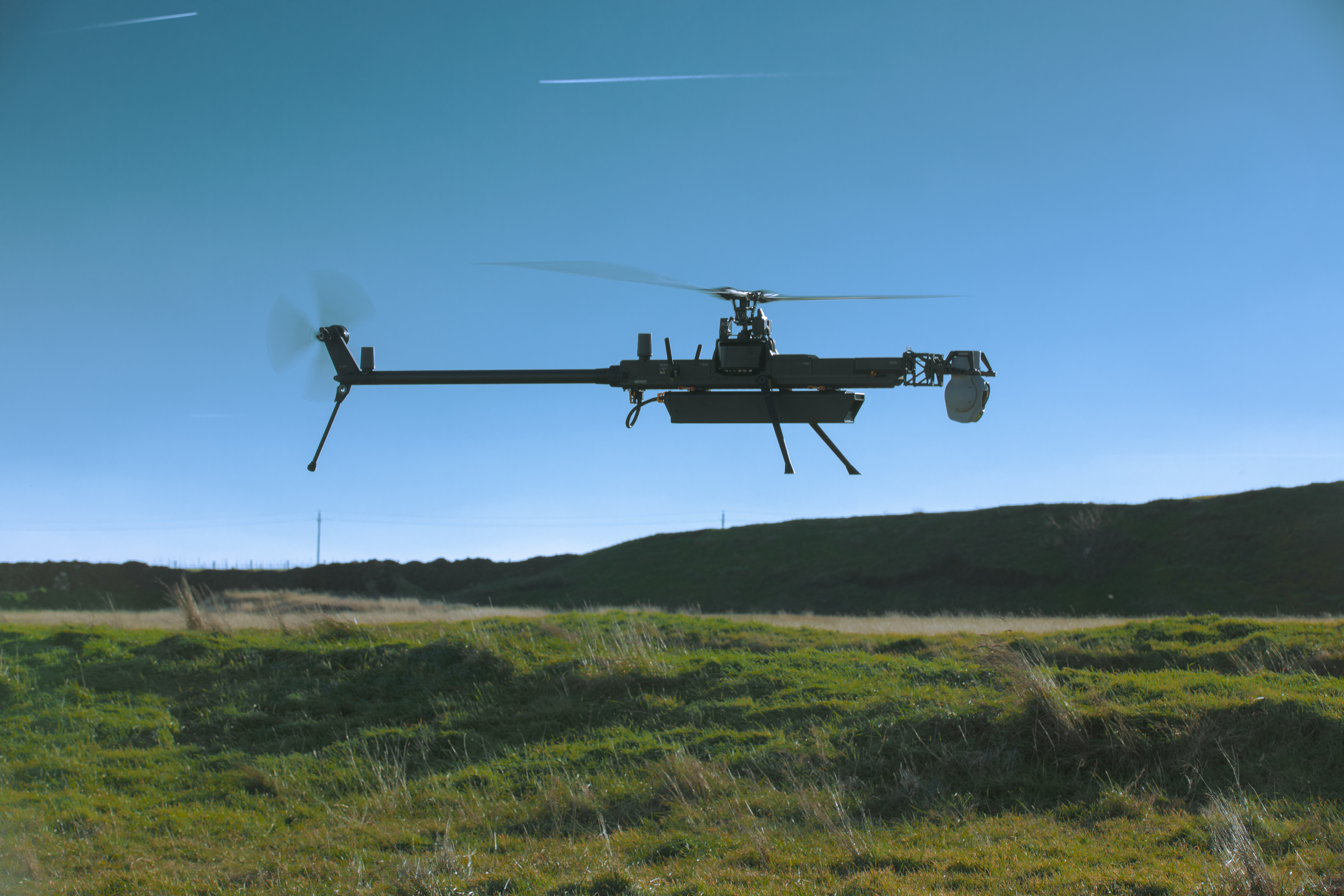
Photo: U.S. Army / Pfc. Nathan Arellano Tlaczani — public domain (Wikimedia Commons).
Videos

Ghost is a small autonomous helicopter unmanned aerial system built by Anduril Industries, the California-based defence firm founded in 2017 by Palmer Luckey. The platform entered service in 2020 and is built around a single-rotor VTOL airframe that a lone operator can unpack and launch within roughly two minutes. Its role is short-range intelligence, surveillance and reconnaissance for ground forces and special-operations teams — the kind of close, persistent overwatch that fixed-wing tactical drones struggle to provide because they need a runway or a launcher.
The aircraft is tightly coupled to Lattice, Anduril’s autonomy and command-and-control software, which handles flight, sensor cueing and target tracking with minimal operator input. That coupling is what distinguishes Ghost from earlier compact ISR helicopters: the operator marks an area or a target on a tablet and the aircraft executes the rest, fusing its electro-optical and infrared imagery into the same operational picture used by other Anduril systems. Endurance sits at around 100 minutes per flight and the payload bay is modular, so the aircraft can be reconfigured between EO/IR balls, signals-intelligence packages or communications relays without redesigning the airframe.
Ghost is fielded by the United States, the United Kingdom and Ukraine. The clearest production customer is US Special Operations Command, which adopted the system to support reconnaissance and direct-action missions where small footprint and quiet operation matter more than range. The British armed forces have trialled the platform as part of ongoing experimentation with small autonomous ISR. Ukrainian outlets have reported the system in use there since 2022, though that reporting is not officially confirmed; where it has flown, operators describe its value as finding targets at night and passing coordinates back to artillery and loitering munitions.
The product line has continued to develop since first delivery. Ghost 4 was the early workhorse; the current production variant is Ghost-X, a heavier, longer-endurance derivative with a maximum take-off weight around 25 kg, roughly an hour of cruise endurance and a payload near 9 kg, navigating without GPS using a vision-based system. In September 2024 the US Army selected Ghost-X for the first tranche of its Company-Level Small UAS requirement, fielding it through the Pentagon’s Replicator initiative alongside the PDW C100. The company markets the family as a building block in a wider system rather than a standalone aircraft, with Ghost feeding sensor data into Lattice and receiving tasking from the same network that controls Anduril’s ground sensors and counter-UAS effectors.
Within the small-UAS market Ghost sits between consumer-derived quadcopters and traditional military rotary platforms — heavier and more capable than a Skydio or Parrot, but far smaller and cheaper to operate than a Schiebel Camcopter or an MQ-8 Fire Scout. Its survival in operational use, particularly in Ukraine, has become the strongest argument for the autonomy-first approach Anduril has pushed since its founding.
Sources
- www.airforce-technology.com/projects/ghost-4-vtol-suas/ (2026-06-22) — Ghost 4 dimensions, ~137 km/h max speed, >100 min endurance, single-rotor electric VTOL, onboard autonomy compute.
- www.designation-systems.net/dusrm/app4/ghost-x.html (2026-06-22) — Ghost-X specs (~25 kg MTOW, ~9 kg payload, vision-based GPS-denied navigation) and the US Army Company-Level sUAS selection.
- defensescoop.com/2024/10/17/replicator-ghost-x-drones-anduril-army/ (2026-06-22) — US Army fielding Ghost-X via Replicator alongside the PDW C100.
- www.anduril.com/article/anduril-unveils-ghost-x/ (2026-06-22) — Official Ghost-X announcement.
- en.defence-ua.com/analysis/ukraines_forces_secretly_use_american_ghost_x_uavs_with_artificial_intelligence_since_2022-12530.html (2026-06-22) — Ukrainian outlet reporting Ghost-X use since 2022 — single-source, not officially confirmed.