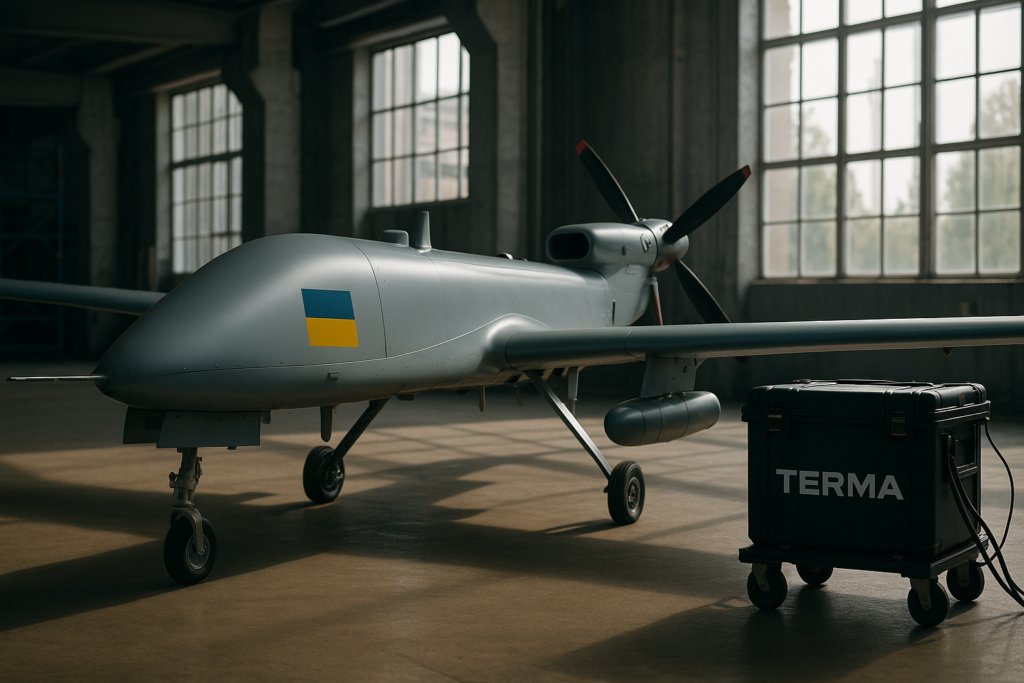
Terma
Radar, EW, and self-protection systems; Scanter naval and counter-UAS radars are widely fielded across NATO.
Terma A/S was founded in 1949 in Aarhus, Denmark, where it remains headquartered today. The firm is privately held through Thrige Holding A/S and operates as Denmark’s largest aerospace and defence company, employing roughly 2,200 people across sites in Europe, the United States, India, and the Middle East. Jes Munk Hansen, a former Osram Sylvania chief executive, has led the company as CEO since 2017, a period during which Terma has expanded its footprint in radar, electronic warfare, and space.
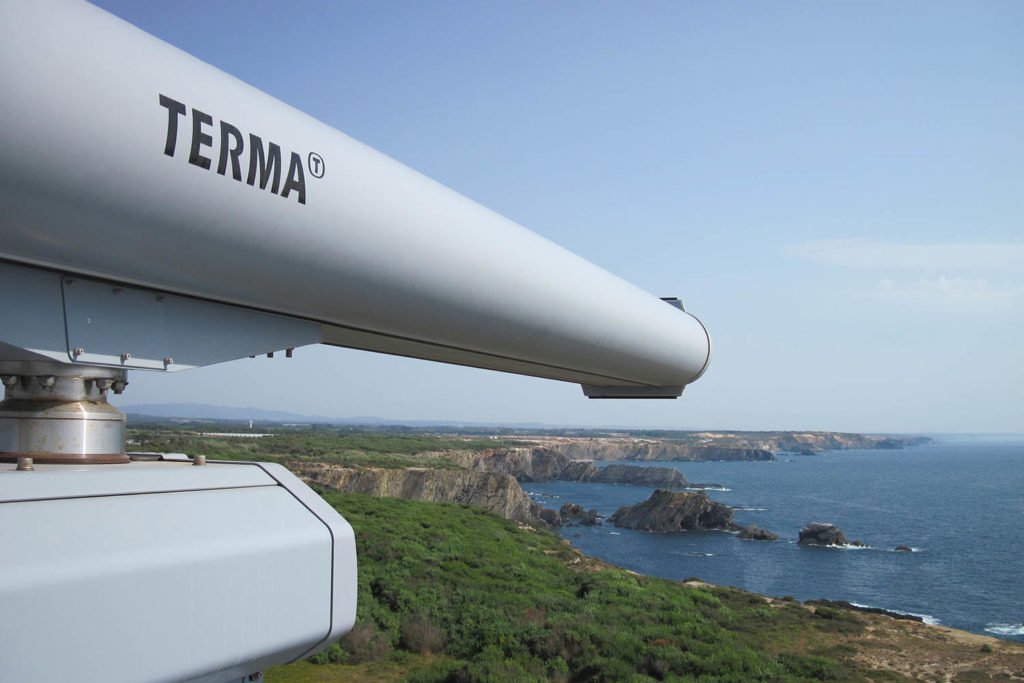
The product line splits across four broad areas. Its best-known family is the Scanter radar series — solid-state, frequency-agile sensors used both as naval surveillance radars on frigates and patrol vessels and as ground-based systems for airport surface movement control and counter-UAS detection. Scanter installations sit on Royal Danish, Royal Netherlands, and Royal Australian Navy ships, among others, and on airfields from Copenhagen to Singapore. Alongside the radars, Terma builds self-protection suites for combat aircraft and helicopters: the Modular Aircraft Survivability Equipment (MASE) pod, the ALQ-213 electronic warfare management system, and the Pylon Integrated Dispenser System (PIDS+) and Electronic Combat Integrated Pylon System (ECIPS+) carried on F-16s across more than a dozen air forces. A third leg is space, where the company supplies power systems, star trackers, and mission-control software to ESA and NASA programmes, including instruments on the BepiColombo mission to Mercury and ground-segment work for Galileo. The fourth strand is its work as an industrial partner on the F-35 Lightning II, where Terma manufactures composite components, the gun pod for non-US variants, and the advanced countermeasures dispenser.
On the customer side, Terma’s electronic-warfare kit equips F-16 fleets in the United States, Denmark, the Netherlands, Belgium, Norway, Poland, Romania, Pakistan, and several others, with active retrofit campaigns continuing as those fleets are passed on from one user to another. Its Scanter radars have become a quiet standard for NATO surface fleets, and the counter-UAS variant has been pitched into European border-protection and base-defence programmes as drone threats have multiplied. The company books revenue in the low single-digit billions of Danish kroner annually and has been growing at double-digit rates since 2022, riding the same European rearmament wave that has lifted Saab, Kongsberg, and Rheinmetall.
Ownership sits with the Thomas B. Thrige Foundation through Thrige Holding, which has periodically considered a sale or partial listing without acting on it; the structure has given Terma room to invest through downturns and to keep its headquarters and most of its manufacturing in Denmark. The firm has avoided the controversies that attach to larger primes, though its work on F-35 components has occasionally drawn questions from Danish parliamentarians about export-control oversight.
What makes Terma’s position distinctive is the combination of a full self-protection stack for legacy fighters, a maritime radar line with deep NATO penetration, and a serious space business — an unusually broad portfolio for a company of its size, anchored in a small country that has lately become one of Europe’s more outspoken voices on defence spending.
Products
Software
ALQ-213 Electronic Warfare Management System
Cockpit EW controller that fuses RWR, MWS, chaff/flare, and jammer outputs into a single threat-response loop.
Introduced 1995
C2 Maestro
Modular battle-management and data-fusion C2 system for integrated air and missile defence operations.
Introduced 2015
Sky Nexus
Multi-sensor counter-UAS command-and-control platform that fuses radar, RF, EO/IR, and acoustic inputs into a common operational picture.
Introduced 2021
Hardware
ATOS
Podded airborne surveillance suite combining EO/IR, radar, and AIS for maritime patrol and fisheries-enforcement missions.
Introduced 2010
F-16 Electronic Combat Pod
Podded active jamming suite for F-16 providing standoff and self-protection ECM in contested airspace.
Introduced 2001
MASE
Multi-function Advanced Stabilised ESET: a single gimballed turret combining missile approach warning, laser warning, and directed IR countermeasures for helicopter self-protection.
Introduced 2012
AN/AAR-60 MILDS
Passive infrared missile launch detection system providing 360-degree hemisphere coverage for rotary- and fixed-wing aircraft.
Introduced 2000
Modular Aircraft Survivability Equipment Pod
Self-protection pod bundling missile-warning sensors, RF jammers, and countermeasure dispensers for transport and rotary-wing aircraft.
Introduced 2008
Terma Recce Pod
Podded electro-optical and infrared reconnaissance system for tactical fast jets, delivering day/night ISR imagery.
Introduced 2005
SCANTER
Family of solid-state naval and coastal surveillance radars covering surface search, vessel traffic service, and counter-UAS detection; the most widely fielded surface-search radar in NATO navies.
Introduced 1990
SCANTER 4000
Air and coastal surveillance radar tuned for small, slow, low-flying targets — the basis of Terma's counter-UAS offering.
Introduced 2016
SCANTER 5000
X-band 2D surveillance radar for naval surface picture and helicopter control, widely fielded across NATO surface combatants.
Introduced 2010
SCANTER 6000
Solid-state X-band naval surveillance radar for surface picture, helicopter control, and small-target detection in heavy clutter.
Introduced 2014
T-350
Multi-sensor targeting pod with day/night EO/IR and laser designation, qualified for F-16 and Gripen.
Introduced 2015