Auterion
Skynode flight control, AuterionOS, and Nemyx swarm autonomy — the software inside Western drone-strike kits going to Ukraine.
Auterion was founded in Zurich in 2017 by Lorenz Meier and Kevin Sartori, growing out of Meier’s academic work at ETH Zurich on the open-source PX4 autopilot project. PX4 had become the de facto open flight-control stack for research drones over the previous decade, and the founders’ bet was that the same software, hardened and supported commercially, could become the standard for enterprise and military uncrewed systems. The company has since shifted its centre of gravity to the United States: it is headquartered in Arlington, Virginia, with software engineering in Munich and civil-side work continuing in Zurich. Meier remains chief executive.
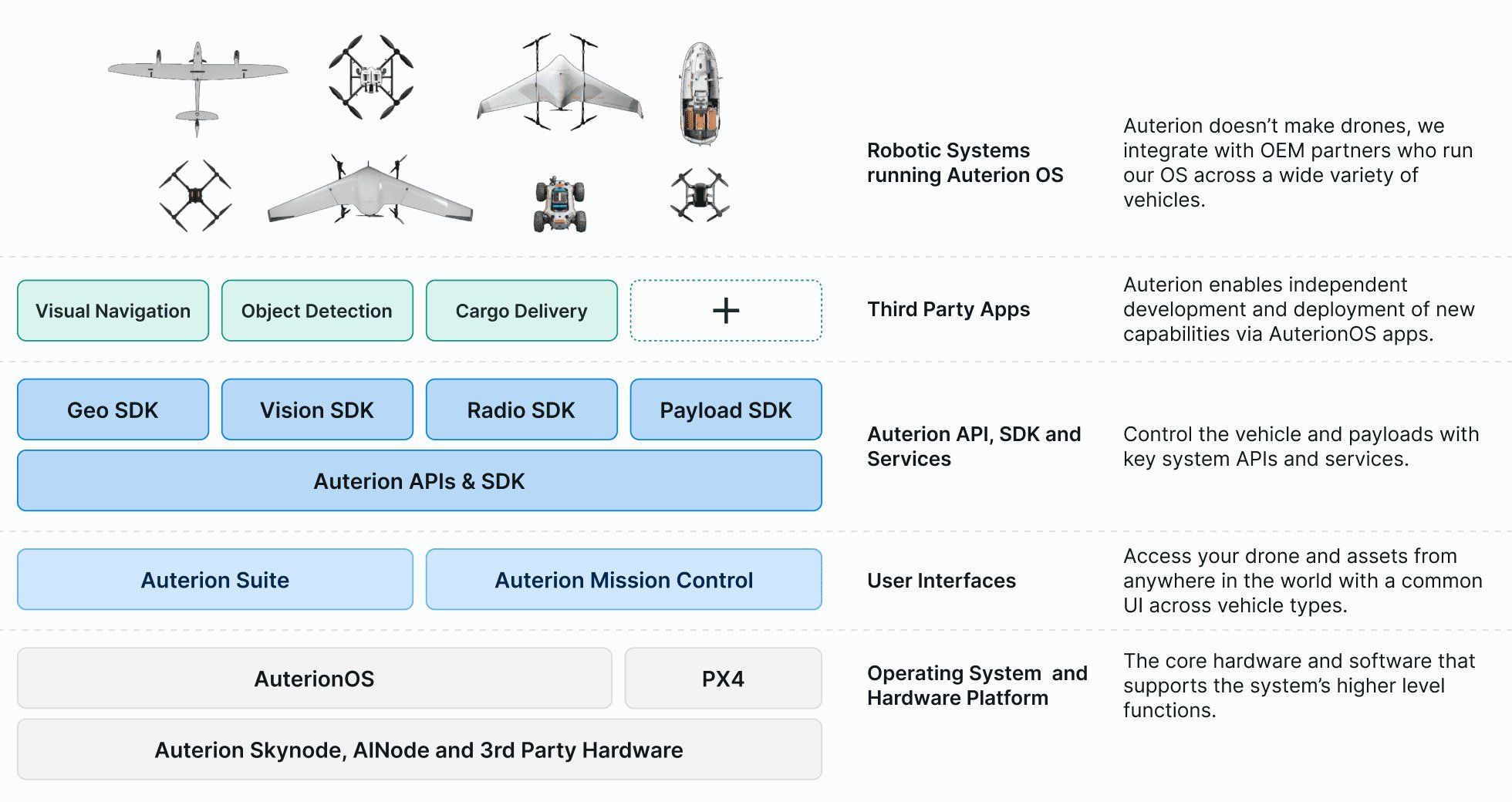
The product line is built around a single idea — a common operating system that turns interchangeable airframes into a software platform. AuterionOS is the commercial distribution of PX4, sold with long-term support and security hardening. Skynode is the hardware module that runs it: a flight controller paired with onboard mission compute, sold in S, X and N variants for different size classes of aircraft. Auterion Mission Control is the ground-station companion. The newest layer is Nemyx, a swarming-autonomy capability that lets Skynode-equipped drones coordinate as a group rather than fly as individual remote-piloted vehicles. Because the stack is open-architecture, dozens of drone manufacturers — rather than a single proprietary platform — ship aircraft running AuterionOS.
The defining contract came in 2025, when the United States Department of Defense placed an order with Auterion for 33,000 Skynode S strike kits destined for Ukraine. The kits convert commercial first-person-view drones into terminal-guided munitions with onboard target recognition, addressing the electronic-warfare problem that has reshaped the front line: a kit that locks onto its target on final approach keeps flying when the radio link is jammed. The order made Auterion one of the most consequential Western suppliers to the Ukrainian drone war and validated PX4-derived software as a viable basis for fielded weapons. Skynode is also embedded in products from Quantum-Systems, Neros and other Western drone makers, and the company works alongside Shield AI on autonomy stacks for larger uncrewed aircraft.
Auterion is privately held. It has raised institutional capital from venture investors including Lakestar and Costanoa Ventures, and reported a Series B led by Lakestar in 2021. More recent rounds have not been disclosed in detail, though the Pentagon contract and a wave of European defence-tech investment in 2024–2025 have lifted the company’s profile considerably. Headcount sits in the low hundreds across the three offices.
The firm sits at a particular intersection. Many defence drone primes build closed, vertically integrated systems; Auterion’s pitch is the opposite — a software layer thin enough to run on a commodity board and open enough to be adopted by competing airframe vendors. That stance makes it both an enabler of allied production at scale and a target of the same export-control and end-use scrutiny that follows any company whose code ends up steering munitions. Its current work points further in the same direction: more autonomy at the edge, larger swarms, and tighter integration with the Western defence supply chain feeding Kyiv.
Products
Software
AuterionOS
Hardened commercial distribution of the open-source PX4 flight-control software.
Auterion Mission Control
Ground-control station software.
Nemyx
AI capability for coordinated autonomous drone swarms, integrated into Skynode-equipped airframes.
Auterion Mission Control
Ground-control application for planning, monitoring, and commanding Auterion-powered drone fleets.
Introduced 2020
AuterionOS
PX4-derived drone operating system standardising autopilot, payload, and ground-station integration across third-party airframes.
Introduced 2018
Auterion Suite
Cloud fleet-management and mission-planning platform for enterprise drone operations — analytics, live telemetry, and OTA deployments.
Introduced 2020
Nemyx
Swarm autonomy stack letting groups of strike and ISR drones coordinate target assignment with minimal operator input.
Introduced 2025
Hardware
Skynode (S, X, N)
Flight controllers with onboard mission compute; the chip behind the 33,000 Pentagon-funded strike kits being delivered to Ukraine.
Skynode
Compact flight-controller module bundling autopilot, mission computer, and secure datalink for fixed-wing and multirotor drones.
Introduced 2019
Skynode S
Strike-optimised Skynode variant for one-way attack drones, with onboard computer-vision targeting and terminal guidance.
Introduced 2024
Skynode X
Higher-compute Skynode variant for ISR and multi-payload drones requiring richer onboard AI processing.
Introduced 2023
YouTube

Media
Articles
Germany to manufacture thousands of autonomous strike drones for Ukraine
The Defense Post · 2026-04-15
Inside the secret Munich factory producing 10,000 Ukrainian drones a year
DroneXL · 2026-03-02
Auterion wins $50M Pentagon contract to deliver 33,000 AI-driven drone strike kits to Ukraine
DroneLife · 2025-07-29
Sources
- en.wikipedia.org/wiki/Auterion (2026-05-02) — Encyclopedic summary — confirms November 2017 Zurich founding by Lorenz Meier and Kevin Sartori, the 2024 Arlington VA relocation, the AuterionOS / Skynode / AMC / Nemyx product line, the PX4 / MAVLink / QGroundControl open-source heritage, and the September 2025 $130M Series B led by Bessemer at over $600M valuation.
- auterion.com/auterion-secures-contract-to-deliver-33000-skynode-drone-strike-kits-to-ukraine/ (2026-05-02) — Official announcement of the July 2025 $50M Pentagon contract for 33,000 Skynode strike kits to Ukraine.
- thedefensepost.com/2026/04/15/germany-auterion-drones-ukraine/ (2026-05-02) — Reporting on the Auterion-Quantum Systems "Airlogix" joint venture to mass-produce autonomous strike drones in Germany for Ukraine.
- defence-industry.eu/auterion-secures-130-million-to-scale-ai-defence-software-and-transform-drone-warfare/ (2026-05-02) — Defence Industry Europe coverage of the September 2025 Series B.
Sources (11)
- en.wikipedia.org/wiki/Auterion
- www.wikidata.org/wiki/Q135185405
- en.wikipedia.org/wiki/Auterion
- en.wikipedia.org/wiki/Auterion
- en.wikipedia.org/wiki/Auterion rate limited
- en.wikipedia.org/wiki/Auterion
- en.wikipedia.org/wiki/Auterion rate limited
- en.wikipedia.org/wiki/Auterion
- en.wikipedia.org/wiki/Auterion
- en.wikipedia.org/wiki/Auterion rate limited
- en.wikipedia.org/wiki/Auterion rate limited