R-18
Heavy octocopter designed for night precision strikes on armoured vehicles using thermal imaging and gravity-dropped munitions.
Droneby AerorozvidkaIntroduced 2017
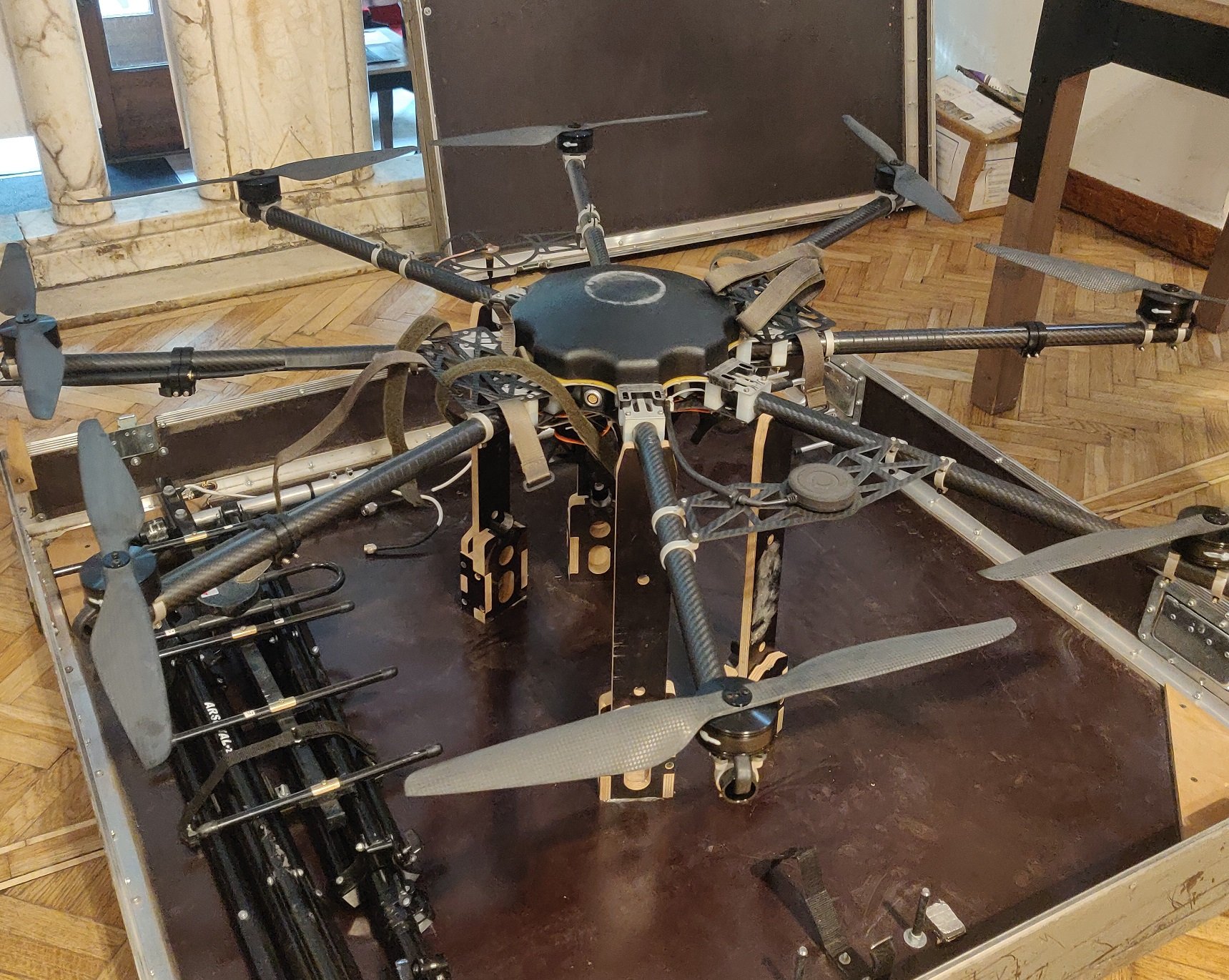
Photo: Wikipedia
The R-18 is a heavy octocopter built by Aerorozvidka, a Ukrainian volunteer-rooted drone unit, designed for night precision strikes on armoured vehicles. First fielded around 2017, the platform fills a gap between handheld quadcopters and larger fixed-wing strike systems: a multi-rotor heavy enough to carry anti-armour ordnance, quiet enough to approach targets in darkness, and cheap enough to lose. It is operated almost exclusively by Ukrainian forces, and its profile rose sharply during the 2022 full-scale Russian invasion.
Mechanically, the R-18 is an eight-rotor airframe with a payload of roughly five kilograms, a thermal and night-vision optics package, and a release mechanism for gravity-dropped munitions. The standard armament is a modified RPG warhead — typically the PG-7VL anti-tank round — adapted with a tail fin and impact fuze so it can be released vertically onto the thin top armour of tanks and infantry fighting vehicles. Thermite incendiary grenades are also dropped, used against fuel trucks, ammunition stores, and soft-skinned logistics. Operators fly it at night and at low speed, relying on the heat signature of stationary or stopped vehicles to find targets. Range sits around four kilometres, with endurance long enough for a single mission against a parked column.
Aerorozvidka began as a volunteer collective in 2014 during the Donbas war, refining drone tactics in the field before being formally absorbed into the Ukrainian armed forces. The R-18 was the unit’s signature platform, hand-assembled in small numbers and refined iteratively from operator feedback. Combat use scaled dramatically after February 2022. The platform is most closely associated with strikes on the Russian armoured column advancing on Kyiv, where night sorties hit the head of the convoy on the Zhytomyr highway and contributed to the column’s stalling. It has since been credited with destroying or disabling T-72 tanks, BTR-82 personnel carriers, fuel tankers, and command vehicles across multiple fronts.
Unit cost has been reported at roughly twenty thousand dollars — an asymmetry that defines the system’s appeal, since a single drop can disable a vehicle worth a hundred times that. The airframe has continued to evolve as Ukrainian operators modify optics, release mechanisms, and control links to match shifting Russian electronic-warfare countermeasures. The R-18 now sits alongside a wider Ukrainian heavy-lift drone ecosystem — the Vampire, the Baba Yaga family — that has effectively normalised commercial-derived octocopters as precision strike platforms. It is one of the early examples in that lineage, and the one most closely tied to the opening weeks of the defence of Kyiv.