Skyeton
Long-endurance Raybird reconnaissance UAVs, combat-proven over 350,000 hours in Ukraine.
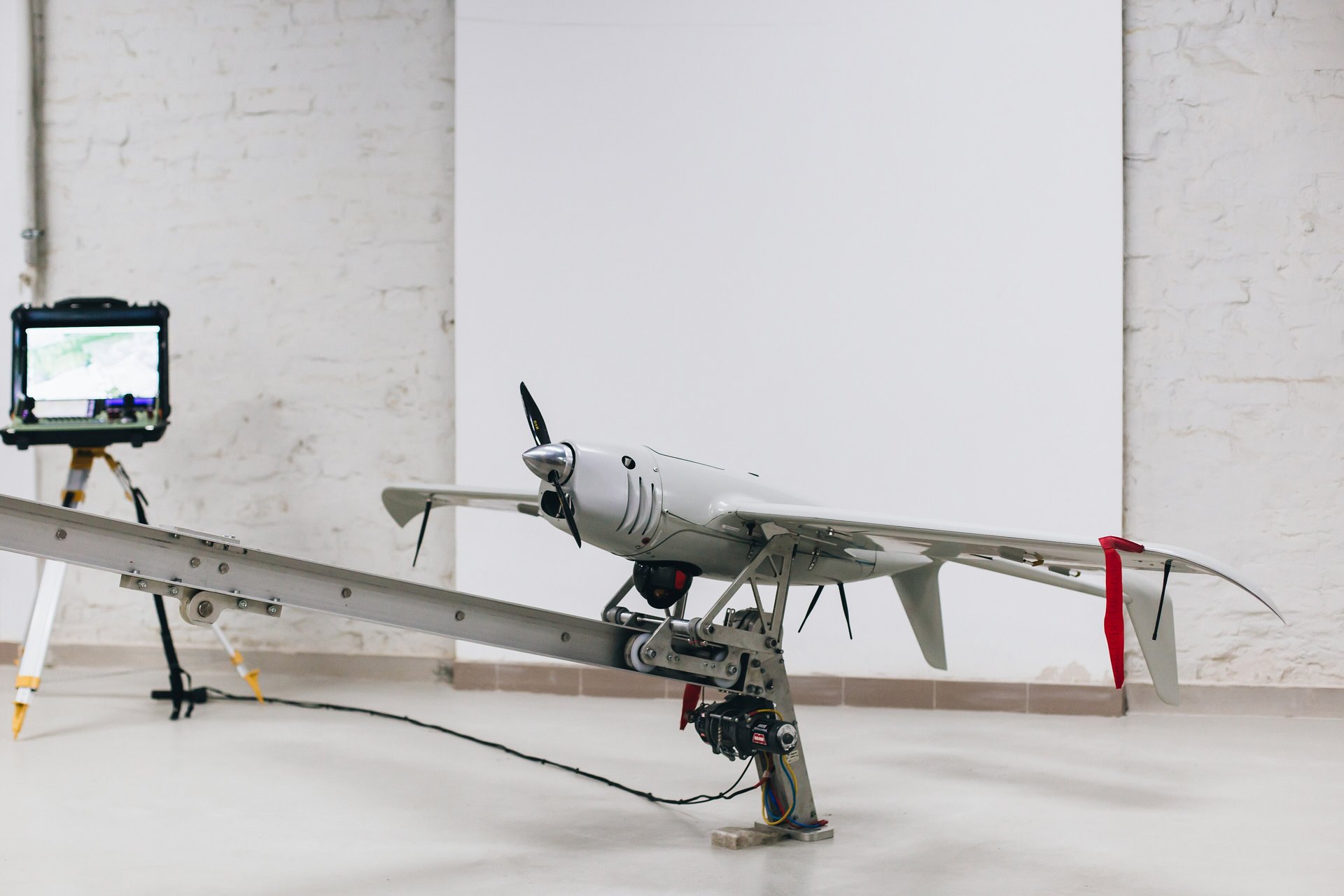
Skyeton was founded in 2006 in Ukraine as a manufacturer of light aircraft and dual-use aviation systems, well before the country’s drone industry became a wartime fixture. The company is led by CEO Roman Knyazhenko, who has steered it from a small civil-aviation outfit into one of the busier reconnaissance-UAV suppliers feeding the Ukrainian armed forces. Its workshops produce the Raybird family of fixed-wing systems, marketed civilian-side as the ACS-3 platform and fielded militarily as the ACS-3M.
The Raybird-3 sits at the centre of the product line. It is a long-endurance fixed-wing aircraft built for intelligence, surveillance, target acquisition, and reconnaissance work — class I under NATO classification — designed to stay aloft for more than 28 hours per sortie. The control link extends to roughly 240 km, with an offline operating range of about 2,500 km and a service ceiling above 5 km, putting it in a category between hand-launched tactical drones and the larger MALE platforms. The airframe is small enough to be launched from a catapult and recovered without a runway, which matters in the dispersed, mobile rear areas of the Ukrainian front.
Around the base Raybird, Skyeton has rolled out variants that track the operational pressures of the war. A satellite-communications version was delivered to Ukrainian Defence Forces in 2025, freeing the aircraft from the line-of-sight tether that radio-frequency jamming makes increasingly fragile. A hydrogen-hybrid variant entered combat use in December 2025, extending endurance beyond what conventional fuel allows. A radiation-monitoring payload version was supplied to Ukraine’s State Emergency Service, a reminder that the platform’s customer list now reaches beyond the military into civil-protection work around contaminated infrastructure.
By Skyeton’s own count, Raybirds have logged more than 350,000 combat flight hours over Ukraine — a figure that, if anywhere near accurate, places the type among the most heavily flown reconnaissance drones of the war. The company’s positioning emphasises resilience to electronic warfare, which has become the differentiating axis in Ukrainian airspace as Russian jamming and spoofing have improved. Operators describe using Raybirds for artillery correction, deep ISR over occupied territory, and battle-damage assessment, often handing target data to strike assets rather than carrying munitions itself.
Skyeton has expanded internationally as the platform’s combat record has accumulated. The firm has opened production and partnership arrangements outside Ukraine — including reported assembly footprints in NATO countries — to insulate output from Russian missile strikes on Ukrainian factories and to court export customers wary of relying on a single wartime supply line. The company remains privately held, with no published headcount or revenue figures.
The Raybird’s place in the field is less about novelty than about hours flown. In a conflict where most reconnaissance drones survive minutes, a system racking up six-figure combat hours becomes a reference point for what an ISR UAV needs to be — long-endurance, EW-resistant, and producible at scale.
Products
Drones
Raybird-3 / ACS-3 / ACS-3M
Long-endurance fixed-wing reconnaissance UAV; 28+ hours flight time, 240 km control link, 2,500 km offline range, 5.5 km ceiling.
Raybird hydrogen-hybrid
Hydrogen-powered Raybird variant; combat missions in Ukraine since December 2025.
Raybird satcom variant
Raybird with integrated satellite communications, delivered to Ukrainian Defence Forces in 2025.
Raybird radiation-sensor variant
Raybird with radiation-monitoring payload; delivered to Ukraine's State Emergency Service.
Raybird UAS
Long-endurance fixed-wing reconnaissance UAV with 28+ hour flight time, SAR and EO/IR payloads, and real-time fire-control integration — the primary ISR platform of the Ukrainian Armed Forces.
Introduced 2018
Raybird-3
Long-endurance fixed-wing reconnaissance UAV with autonomous mission capability, used extensively by Ukrainian forces for deep ISR.
Introduced 2015
Raybird-5
Larger-class fixed-wing ISR UAV with extended endurance and payload capacity over the Raybird-3.
Introduced 2022
Raybird-9
Larger long-endurance ISR variant with extended range for deep-reconnaissance missions.
Introduced 2021
Gallery
Media
Sources
- en.wikipedia.org/wiki/Skyeton_Raybird-3 (2026-05-02) — Encyclopedic entry — confirms APC Skyeton, the ACS-3 and ACS-3M variants, the 23 kg MTOW / 28-hour endurance / 240 km control link / 2,500 km offline range, the 2014 prototype, and the 2016 Armed Forces authorisation.
- theaircurrent.com/ukraine-special-report/company-profile-skyeton/ (2026-05-02) — The Air Current company profile — confirms 2006 founding (originally for the K-10 Swift sport aircraft), CEO Roman Knyazhenko, and over 350,000 combat flight hours.
- skyeton.com/news/skyeton-integrates-satellite-communications-into-raybird-uas/ (2026-05-02) — Official news release on satellite communications integration delivered to a Ukrainian Defence Forces unit in 2025.
- skyeton.com/news/hydrogen-powered-hybrid-raybird-uav-completes-combat-missions-in-ukraine/ (2026-05-02) — Official news release on the hydrogen-hybrid Raybird's first combat missions, December 2025.
- oboronka.mezha.ua/en/raybird-otrimav-sistemu-radiaciynogo-monitoringu-309070/ (2026-05-02) — Coverage of the radiation-sensor Raybird handed over to Ukraine's State Emergency Service.