Panther KF51
Next-generation main battle tank with a 130mm smoothbore, integrated loitering munition launcher, and a digitised fire-control loop.
vehicleby RheinmetallIntroduced 2022
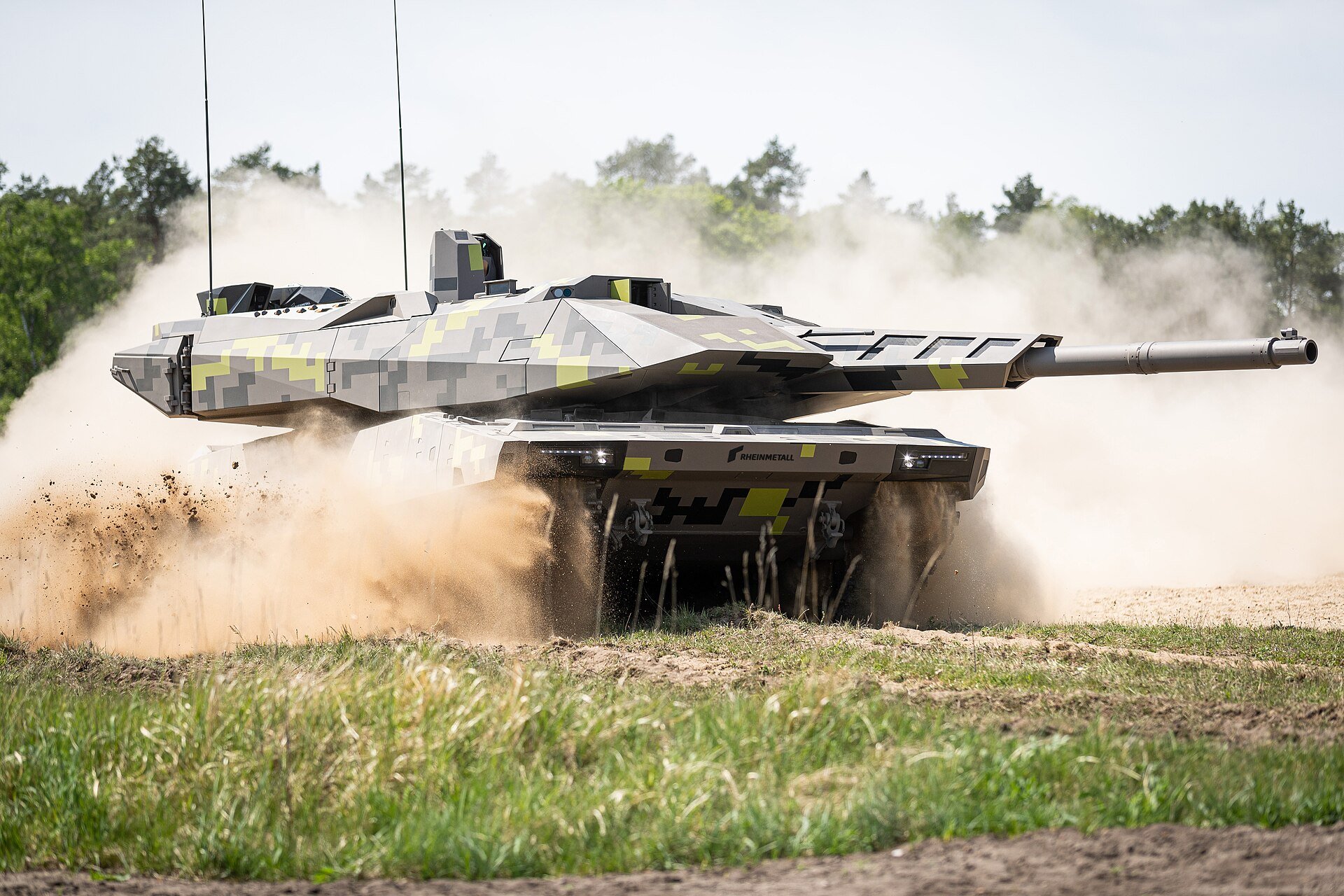
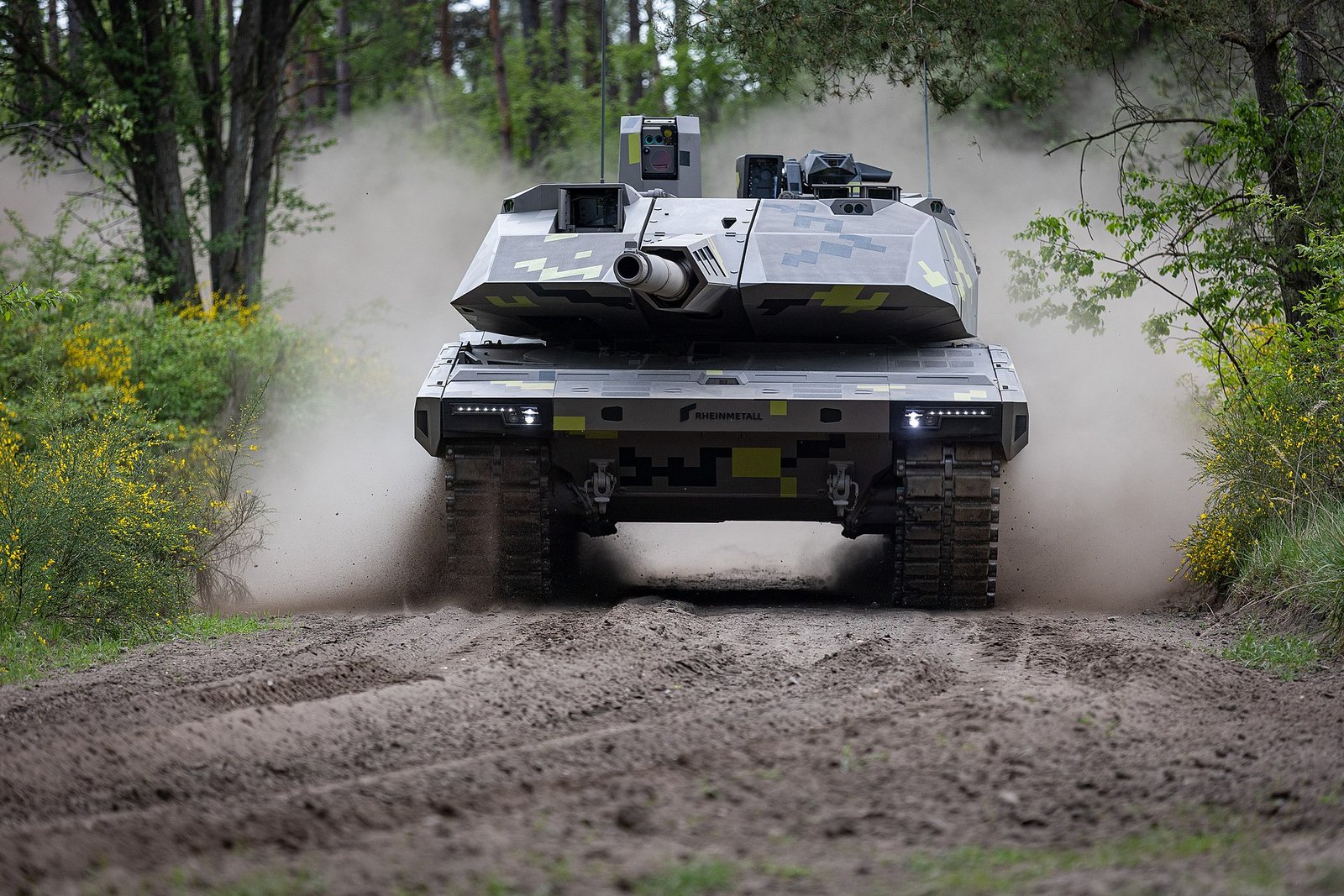

Photos: Rheinmetall Defence · Rheinmetall
The Panther KF51 is Rheinmetall’s bid to set the next benchmark for European main battle tanks, unveiled at Eurosatory in June 2022 and pitched as a successor to the Leopard 2 lineage that has shaped NATO armoured doctrine for four decades. Built around a roughly 59-tonne hull, the KF51 leaves behind the standard NATO 120mm gun for a 130mm smoothbore Future Gun System and folds in features — a loitering munition launcher, AI-assisted fire control, a networked digital backbone — that mark it less as an iteration than as an attempt to rewrite what a tank does in a battlespace increasingly dominated by drones and top-attack threats.
At the heart of the platform is Rheinmetall’s 130mm Future Gun System paired with an autoloader, removing the human loader from the crew and giving commanders a roughly 50% kinetic energy uplift over the L/55A1 120mm currently fielded on the Leopard 2A7. The turret integrates a HERO-120 loitering munition launcher developed with Israel’s UVision, allowing the crew to engage targets beyond direct line of sight — an explicit answer to the Ukraine-war lesson that armoured columns now operate under near-constant overhead surveillance and one-way drone attack. Sensor fusion runs through a digital backbone built to NATO Generic Vehicle Architecture standards, with AI-assisted target acquisition, automatic threat cueing, and a hunter-killer optical suite. An active protection system, electronic countermeasures, and a comparatively low-profile turret round out the survivability package.
Italy is the Panther’s first declared customer. In early 2024, Rome announced a long-running programme worth roughly €20 billion to replace its Ariete fleet with a Panther-derived platform, executed jointly with Italy’s Leonardo and with deliveries running into the 2030s. Hungary was an early evaluation partner, and Rheinmetall has marketed the platform aggressively across central and eastern Europe as legacy Leopard fleets near retirement. The system has not seen combat; first production-standard hulls are still pending.
Rheinmetall has shown two principal configurations of the platform — a manned variant retaining a three-person crew, and a future configuration optimised for an unmanned turret and remote operation, briefly previewed as the KF51-U. The company has also signalled that the digital backbone is meant to evolve as a platform rather than a fixed product, with software updates pushing new capabilities to fielded vehicles in service.
The Panther sits in direct competition with the Franco-German MGCS programme — the official next-generation tank for both armies, but one whose timeline keeps slipping — and with American M1E3 and Korean K2 efforts. Rheinmetall’s bet is that European armies needing replacements this decade rather than next will pick a system available now over a coalition platform still on paper.