Products Palantir Technologies
Gotham
Intelligence and operations platform that fuses sensor, signals, and human-source data into a single targeting and decision picture for defence and intelligence users.
Softwareby Palantir TechnologiesIntroduced 2008


Photos: winbuzzer.com · consultoriainformatica.net · blog.sociallinks.io · diystockpicker.com · techhack.co.uk
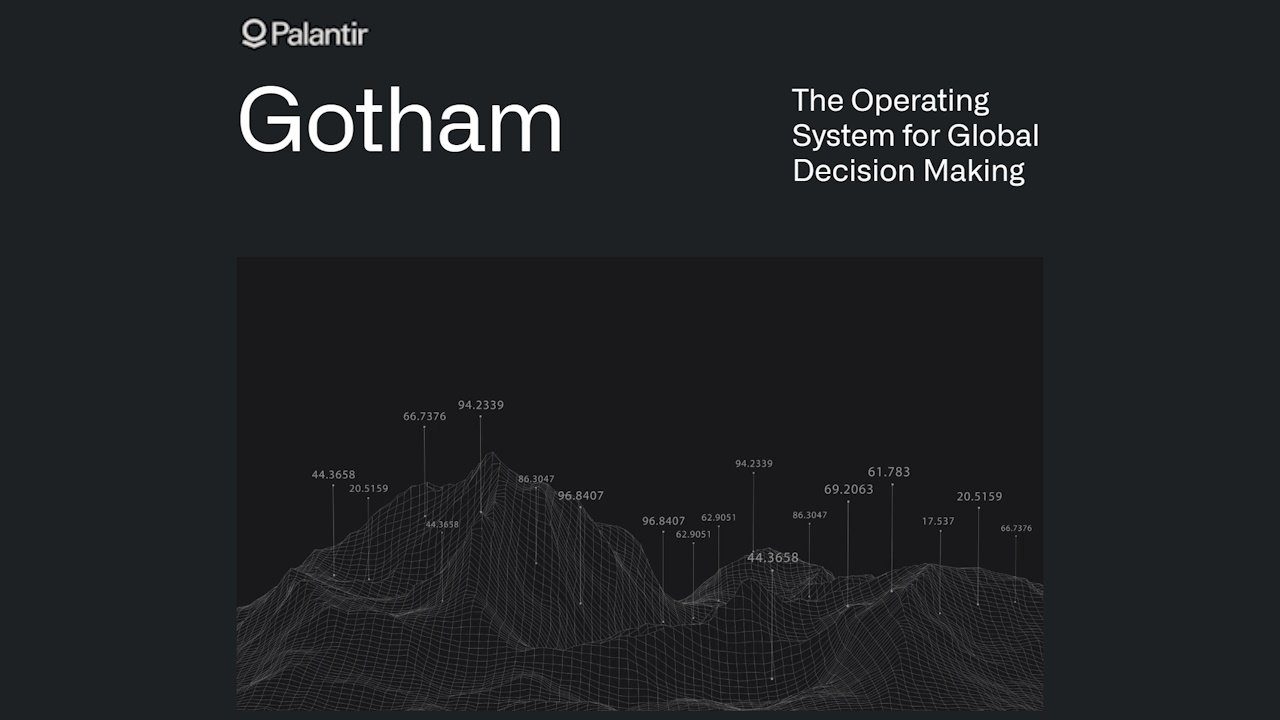
Gotham is Palantir Technologies’ intelligence and operations platform, first deployed in 2008 and built to give analysts a single working surface for fusing classified sensor feeds, signals intelligence, human-source reporting, and open-source material. It emerged from Palantir’s early CIA-adjacent contract work — In-Q-Tel was an initial investor — and was designed for the counterterrorism analyst’s core problem: tens of thousands of fragmentary records about people, places, vehicles, and events scattered across systems that could not talk to each other.
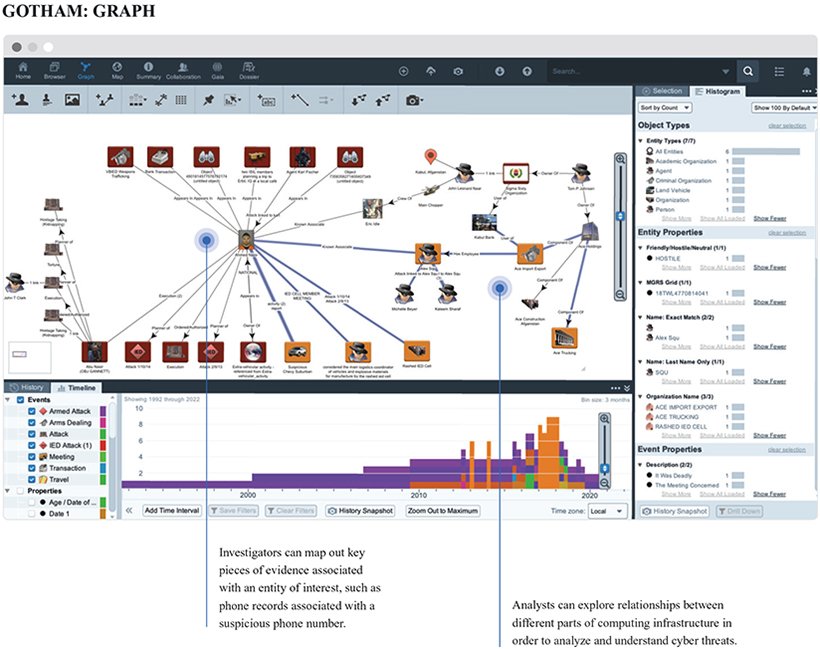
At its heart Gotham is entity-centric. Records from each source are resolved into objects — a person, a vehicle, a building, a phone number, a transaction — and every relationship between them is preserved as a typed link. Analysts work the resulting graph through link-analysis tools, a geospatial layer that places those entities on a map, and a time scrubber that shows how the network evolved. Newer releases fold in machine learning for pattern-of-life detection and anomaly flagging, and the platform now exposes Palantir’s AIP agentic LLM layer, so operators can interrogate the data set in natural language and chain inference steps across structured and unstructured sources.
The platform is fielded across the US intelligence community and the Department of Defense. An August 2024 partnership with Microsoft brought Gotham, Foundry, and AIP onto Azure Government Secret and Top Secret clouds, deepening its reach into classified networks. Allies running Palantir software include the United Kingdom, Israel, France, and — most visibly since 2022 — Ukraine, where Gotham underpins targeting workflows in the war with Russia. Palantir CEO Alex Karp has said publicly that the company’s software handles much of the targeting work on the Ukrainian side, a claim broadly echoed by Western reporters covering the war effort.
Among intelligence platforms Gotham sits at the high end: more analyst-facing than the BAE and Raytheon ground systems that compete with it on raw ingest, and more deeply wired into operational targeting than visualisation tools such as IBM i2. That positioning, more than any single feature, is what has kept it inside the targeting cycles of the largest Western militaries for nearly two decades.
Sources
- www.palantir.com/platforms/gotham/ (2026-06-21) — Palantir's official Gotham platform page — intelligence/operations/targeting positioning.
- news.microsoft.com/source/2024/08/08/palantir-and-microsoft-partner-to-deliver-enhanced-analytics-and-ai-services-to-classified-networks-for-critical-national-security-operations/ (2026-06-21) — Microsoft press release (8 Aug 2024) — Gotham/Foundry/AIP onto Azure Government Secret (IL6) and Top Secret clouds for DoD/IC.
- fedscoop.com/microsoft-palantir-ai-analytics-products-intelligence-defense-natsec/ (2026-06-21) — FedScoop (8 Aug 2024) — independent confirmation of the Palantir–Microsoft classified-cloud partnership.
- time.com/6293398/palantir-future-of-warfare-ukraine/ (2026-06-21) — TIME (2023) — Gotham central to Ukraine targeting; fuses drone, satellite and intercept data.
- united24media.com/war-in-ukraine/palantir-the-secretive-tech-giant-shaping-ukraines-war-effort-5519 (2026-06-21) — United24 Media (2025) — Ukraine targeting use; Gotham ingests citizen tips, drone video and satellite imagery.