Nammo
Joint Norwegian-Finnish ammunition and rocket-motor maker; develops loitering and ramjet-powered munitions.
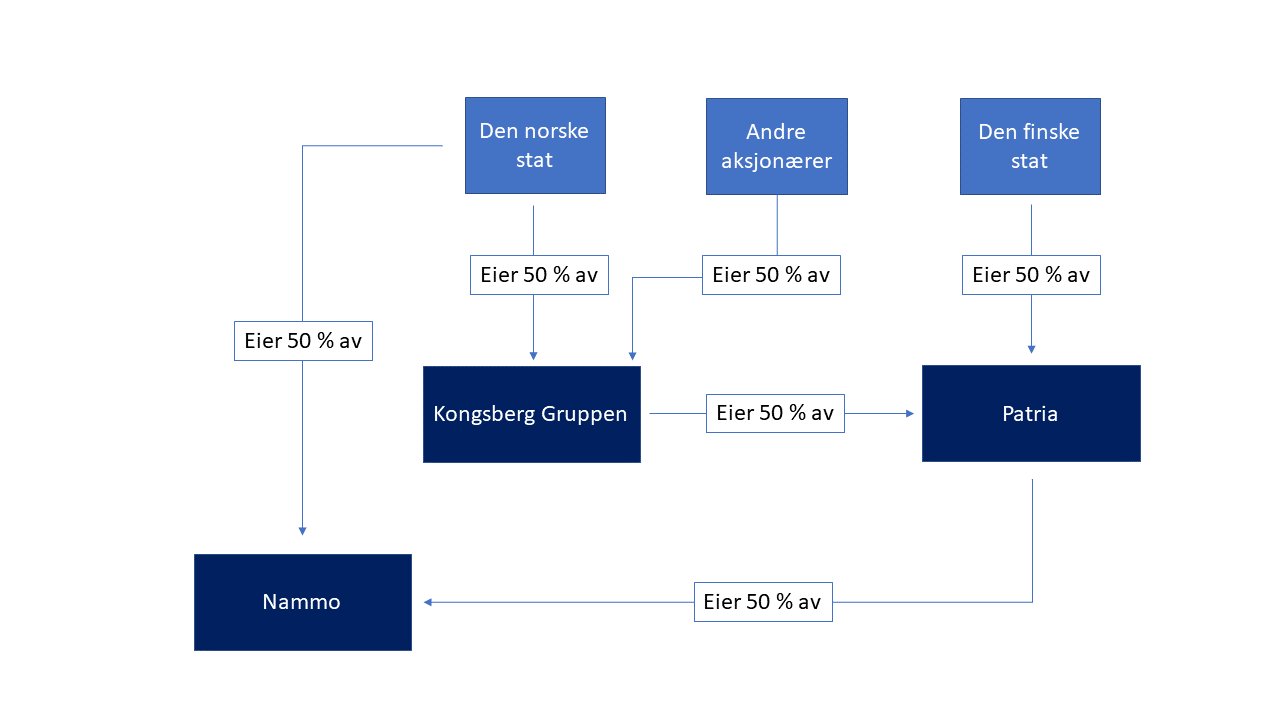
Nammo, formally the Nordic Ammunition Company, was formed in 1998 from the merger of the ammunition arms of Norway’s Raufoss ASA, Sweden’s Celsius and Finland’s Patria. The arrangement that emerged is unusual in European defence: ownership is split evenly between the Norwegian state and Patria, which is itself majority-owned by the Finnish state, making Nammo one of the few genuinely binational defence groups on the continent. Headquarters remained at Raufoss in eastern Norway, the small industrial town that had supplied the Norwegian army since the late nineteenth century. Morten Brandtzæg has led the company as president and chief executive since 2012, having joined as chief financial officer two years earlier.
The portfolio runs from small-arms cartridges to space launch vehicles, but the bulk of the revenue comes from medium- and large-calibre ammunition and from rocket motors. Nammo manufactures the 5.56 mm and 7.62 mm rounds carried by NATO infantry, the 12.7 mm Multipurpose round originally developed at Raufoss for the Browning M2, and a wide line of tank and artillery shells including the M72 light anti-armour weapon, which it produces alongside its US partners. On the propulsion side, the company builds rocket motors for the AIM-9X Sidewinder, the AMRAAM, the Iris-T, the ESSM and the Penguin anti-ship missile, and it has spent the past decade developing solid-fuel ramjet technology that gives projectiles roughly double the range of conventional rocket-assisted shells. Nammo is also a significant shareholder in Andøya Space and supplies hybrid motors for sub-orbital research rockets.
Customers reach across the alliance. The Norwegian, Finnish, Swedish, Danish, German, Dutch, Spanish and US armed forces are recurring buyers, and the firm’s ammunition has flowed in volume to Ukraine since 2022, both directly from Nordic stockpiles and through new production. In 2023 the Norwegian and Finnish governments together announced a roughly NOK 2.6 billion injection to expand Nammo’s capacity for 155 mm artillery shells, part of a wider European push to rebuild a manufacturing base that had been allowed to wither during the long peace. A new propellant line at Raufoss and expanded shell-loading capacity in Finland were brought forward as a result. The company reported revenue of about NOK 9 billion for 2023, up sharply from pre-war levels, and employs in the region of 3,000 people across roughly a dozen countries.
The Ukraine war has also drawn Nammo into the loitering-munitions field that several European peers entered earlier. The firm has demonstrated tube-launched effectors and acquired stakes and partnerships aimed at giving its rocket motors and warheads a home in autonomous strike systems. Its ramjet-powered 155 mm shell, developed with Boeing, has been pitched to the US Army’s long-range cannon programme as a way of pushing tube artillery beyond 100 kilometres.
Nammo has had its share of public friction. In 2021 Brandtzæg disclosed that a TikTok data centre being built next door to the Raufoss plant was consuming so much of the available grid capacity that the company’s planned expansion of explosives production was at risk; the episode became a small case study in how civilian cloud infrastructure can collide with rearmament. Production of cluster munition components was wound down after Norway ratified the Oslo Convention, and the firm has periodically faced scrutiny over end-use of ammunition exported to coalition partners operating in Yemen.

Products
Missiles & loitering munitions
AGM-114-class APKWS guidance kits
Precision laser-guidance kits transforming unguided 70mm Hydra rockets into guided munitions.
Introduced 2012
Hydra 70 / 2.75-inch Rocket
70 mm folding-fin aerial rocket for helicopters and fixed-wing aircraft, field-upgradeable with precision guidance kits.
Introduced 1948
Weapons
3P Programmable Ammunition
Programmable prefragmented proximity-fuzed 40 mm round enabling airburst against drones and low-altitude threats.
Introduced 2000
AT4
Disposable 84 mm unguided recoilless rifle; Nammo produces assemblies and warheads for the Saab-designed launcher.
Introduced 1987
HEAB Programmable Ammunition
Programmable 20–40 mm air-burst rounds for engaging aerial targets, drones, and dismounted infantry behind cover.
Introduced 2000
40 mm HEAB
Programmable high-explosive air-burst round for 40 mm grenade systems; detonates above cover or in a drone-intercept corridor.
Introduced 2010
M72 LAW
Lightweight, single-shot 66mm shoulder-fired anti-armour rocket launcher in widespread NATO service.
Introduced 1963
Nammo Ramjet Artillery Shell
Ramjet-powered 155 mm projectile that extends NATO artillery range beyond 100 km.
Introduced 2023
Ramjet 155
Ramjet-boosted 155 mm artillery projectile designed to more than double the range of existing NATO howitzers.
Raufoss Mk 211
Multipurpose .50-calibre round combining armour-piercing, incendiary, and explosive effects in a single 12.7 mm cartridge.
Introduced 1983
Raufoss Multipurpose (NM140 MP)
12.7 mm anti-material cartridge combining armor-piercing, incendiary, and explosive effects in a single round.
Introduced 1981
Shoulder Launched Munition System (SLMS)
Reusable multi-shot shoulder launcher firing 84 mm rockets, replacing the M72 LAW where a heavier anti-armour punch is needed.
Introduced 2005