Strategy, Evolution, and War
From Apes to Artificial Intelligence
by Kenneth Payne2018Georgetown University Press
Kenneth Payne, a reader in international relations at King’s College London with a background in war studies and the BBC, uses Strategy, Evolution, and War to ask where strategic behaviour comes from and what happens to it once machines start making decisions. The book sits between cognitive science and military theory, treating strategy less as a body of doctrine than as a deeply human cognitive habit that artificial intelligence is now starting to inherit.
Payne’s central argument is that the way humans wage war is rooted in the evolved psychology of social primates — coalition-building, status competition, deception, theory of mind, the capacity to feel honour and humiliation — and that this psychology has quietly shaped every strategist from Sun Tzu to the present. Once decisions begin to migrate to systems that do not share that inheritance, the underlying logic of strategy shifts. Machines optimise; they do not bluff for reputation, fear death, or care about their tribe. Payne argues this will not just speed up warfare but change what strategy is.
The book moves through this in stages. Early chapters draw on evolutionary psychology and primatology — Frans de Waal’s chimpanzee politics, the role of language and cooperation in hominid violence, the emotional architecture behind risk-taking — to reconstruct how strategic cognition might have emerged. Payne then walks through classical strategic thought, reading Clausewitz, Thucydides and Boyd’s OODA loop as descriptions of a specifically human decision-maker shaped by emotion as much as reason. The later chapters turn to AI: narrow systems already embedded in targeting, surveillance and autonomous platforms; the prospect of more general machine reasoning; and the awkward question of whether a non-conscious agent can be said to have a strategy at all. He discusses DeepMind’s game-playing systems, drones and loitering munitions, the brittleness of reinforcement learning under adversarial pressure, and the command-and-control problem of humans trying to supervise decisions made faster than they can follow. Nuclear stability, escalation control and the ethics of delegated lethality all surface here.
Against the field, Payne’s book is distinctive for refusing to treat AI in war as either a technological story or a legal one. Where Paul Scharre catalogues systems and Christian Brose presses for procurement reform, Payne is interested in the cognitive substitution itself — what is lost and what is altered when the strategist is no longer human. It reads as a useful companion for defence analysts trying to think about autonomy beyond the platform level, for AI researchers curious about how their tools land in the security domain, and for general readers willing to follow an argument that takes the long view from the African savannah to algorithmic command.
Read the longer summary
Kenneth Payne wrote “Strategy, Evolution, and War: From Apes to Artificial Intelligence” while teaching in the Department of War Studies at King’s College London, and Georgetown University Press published it in 2018, the same year that saw a small wave of books trying to make sense of what machine intelligence might mean for the practice of war. Paul Scharre’s “Army of None” appeared that year, as did Peter Singer and August Cole’s near-future novel “Ghost Fleet”. Payne joined that conversation from an unusual direction. Most of his peers approached AI through hardware, doctrine, or international law — the practical machinery of autonomous weapons. Payne instead came in through evolutionary biology, cognitive science, and the question of what a strategist actually is. Before academia he worked as a journalist at the BBC; his earlier book, “The Psychology of Strategy”, had examined the cognitive failures behind Lyndon Johnson’s prosecution of the Vietnam War. The new book widened that frame considerably, asking not just how individual leaders fail but why human beings make strategy the way they do at all, and what changes when machines start doing it.
The central argument is that strategy is a biological inheritance, not a purely rational practice. Payne contends that the behaviours strategists rely on — coalition-building, deception, threat assessment, calibrated aggression, theory of mind — are products of millions of years of evolution in social primates. Humans do not approach war as detached calculators. They approach it carrying the emotional and cognitive equipment that natural selection produced for life in small kin groups: fear of strangers, loyalty to in-groups, status-seeking, vengeance, an obsession with reputation. Clausewitz called the resulting mixture passion, chance, and reason and treated it as the essence of war. Payne reads Clausewitz as a proto-evolutionary psychologist who simply lacked the vocabulary. If this is right, then the arrival of machine intelligence is not a technological story but an anthropological one. A computer that plans military operations is not just faster than a human staff officer; it is a different kind of strategist altogether, free of mortality, in-group loyalty, and the millions of years of selection pressure that shaped human decision-making. Whether that is a problem or an advantage is the question the book worries at.
The structure follows that argument from deep history to near future. Payne opens by establishing what strategy is, drawing on Lawrence Freedman and others, and insisting that strategy depends on cognition — on agents capable of modelling the minds of other agents. He then turns to non-human strategists: chimpanzees in particular, but also other primates, dolphins, and cooperative carnivores. The middle chapters trace strategic behaviour through hunter-gatherer societies, the agricultural revolution, the rise of the state, and the industrial wars of the nineteenth and twentieth centuries. He spends considerable time on the Cold War, treating nuclear deterrence as the case where emotional, evolved cognition met its strangest test — strategists asking themselves what a rational opponent would do, while being acutely aware that no participant could afford to behave purely rationally. The final third of the book turns to artificial intelligence proper: what current systems can and cannot do, what autonomy in weapons systems means in practice, and what kind of strategic actor a sufficiently capable machine would be.
The concrete examples are where the book does most of its work. Payne draws on Jane Goodall’s observations of chimpanzee coalition violence at Gombe, and on Richard Wrangham and Dale Peterson’s “Demonic Males”, to argue that lethal raiding behaviour is older than humanity. Chimpanzee patrols on the borders of a group’s territory, attacking isolated members of neighbouring groups, look uncomfortably like the small-unit infantry operations that fill the war diaries of every army. He uses Robin Dunbar’s social brain hypothesis — the proposition that primate brain size scales with group size because tracking allies and rivals is computationally expensive — to argue that the human capacity for strategy is the same capacity that allowed humans to live in groups of about a hundred and fifty. The Machiavellian intelligence literature, which treats primate cognition as fundamentally political, threads through these chapters.
Moving into recorded history, Payne picks examples that show strategy as a contest of evolved minds rather than calculation. He discusses Thucydides on the Peloponnesian War, particularly the Melian dialogue, as a study of how power, fear, and reputation drive states to do things that look irrational from outside. He treats Sun Tzu and Kautilya as observers of the same psychological terrain. The Napoleonic Wars and the First World War appear as cases where mass mobilisation amplified the emotional content of war rather than reducing it. The chapter on the twentieth century takes seriously the idea that air power theorists, particularly Giulio Douhet and the British and American advocates of strategic bombing, were trying to use technology to bypass the human equation — to substitute industrial capacity for the messy business of breaking armies — and that this attempt repeatedly failed because civilian populations, like armies, are made of social primates who do not simply collapse when bombed.
The Cold War material is the longest single example. Payne reads Thomas Schelling, Herman Kahn, and the RAND tradition as the high point of attempts to treat strategy as game theory — and as a tradition that quietly imported emotional, evolved cognition into its models under the names of “credibility” and “resolve”. A deterrent threat works only if the opponent believes the threatener would actually carry it out, even in circumstances where carrying it out would be catastrophic for the threatener. That belief is not a matter of arithmetic; it is a judgment about what kind of social animal the threatener is. Payne uses this to argue that even the most rationalist strategic tradition of the twentieth century was, underneath, an exercise in primate psychology dressed up in equations.
The pivot to artificial intelligence comes through machine game-playing. The defeat of Lee Sedol by DeepMind’s AlphaGo in March 2016 — a defeat that experts had not expected for at least another decade — sits at the centre of these chapters. Payne treats Go as significant not because the game itself maps onto warfare but because it required a kind of intuitive pattern recognition that had been treated as distinctly human. He moves from there to military applications: unmanned aerial vehicles, the loitering munitions then being fielded by Israel and others, automatic target recognition systems, the developing autonomy of underwater and surface naval drones. He discusses the Pentagon’s Third Offset Strategy, then current under Robert Work as deputy secretary of defense, which placed bets on human-machine teaming and autonomy as the answer to Russian and Chinese efforts to negate American conventional advantages. He treats Project Maven, the early Pentagon-Google partnership on machine vision for drone footage, as the bow wave of much larger changes.
What he then asks is what a fully capable machine strategist would actually be like. Without mortality, an AI has no fear of death; without kin, no in-group loyalty; without status to defend, no honour-driven escalation; without a body, no instinctive aggression. In game-theoretic terms this could be liberating — a clean rational actor, free of the cognitive biases that have led humans into so many catastrophic wars. In strategic terms, Payne is less optimistic. Deterrence has always depended on a shared understanding of what the other side would and would not do, anchored in a shared set of evolved drives. A machine adversary, or even a machine commander on one’s own side, breaks that shared frame. He raises the prospect of conflicts that are faster than human cognition can follow — algorithmic engagements at the speed of computation, with humans nominally in the loop but functionally bystanders. He notes that machines are very good at the kinds of analysis humans are bad at, and bad at the kinds of analysis humans take for granted, particularly social and moral judgment under ambiguity.
The book also takes seriously the ethical and legal terrain, though it does not get lost there. Payne walks through the Campaign to Stop Killer Robots, the work of Human Rights Watch, and the early debates at the UN Convention on Certain Conventional Weapons in Geneva. He acknowledges the case for a ban on lethal autonomous weapons systems and the case against, and lands roughly where Scharre lands in “Army of None”: that a ban is unlikely to hold, that the more useful question is how to make autonomy accountable, and that the strategic incentive structure pushes hard towards machine speed.
The reception has been broadly favourable in academic and policy circles. The book was reviewed positively in International Affairs and the Journal of Strategic Studies for bringing cognitive science into a literature that often defaulted either to technological determinism or to legalistic abstraction. It is cited regularly alongside Scharre’s “Army of None” and, in later years, alongside Christian Brose’s “The Kill Chain” and Ben Buchanan and Andrew Imbrie’s “The New Fire”. Critics have pushed back on two main points. The first is that Payne leans heavily on evolutionary-psychology arguments that some specialists consider too tidy — the field’s “just-so stories” problem, where any observed behaviour can be explained post hoc by selection pressure. The second is that the book gives less attention to the political economy of military AI — the firms, the contracts, the supply chains — than to the cognitive and biological story. Readers looking for a hard-edged account of who is building what should pair it with other texts.
In the years since publication, much of what Payne flagged has accelerated. The Russian invasion of Ukraine in 2022 became the first sustained conflict in which loitering munitions, FPV drones, and AI-assisted targeting played a battlefield-shaping role at scale, with both sides iterating their systems faster than doctrine could keep up. The same period saw the emergence of large language models powerful enough that defence ministries started building specialised variants, and a Pentagon Replicator initiative aimed at fielding thousands of autonomous platforms. The Lee Sedol moment that anchors Payne’s AI chapters now reads as an early data point in a much longer curve. His later book “I, Warbot”, published in 2021, extends the argument and updates the technology, and is often read as a companion volume.
For someone reading widely on AI in warfare, “Strategy, Evolution, and War” sits in a specific and useful place. It does not try to be a technology primer; readers wanting that will do better with Scharre or with Buchanan and Imbrie. It does not try to be a policy manual; readers wanting that should look to RAND papers and to the Center for a New American Security. What it does is supply the cognitive and biological backdrop against which the technology and policy stories make sense. It pairs well with Lawrence Freedman’s “Strategy: A History” — Freedman provides the institutional and intellectual history, Payne provides the underlying anthropology. It also sits alongside John Keegan’s “A History of Warfare” and Azar Gat’s “War in Human Civilization”, both of which take an evolutionary view of conflict. Readers focused narrowly on contemporary defence acquisition will find it abstract; readers wondering why states keep making the strategic choices they do, and what changes when those choices start to be made by something that is not a primate, will find it doing work that few other books in the field attempt.
What is likely to age well is the central argument — that the human practice of strategy is not a free-floating intellectual discipline but the application of a particular evolved cognitive package to a particular set of problems, and that machines bring a different package. That claim becomes more rather than less interesting as machine systems take on more strategic functions. What is already dated is some of the specific technology — the autonomous systems Payne describes have been overtaken by the drones, loitering munitions, and AI-enabled command tools fielded since 2022, and the AlphaGo moment now feels like a long time ago. The geopolitical frame, too, has hardened: Payne writes in a register of cautious anticipation that was still plausible in 2018, before Ukraine and before the open Sino-American technology competition. The book remains the place to go for the underlying question of what kind of mind makes war, and what happens when a new kind of mind starts trying.
Publisher's description
- TECHNOLOGY & ENGINEERING
Watch & listen



Podcasts

8. Global Axess 2023 – Kenneth Payne – AI Goes to War
Axess Podd · apple · 2023-10-22
Episode 9 - How Will Lethal Autonomous Weapons Change the Future of Armed Conflict?
Lethal Autonomous Weapons: 10 things we want to know · apple · 2021-11-24
AI & Warfare: Are We in a New "Horse & Tank Moment"? with Kenneth Payne
Carnegie Council Podcasts · apple · 2021-11-17
AI & Warfare: Are We in a New "Horse & Tank Moment"? with Kenneth Payne
Carnegie Council Podcasts · apple · 2021-11-17
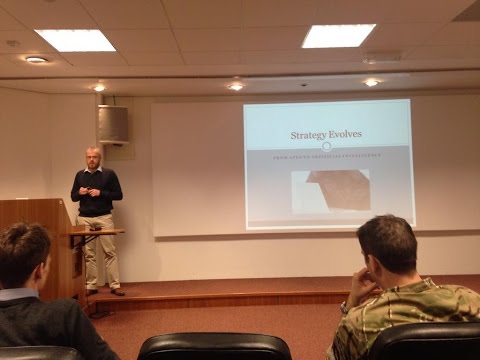
Strategy Evolves from apes to Artificial Intelligence
Changing Character of War · apple · 2016-12-05
Last researched .