The Kill Chain
Defending America in the Future of High-Tech Warfare
by Christian Brose2020Hachette
Christian Brose spent years as staff director of the Senate Armed Services Committee under John McCain, drafting defense legislation from inside the Pentagon’s oversight machinery. The Kill Chain, published in 2020, is his argument that the United States military is structurally unprepared for a war it is far closer to than its budgets suggest, and that the problem is not money but the shape of the force itself.
The book’s central claim is that warfare is decided by how quickly a side can close what Brose calls the kill chain — sensing a target, deciding to act, and striking — and that the American force is built around platforms that close it too slowly. Decades of investment have flowed into a small number of large, exquisite, manned systems: aircraft carriers, fifth-generation fighters, nuclear submarines. Each is a marvel, and each, Brose argues, is becoming a vulnerable node in a network that an opponent like China has spent twenty years learning to break. The alternative he describes is a distributed battle network of cheaper, more numerous, more autonomous machines, stitched together by software that lets sensors and shooters in any service find and finish a target in seconds.
Much of the book is reportage from inside that mismatch. Brose recounts wargames in which Chinese anti-access systems sink the carriers in the opening hours, traces how the F-35 and Ford-class programmes consumed the budget for the systems that might replace them, and walks through the acquisition rules that punish small companies for trying to sell to the Pentagon. He profiles the engineers building autonomous undersea vehicles, swarming drones, and AI targeting tools, and the contractors and officials who keep those programmes marginal. McCain appears throughout, pushing reforms against a service-led culture that prefers the next iteration of what it already operates. The book also turns toward China’s own modernisation — the doctrine, the shipyards, the willingness to skip a generation of platforms — and to the harder question of whether the American defence industrial base can still build at the scale a long war would demand.
Within the post-2018 wave of American defence writing, The Kill Chain sits closer to the operator-and-staffer end than to the academic one. It does not theorise about deterrence so much as describe, in concrete programme names and procurement timelines, why the force on the books may not be the one that fights. It is most useful for readers trying to understand why congressional defence debates so often turn on phrases like “legacy platform” and “joint all-domain”, and for anyone tracking how the American military is — or is not — adapting to a generation of cheaper, smarter, more numerous weapons.
Read the longer summary
Christian Brose spent most of his career inside the rooms where American defense policy is set rather than the labs and factories where weapons are built, and The Kill Chain reads like the long-form argument he had been making across those rooms for the better part of a decade. Brose worked as a senior staffer on the Senate Armed Services Committee for years under John McCain, and finally served as the committee’s staff director until McCain’s death in 2018. The book, published in 2020 by Hachette, distils what he watched from that perch — a Pentagon and Congress that he believes have collectively failed to grasp how warfare is changing, and a Chinese military that has spent the last quarter-century building the tools to exploit that failure. By the time the book appeared, Brose had already left the Hill and joined Anduril Industries, the defense-software start-up co-founded by Palmer Luckey, as chief strategy officer. The book serves both as diagnosis and as a kind of mission statement for the small but growing camp inside American defense that wants to tear up the existing playbook.
The central argument runs through every chapter. The United States, Brose writes, does not have a military problem so much as it has a kill chain problem. The kill chain is the cycle by which a military understands the battlefield, decides what to do, and acts — the loop that runs from sensor to shooter, whether the shooter is a sniper or a carrier battle group. For decades the American way of war has been to win this loop by fielding a smaller number of extraordinarily capable platforms — aircraft carriers, stealth fighters, nuclear submarines, armoured brigades — and tying them together with command structures designed around those platforms. Brose’s thesis is that the platforms have become the wrong organising idea. The future belongs to whoever can close the kill chain fastest, and closing it fastest requires distributing sensing, decision and effect across many cheaper machines, much of it autonomous, all of it tied together by software. China, he argues, has understood this from the opposite direction. Rather than try to match American carriers with Chinese carriers, the People’s Liberation Army built a network of satellites, over-the-horizon radars, anti-ship ballistic missiles, submarines and cyber tools whose only purpose is to break the American kill chain — to blind the sensors, jam the links, and kill the platforms before they can shoot. The book’s accusation is blunt: the United States has spent twenty years buying more of the things China has spent twenty years learning to destroy.
The book is built in three movements. The opening chapters are scene-setting, with Brose retracing his own education on the committee under McCain, his early travels to allied capitals, and the moment in classified war games during the second Obama term when he started watching American forces lose to a simulated China in the Western Pacific again and again. The middle chapters are the indictment — a tour through the failures of the post-Cold War acquisition system. Here Brose anatomises specific programmes: the F-35 Joint Strike Fighter, whose unit cost and schedule slip he treats less as scandal than as symptom; the Ford-class aircraft carrier, with its electromagnetic catapults and weapon elevators that did not work at delivery; the Zumwalt-class destroyer, three hulls of a planned thirty-two, whose 155-millimetre Advanced Gun System ended up without affordable ammunition; the Littoral Combat Ship, which Brose treats as a parable about a Navy that designed a hull before it had decided what it was for. He also writes at length about the Future Combat Systems programme, the Army’s failed bid in the early 2000s at a networked family of manned and unmanned vehicles — a programme cancelled in 2009 after roughly eighteen billion dollars, which Brose presents as both a warning and a missed opportunity, the right idea executed with the wrong tools. The final movement is prescriptive: the book sketches what a kill-chain-centric force would look like and what political and bureaucratic surgery would be needed to build it.
The examples that drive the book are mostly drawn from the Pacific and from the technical edges of the force. Brose returns repeatedly to China’s DF-21D and DF-26 anti-ship ballistic missiles — the so-called carrier killers — as the clearest expression of how an adversary designs around an American strength. He walks the reader through the consequences: if the threat range of those missiles pushes carriers further from the Chinese coast, then the carrier air wing, optimised for short-range strike, cannot reach its targets without tanking that the US fleet does not have in enough numbers. He works through similar geometries for runway-dependent air power in the first island chain, where bases such as Kadena on Okinawa and Andersen on Guam sit within range of large Chinese ballistic and cruise-missile inventories. He discusses the People’s Liberation Army Rocket Force, the 2015 reorganisation of the PLA into theatre commands, and the doctrinal writing on systems destruction warfare that has been published openly by Chinese military thinkers. Brose’s point is not that any one of these capabilities is unanswerable; it is that the cumulative effect is to make the American operational concept — surge forces forward, fight from a small number of large platforms and fixed bases — increasingly unaffordable in casualties as well as dollars.
Against that, he describes what he thinks the American response should look like, and here the book becomes a more recognisable manifesto for software-defined warfare. The recurring word is many. Many small unmanned aircraft instead of a few exquisite manned ones. Many cheap undersea vehicles rather than fewer expensive submarines. Many distributed sensors on small satellites and unattended ground systems rather than a few high-value collection platforms. The argument leans on autonomy not as an end in itself but as the only way to make many tractable: with enough machines in the loop, no human team can fly each one individually, so the loop has to be closed by software. Brose discusses the work of the Defense Advanced Research Projects Agency on autonomy and human-machine teaming, the Air Force’s Skyborg programme on loyal-wingman drones, and the Navy’s Sea Hunter, the long-endurance unmanned surface vessel built under the ACTUV programme. He gives sustained attention to the Pentagon’s brief experiment with Silicon Valley — the Defense Innovation Unit established in 2015 under Ash Carter, the Joint Artificial Intelligence Center created in 2018, the Project Maven controversy that saw Google withdraw from a computer-vision contract after employee protest in the same year. Each of these features both as evidence that the right ideas exist inside the building and as evidence of how marginal those ideas remain to the programmes that actually get the money.
The book’s politics, when they surface, are inseparable from McCain’s. Brose presents acquisition reform less as a technical question than as a question of will, and he takes pains to describe the reformers as a small, beleaguered minority across both parties. He writes warmly about figures such as Robert Work, the deputy secretary of defense under Obama and Trump and the principal author of the Third Offset Strategy that pushed AI and autonomy into the defense vocabulary in the mid-2010s. He writes less warmly about the institutional resistance of the services, the prime contractors, and the appropriations process — the closed loop, he argues, that selects for known platforms with known suppliers in known congressional districts. The book is openly hawkish on China but it is hawkish in a structural rather than rhetorical register: the threat, in Brose’s telling, is not that Beijing is uniquely malevolent but that it has been allowed twenty years to design a military with American weaknesses in mind, and that the United States no longer has the luxury of treating that as someone else’s problem to solve later.
Reception of the book inside the defense community was strong and mostly along expected lines. Reformers in Congress, in the think-tank world around the Center for Strategic and Budgetary Assessments and the Center for a New American Security, and in the small ecosystem of defense start-ups treated The Kill Chain as a consolidating statement of arguments many of them had been making in fragments. Andrew Krepinevich’s earlier writing on operational concepts and the offset strategies, Robert Work and Shawn Brimley’s papers on the Third Offset, and David Ochmanek’s wargame reporting at RAND all sit in the same intellectual neighbourhood; readers who came to Brose through those works found the connections explicit. The more critical responses came from two directions. Some traditionalists pushed back on the implication that legacy platforms are nearly obsolete, pointing out that aircraft carriers, fighters and submarines still do most of the operational work the United States actually performs around the world, and that survivability against a peer adversary in a particular Pacific scenario is not the only test of a platform. Others worried that the book underweights the political and humanitarian costs of moving towards autonomy at scale — the question of meaningful human control over lethal decisions, which by 2020 was already the subject of an active debate at the United Nations Group of Governmental Experts on lethal autonomous weapons systems. Brose addresses the autonomy ethics question, but briefly; readers who want a fuller treatment generally turn to Paul Scharre’s Army of None or to the academic literature.
Since publication the policy conversation has moved in the direction Brose argued for, though unevenly. The Department of Defense’s 2022 National Defense Strategy treats China as the pacing challenge in explicit terms. The Replicator initiative announced by Deputy Secretary Kathleen Hicks in 2023, aiming to field thousands of attritable autonomous systems within roughly two years, reads like a direct operationalisation of the many-over-few thesis. The Air Force’s Collaborative Combat Aircraft programme, the Navy’s expansion of unmanned surface and undersea efforts, and the rapid rise of defense-software companies — Anduril among them, with its Lattice command-and-control platform, but also Shield AI, Saronic, and a number of others — all sit downstream of the argument the book made in 2020. At the same time, the F-35 continues to be bought, the carrier programme continues, the Columbia-class ballistic-missile submarine remains the Navy’s top priority, and the structural critiques Brose levelled at the acquisition system have not been resolved. The book’s diagnosis has been broadly accepted; its prescription is still being negotiated programme by programme.
For a reader assembling a shelf on the future of AI and warfare, The Kill Chain sits in a specific slot. It is not a technical primer on artificial intelligence in weapons systems; Scharre’s books do that work more carefully, as does the academic literature on autonomy and targeting. It is not a deep history of the post-Cold War American military; for that the standard references remain Krepinevich, Mahnken and the war studies literature out of Yale, Johns Hopkins SAIS, and the Naval War College. It is not a China book in the narrow sense; for the inside view of the PLA modernisation, readers usually pair it with the work of M. Taylor Fravel and the RAND China studies. What The Kill Chain offers instead is the connective tissue: a Washington insider’s account of why the system that buys American military power is mis-tuned for the contest that has already begun, written with enough operational specificity to be argued about rather than waved away.
What is likely to age well in the book is the framing. The shift in vocabulary from platforms to kill chains, from inventories to networks, from exquisite to attritable, has by now propagated through American doctrine and through allied defense ministries in Europe and the Indo-Pacific. The case studies of individual programmes will date — some of the indictments will be overtaken by mid-life upgrades, some by cancellations, some by results that look better in 2030 than they did in 2020 — and the specific numbers will be superseded by the next budget cycle. The political argument, that a great power which designs its military around legacy assumptions tends to lose the first round of the next war and only sometimes gets a second round, is harder to date. That is the argument Brose came out of McCain’s office determined to keep making, and it is the one the rest of the field is still working through.
Publisher's description
- Political Science
Watch & listen


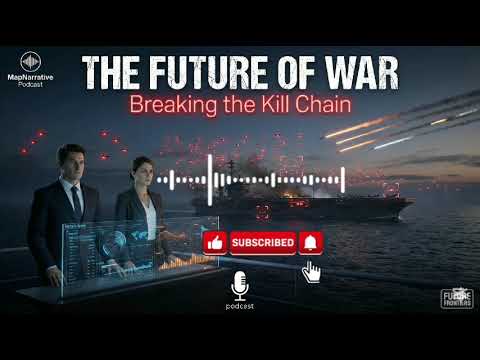

Podcasts
Reimagining The Kill Chain with Christian Brose
Village Global's Solarpunk · apple · 2022-10-06
Reimagining The Kill Chain with Christian Brose
Village Global Podcast · apple · 2022-10-06
(Knowledge Wins) The Kill Chain | Defending America
Pineland Underground · apple · 2021-06-18
The Kill Chain | Christian Brose
State of the World · apple · 2021-03-29
The Kill Chain: Defending America in the Future of High-Tech Warfare | Chris Brose
Hidden Forces · apple · 2020-10-19
Last researched .