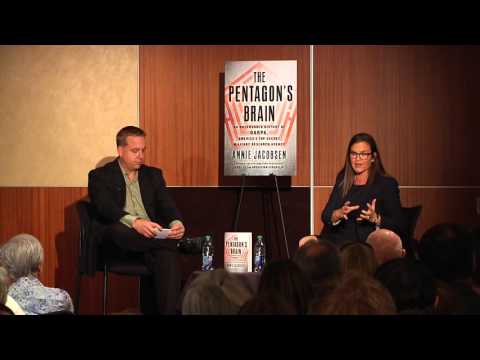
The Pentagon's Brain
An Uncensored History of DARPA, America's Top-Secret Military Research Agency
by Annie Jacobsen2015Little, Brown
Annie Jacobsen, an investigative journalist whose reporting has long focused on the classified end of American national security, turns in The Pentagon’s Brain to the Defense Advanced Research Projects Agency — the small Pentagon office that has shaped more of modern warfare than any other. The book is a narrative history of DARPA from its founding in 1958, through the Cold War, Vietnam, the Gulf, the post-9/11 wars, and into the early years of autonomous machines.
Jacobsen’s argument is that DARPA is the engine room of American military power, and that its work has reached a turning point. For most of its existence the agency produced enabling technologies — stealth, precision guidance, GPS, the ARPANET — that armed humans more lethally. In the chapters covering the last fifteen years of her timeline, she contends, the projects have begun to push past the human operator entirely, toward systems that sense, decide, and act with diminishing supervision. She traces that drift without polemic, but does not look away from it either.
The book opens with the nuclear-weapons science that produced the agency: Operation Argus, the high-altitude tests, and the JASON scientific advisory group that fed DARPA its early ideas. From there it moves through Project AGILE and the counterinsurgency experiments in Vietnam, the Assault Breaker programme that gave NATO an answer to Soviet armour, the Strategic Computing Initiative of the 1980s, and the unmanned aerial vehicles — Predator, Global Hawk, the lineage running back to Amber and GNAT — that would define the wars after 2001. Jacobsen devotes substantial space to programmes most readers will not have heard named: LifeLog, Total Information Awareness, the Human Identification at a Distance work, the brain-machine interface research under Tony Tether, and the robotics push from the DARPA Grand Challenges through to the humanoid trials at Fukushima. She profiles directors including Jack Ruina, George Heilmeier, Tether and Regina Dugan, and the scientists — Charles Townes, Richard Garwin, Stephen Lukasik, John Foster — whose decisions still shape what the Pentagon buys.
Where the book sits in the field is fairly clear. It is longer and more archival than the trade histories of military technology that preceded it, drawing on declassified files and on more than a hundred interviews with former DARPA personnel. Readers looking for a technical treatment of any single programme will find deeper accounts elsewhere; readers who want one continuous thread from the hydrogen bomb to the autonomous robot, written for a general audience and structured around the people who made the choices, will find that thread here. It is most useful as an orientation to how the United States actually generates new military capability, and to the institutional pressures now pushing that capability toward machines that fight on their own.
Read the longer summary
Annie Jacobsen published The Pentagon’s Brain in 2015, after a string of investigative books that worked the seam between American national security and the institutions the public rarely sees clearly. Area 51 had taken her into the world of black-budget aviation; Operation Paperclip into the postwar absorption of Nazi scientists into American defence research. The Pentagon’s Brain extends that arc to the Defense Advanced Research Projects Agency, the small Pentagon office that has shaped, more than any other single institution, what American military technology has looked like for the last six decades. Jacobsen approaches DARPA not as a corporate biographer but as a journalist working a beat. She interviewed dozens of former directors, programme managers, and scientists, pulled tens of thousands of pages of declassified documents, and reconstructed a chronological history of the agency from its founding in 1958 to the autonomous-systems and neuroscience programmes underway as she was writing.
The argument that organises the book is simple and unembarrassed. DARPA, in Jacobsen’s telling, is the engine room of American military power. The agency was created in the panicked weeks after Sputnik, when Eisenhower wanted a civilian-controlled research body that could place high-risk bets on technologies the individual services were too parochial or too conservative to fund. Out of that mandate, over the following half century, came the geostationary satellite, ARPANET and the protocols that became the internet, stealth aircraft, the Global Positioning System, precision-guided munitions, unmanned aerial vehicles, and the seed work for nearly every robotic and autonomous weapon now in the field. Jacobsen wants the reader to walk away from the book understanding that the strangest, most disruptive American weapons did not arise from the services or from industry on their own — they were commissioned, often against fierce internal resistance, by a few hundred people in a building in Arlington. She also wants the reader to grasp that the same agency has, throughout its history, conducted lines of research that were morally and politically catastrophic, and that it shows no inclination to slow down.
The book moves chronologically through the eras of the agency, each one organised around a director, a war, and a defining technological obsession. The opening chapters cover the Eisenhower–Kennedy founding period and the figure of Herbert York, the agency’s first chief scientist, who steered ARPA away from purely space-related work after NASA took over that portfolio. Jacobsen then follows the agency into the Vietnam years, where ARPA ran some of its most controversial efforts: Project AGILE, which sent social scientists and weaponeers into Southeast Asia to study counter-insurgency; the herbicide programmes that culminated in Agent Orange; and a long, brutal sequence of behaviour-and-population studies that read very differently in 2015 than they did in 1965. From there the book moves into the late Cold War, with the stealth and precision-strike work that produced the F-117 and the doctrines of the second offset strategy under Defense Secretary Harold Brown and Under Secretary William Perry. A long middle section deals with the post-9/11 reorientation of the agency: counter-IED work, the early Predator and Reaper drone lineages, the DARPA Grand Challenge that catalysed self-driving cars, and the surveillance and data-fusion programmes that grew up around Total Information Awareness. The final chapters turn forward, into brain–machine interfaces, autonomous robotic systems, swarm research, and the agency’s growing footprint inside human biology.
What makes the book substantive rather than merely encyclopaedic is the density of cases. Jacobsen reconstructs Project Vela, the nuclear-test-detection programme that gave the United States the seismic and satellite tools to verify the Limited Test Ban Treaty of 1963, and shows how Vela’s bhangmeter instruments later detected a flash off South Africa in 1979 that the American intelligence community has never fully explained. She walks the reader through the herbicide programme in Vietnam, the chemists who reformulated the agents, the dollar figures of the contracts, and the internal memoranda in which the agency’s own scientists raised concerns that were overruled. She tells the story of ARPANET in unusual detail, beginning not with the famous 1969 connection between UCLA and SRI but with the management decisions of Bob Taylor and Larry Roberts at IPTO, and she names the small group of graduate students who actually wrote the host-to-host protocol and the Interface Message Processor code. The stealth chapters reconstruct the Have Blue prototype and the political fight inside the Pentagon over whether to fund a fighter that no one outside a few dozen people was allowed to know existed. Throughout, Jacobsen names programme managers most readers will never have heard of and lingers on the bureaucratic rooms where decisions were made.
The post-9/11 sections are the most journalistically alive, because Jacobsen had access to people who were still in or freshly out of the building. She covers Tony Tether’s long directorship, which ran from 2001 to 2009 and overlapped with the wars in Afghanistan and Iraq; she traces how counter-IED work, originally a JIEDDO problem, drew on DARPA pattern-recognition and signals research that had been quietly maturing for years. The Grand Challenge of 2004 and 2005 — the cross-desert autonomous-vehicle race that ended its first year with no car finishing more than seven miles, and its second year with five cars completing the course — gets a long, character-driven treatment, because Jacobsen sees it as a hinge moment in the agency’s modern history. The race was a deliberate exercise in seeding the American university and start-up landscape with autonomous-driving talent, and the cohort that came out of it populated Waymo, Cruise, and most of the autonomous-truck and autonomous-weapons companies of the next decade. Jacobsen also reconstructs the brief, embarrassed life of Total Information Awareness under John Poindexter, the only DARPA programme in the modern era to be killed outright by Congress, and notes that the technical work it sponsored migrated into the NSA and into successor programmes with quieter names.
The closing chapters lean hardest into the future the book is most worried about. Jacobsen devotes substantial space to the agency’s neuroscience portfolio: the BRAIN Initiative that the Obama administration announced in 2013, in which DARPA was the lead military partner; the SUBNETS programme, which embedded electrodes into the brains of veterans with treatment-resistant depression and post-traumatic stress; and the work on cortical modems and brain-controlled prosthetics that ran out of the Biological Technologies Office under Geoff Ling and later Justin Sanchez. She lays out the autonomy programmes in similarly granular detail: the X-47B unmanned combat air vehicle that carrier-landed in 2013, the LS3 quadruped pack mule built by Boston Dynamics, the early CODE and OFFSET work on cooperative drone swarms, and the recurring conversation about how much decision authority an armed autonomous platform should hold. Jacobsen reports rather than prescribes, but the cumulative effect of these chapters is a clear question: the agency that produced the stealth fighter and the internet has now decided that the next leap is into autonomous lethality and into the brain itself, and there is no political body genuinely in a position to slow it down.
Reception of the book in 2015 split along familiar lines. Defence-policy reviewers praised the reporting and the access — Jacobsen had clearly sat in rooms most journalists never reach — and quibbled with her characterisations of internal scientific debates. Reviewers from the technology press, particularly those who had covered ARPANET history, pushed back on some of the internet-origin passages, arguing that she leaned too hard on the military-funding line and underweighted the civilian-academic culture that shaped the protocols. Historians of science noted that several of the Vietnam-era episodes she reconstructs had been described more fully in earlier monographs, and that she was synthesising rather than breaking new archival ground in those sections. Civil-liberties writers, by contrast, treated the book as confirmation of long-running suspicions about the surveillance lineage of TIA. Inside the defence community, the book was read attentively but quietly; several former DARPA directors and programme managers gave it measured public endorsements, while others objected to what they read as a deterministic line from agency research to battlefield outcome.
The conversation since publication has gone in directions that make parts of the book look prescient and parts look incomplete. The autonomous-weapons debate that Jacobsen sketched in her final chapters has hardened into a full international policy fight, with the United Nations Group of Governmental Experts on lethal autonomous weapons systems meeting annually in Geneva and the United States position drifting toward principled rejection of a binding ban. The drone war in Ukraine after 2022 made the swarm and counter-swarm research she described — much of it then unclassified only in vague outlines — suddenly visible in news footage. The Replicator initiative announced by the Pentagon in 2023, aiming to field thousands of attritable autonomous systems within two years, drew explicitly on DARPA programmes she had named. On the neuroscience side, the SUBNETS line of research produced its first published results in clinical journals after the book appeared, and BrainGate and Neuralink moved brain–machine interfaces into the public conversation in a way that 2015 readers would not have predicted. The book does not anticipate the rise of generative AI, the CHIPS Act, or the resurgence of great-power competition with China as the organising frame for American defence research; a reader picking it up today has to supply that context themselves.
For a reader working through the literature on AI in war, The Pentagon’s Brain pairs naturally with Paul Scharre’s Army of None, which is the policy-and-ethics companion volume on autonomous weapons specifically, and with P. W. Singer’s Wired for War, which provides the broader cultural framing of military robotics. Where Scharre is a former Pentagon official writing about doctrine and Singer is an analyst writing about systems, Jacobsen is a reporter writing about institutions and people. The book is most valuable for a reader who wants to understand why American military technology looks the way it does — why drones and not airships, why GPS and not LORAN, why stealth and not speed — and who is willing to spend several hundred pages inside the bureaucratic history that produced those choices. It is least useful for a reader who wants a tight conceptual treatment of the ethical questions; Jacobsen lays out the questions but does not pretend to answer them.
What is likely to age well is the institutional portrait. The agency that Jacobsen describes — small, programme-manager driven, willing to bet on lines of research the services would never fund, mostly invisible to the public — is recognisably the agency that exists today, and the directors and programme managers she interviewed will remain the on-the-record voices for this period of its history. What is already dated is the specific technological frontier she chose to close on. The autonomy programmes she names have shipped or been superseded, the neuroscience work has matured into clinical trials, and the political environment around military AI has shifted from a niche concern to a central one. A serious reader will treat the last chapters as a 2015 snapshot rather than a forecast and will reach for more recent reporting to bring the picture up to date. The book’s claim on the shelf rests on the long middle: a careful, well-sourced account of how the United States built the technological core of its current military, and of the office in Arlington where most of those decisions were made.
Publisher's description
Publisher data is pending — Google Books quota deferred until 2026-10-17T02:30:11.165593+00:00.
Watch & listen



Podcasts

1Q1A - Avid Reader with Annie Jacobsen The Pentagon's Brain
The Avid Reader Show · apple · 2015-11-01
Annie Jacobsen author of The Pentagon's Brain
The Avid Reader Show · apple · 2015-09-24
Last researched .