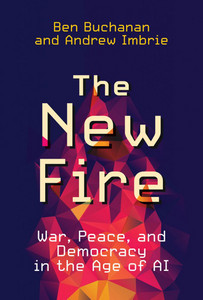
The New Fire
War, Peace, and Democracy in the Age of AI
by Ben Buchanan, and Andrew Imbrie2022MIT Press
Ben Buchanan and Andrew Imbrie are scholars who have spent years inside the machinery of US technology and national security policy — Buchanan at Georgetown’s Center for Security and Emerging Technology and later in the White House on AI, Imbrie at CSET working on the same questions from the diplomatic side. The New Fire is their attempt to lay out, for a general reader, what artificial intelligence is doing to the contest between democracies and their rivals, and how the people running governments can think about it without either panicking or looking away.
The book’s central framing is that AI behaves less like a single weapon and more like fire: a general-purpose capability that reshapes every domain it touches, from intelligence analysis to disinformation to autonomous systems. Buchanan and Imbrie argue that the technology is being shaped by three forces — data, algorithms, and compute — and that whichever powers control those inputs will set the terms of the next era. They take the contest between the United States and China as the organising story, and they treat the diffusion of these tools to authoritarian states and non-state actors as the harder, longer problem.
Across the chapters the authors move through concrete cases. They examine the Chinese surveillance state’s use of facial recognition in Xinjiang, the Russian information operations of 2016 and after, the role of AI in detecting cyber intrusions, the prospect of autonomous weapons on the battlefield, and the diplomatic scaffolding — export controls on advanced chips, alliances among democracies, semiconductor manufacturing concentrated in Taiwan and South Korea — that determines who actually builds the frontier systems. They describe figures like Kai-Fu Lee and the Chinese national plans of 2017, draw on the US Department of Defense’s Joint Artificial Intelligence Center, and weigh the Pentagon’s slow procurement culture against Silicon Valley’s speed. The book devotes serious attention to the risks of accidents, the brittleness of machine-learning systems under adversarial pressure, and the difficulty of governing dual-use research.
Where The New Fire sits in the field is at the bridge between two literatures that usually do not talk to each other. Books by technologists tend to treat policy as background noise; books by strategists often treat the technology as a black box. Buchanan and Imbrie are unusual in being fluent in both, and the book is most useful for readers in government, defence industry, or journalism who need a single volume that maps the technology, the geopolitics, and the institutional choices onto one another. It is not a forecast and it is not a manifesto. It is a careful, sourced briefing on the terrain a generation of officials is about to inherit, written by two of the people who have already been walking it.
Read the longer summary
Ben Buchanan and Andrew Imbrie published The New Fire: War, Peace, and Democracy in the Age of AI with MIT Press in 2022, at a moment when the policy conversation about artificial intelligence had moved decisively out of the labs and into chancelleries. Buchanan, then a professor at Georgetown’s School of Foreign Service and a director of studies at the university’s Center for Security and Emerging Technology, would soon take a position in the Biden White House as Special Advisor for Artificial Intelligence. Imbrie, also at Georgetown’s CSET, had served at the State Department and worked closely with the National Security Commission on Artificial Intelligence, the Eric Schmidt and Robert Work–led commission whose 756-page final report in 2021 had become the de facto American playbook on AI and national security. The two authors wrote The New Fire as a companion volume to that policy ferment — accessible enough for an interested civilian, granular enough to credit those who already worked in the field.
The title borrows from a line attributed to Sundar Pichai: artificial intelligence, the Google chief executive said in 2018, was “one of the most important things humanity is working on … more profound than electricity or fire.” Buchanan and Imbrie take the comparison seriously without taking it solemnly. Fire warms and cooks; it also burns. The book’s project is to describe what AI is good for, what it is dangerous for, who is racing to develop it, and what democratic governments can do to make sure they end up on the right side of its consequences.
The argument runs along two axes. The first is technological: the authors insist that AI is not magic and not a single thing, and that understanding the difference between narrow systems trained on specific tasks and the broader trajectory of machine learning is essential to thinking clearly about policy. The second is geopolitical: the contest in AI is largely a contest between the United States and the People’s Republic of China, played out across chip fabrication, talent flows, datasets, military applications, and information operations, and the outcome will shape whether the twenty-first century’s defining technology serves open societies or closed ones. The authors are clear that they write from inside the American policy tradition, but they push hard against the framing of an inevitable arms race; they argue instead for a posture of resilient competition combined with selective cooperation, particularly on safety and standards.
The book opens with what Buchanan and Imbrie call the three sparks of modern AI: data, algorithms, and computing power. Data is the lifeblood — vast labelled datasets like ImageNet that made deep learning possible after 2012, and the proprietary data hoards of large platforms that confer durable advantages. Algorithms refers to the architectures and training methods, from convolutional neural networks to transformers, that have driven the field’s surprising leaps. Computing power, the third spark, increasingly means access to specialised chips — graphics processing units from Nvidia, the tensor processing units Google builds internally, the lithography machines that ASML in the Netherlands sells to TSMC in Taiwan. The chapter on compute is where the book quietly lays down the foundation for the export-control story that would dominate the next two years of policy, even though the most dramatic US controls on chip equipment to China came after the book’s publication.
From the sparks, the authors move into three domains, which give the subtitle its three nouns. The section on war examines what AI does to combat and to the institutions that prepare for it. They walk through autonomous weapons in detail without retreating into either the techno-utopian or the killer-robot register. AlphaDogfight, DARPA’s 2020 trial in which an AI agent defeated an experienced F-16 pilot in simulated dogfights, is treated as a useful demonstration rather than a turning point. Project Maven, the Pentagon’s effort to use machine learning to interpret drone footage and the cause of an internal revolt at Google in 2018, becomes the test case for the relationship between Silicon Valley and the defence establishment — a relationship the authors view as essential and as more fragile than American policymakers tend to assume. They cover the Joint Artificial Intelligence Center, since folded into the Chief Digital and Artificial Intelligence Office, and the Pentagon’s 2020 publication of five ethical principles for AI use, drafted by the Defense Innovation Board under former Google chief executive Eric Schmidt. They note the same fragility on the Chinese side: the People’s Liberation Army’s stated doctrine of “intelligentized warfare” depends on a fusion between civilian technology firms and the military, but that fusion is harder to execute than to declare.
The peace section, despite its title, is the darker half of the book. Here the authors turn to information warfare — the use of machine learning to manipulate what populations believe, fear, and vote for. They reconstruct the 2016 Russian operation centred on the Internet Research Agency in St. Petersburg, not because it is unfamiliar but because it allows them to draw a clear distinction between human-driven trolling, which is what most of 2016 actually was, and what a fully AI-enabled operation could look like. They walk through deepfakes — including the early Buzzfeed–Jordan Peele Obama video and the more polished synthetic media that has appeared since — and the asymmetric advantage offenders enjoy when defenders have to debunk every fake while attackers only need one to land. GPT-3, then the largest publicly known language model, gets close attention. The authors describe its capacity to write op-ed-length text that human readers struggle to distinguish from a human’s, and they recount the experiments that OpenAI and outside researchers conducted to understand its persuasive power. They are careful not to claim that machine-written propaganda has yet swung an election, but they make the case that the trajectory points clearly in that direction and that democratic societies have done very little to prepare.
The democracy section closes the central argument. It is where the book makes its strongest claim that AI is not merely a weapons technology or a propaganda technology but a regime technology — a tool that can entrench whichever kind of government wields it. The authors describe China’s surveillance complex in Xinjiang in detail, including the predictive policing platform known as the Integrated Joint Operations Platform, the data flows that pull from cameras, identity checks, household registrations, and biometrics, and the role of companies like Hikvision, Dahua, SenseTime, and Megvii in supplying the underlying systems. They cover the export of these surveillance capabilities to Ecuador, to Zimbabwe, to dozens of cities under the loose umbrella of the Belt and Road Initiative’s digital component, sometimes called the Digital Silk Road. The authors do not argue that democracy is doomed; they argue that an autocratic AI stack is now a turnkey product on the global market, and that liberal states need to make their own alternative both attractive and available. They look at Estonia’s e-government, at the GDPR-shaped European approach to data protection, and at the patchwork of state-level rules in the United States, and they are frank about how far behind the writing-of-rules has lagged the building-of-systems.
The case material running through the book is dense and specific. Readers learn about Cambridge Analytica and the limits of what that operation actually did versus what it claimed to do. They get the story of AlphaFold, DeepMind’s protein-folding system, and what its 2020 result at the CASP competition meant for biology. They are walked through the 2017 AlphaGo Zero result and the deeper architectural lesson — that the system learned by self-play from no human data — that the authors think matters more than the spectacle of beating Lee Sedol the year before. They get the dual-use anxieties around the COVID-era use of contact-tracing apps and around clinical decision support in hospitals. They get a careful chapter on bias, in which the authors revisit the ProPublica COMPAS investigation, the Gender Shades work of Joy Buolamwini and Timnit Gebru on facial-recognition error rates, and the broader question of who counts as a stakeholder when a model’s training set under-represents them. Throughout, the authors treat individual researchers and engineers — Geoffrey Hinton, Yoshua Bengio, Yann LeCun, Fei-Fei Li, Demis Hassabis, Andrew Ng — as actors with histories and not as priests of a discipline.
The institutional cast list is similarly concrete. Buchanan and Imbrie cover OpenAI’s transition from a non-profit to a capped-profit company in 2019 and Microsoft’s billion-dollar investment that year. They cover the founding of Anthropic by Dario and Daniela Amodei and other former OpenAI researchers, although that company is younger in the book than it now feels. DeepMind, acquired by Google in 2014, is given its own thread, as are Baidu, Alibaba, Tencent, and the harder-to-pin-down government-aligned Chinese laboratories such as the Beijing Academy of Artificial Intelligence. On the policy side they describe CSET, the Center for a New American Security, the Centre for the Governance of AI at Oxford, and the bilateral track-two dialogues between American and Chinese researchers on safety that have continued, fitfully, despite the broader chill.
Where the book lands on policy is recognisably the moderate-hawk position that has come to define the bipartisan centre of American thinking on technology and China. The authors support export controls on the most sensitive equipment, they support sustained federal investment in AI research and in semiconductor manufacturing — the CHIPS and Science Act passed the same year the book appeared — and they support open immigration policies for AI talent, on the argument that the United States has historically out-competed rivals by importing their best people. They support clear ethical principles for military AI and they support arms-control conversations even with adversaries, while being clear-eyed about how limited those conversations can be in the absence of trust. They argue for tighter content rules around synthetic media and for stronger public investment in media literacy, while noting the First Amendment constraints American policymakers face that European counterparts do not. They are sceptical of a sweeping AI treaty and warm to a thicker mesh of standards bodies, audits, and bilateral arrangements.
Since publication the book has settled into the role of a primer that policy aides and graduate students hand to people who need to be brought quickly up to the conversation. It has been criticised, fairly, for predating the November 2022 release of ChatGPT and the surge of generative AI products that followed; the chapter on language models reads as accurate but pre-cataclysmic. It has also been criticised, less fairly, for the American vantage from which it is written, although the authors are explicit about that vantage. Other writers working the same terrain — Paul Scharre in Four Battlegrounds, Kai-Fu Lee in AI Superpowers, Mustafa Suleyman in The Coming Wave — have argued variously that the book understates the speed of capability gains, overstates the controllability of compute, or pays too little attention to biosecurity. The Buchanan-and-Imbrie answer, present in the book and amplified in interviews, has been that policy needs to be built for a trajectory rather than for a particular forecast, and that humility about timing is itself a virtue.
For a reader assembling a shelf on AI and warfare, The New Fire pairs naturally with Scharre’s Army of None and Four Battlegrounds, with Christopher Coker’s Why War, with the National Security Commission on AI’s final report, and with the more technical primers — Stuart Russell’s Human Compatible, Melanie Mitchell’s Artificial Intelligence: A Guide for Thinking Humans — for readers who want the underlying material. It does not try to be a textbook on machine learning, and a reader who wants to understand how a transformer actually works will need to look elsewhere. It does not deeply engage with biosecurity or with the long-term safety literature in the way that Toby Ord’s The Precipice or Brian Christian’s The Alignment Problem do. Its centre of gravity is the next ten years, viewed from inside a democratic government that has to make decisions now.
What is likely to age well in the book is the framing. The three sparks remain a clean way of pulling apart what is otherwise an undifferentiated cloud of AI hype. The treatment of compute as the policy lever has, if anything, been validated by the export controls that the United States imposed on advanced chips and lithography equipment in October 2022 and tightened twice since. The democratic-versus-authoritarian framing of the technology contest has weathered the change of US administration and has, at least at the rhetorical level, become bipartisan. What has already dated, inevitably, is the specific snapshot of capabilities. The language-model chapter is the most obvious example; the autonomous-weapons chapter is the second, given the way uncrewed systems have reshaped the war in Ukraine since the book went to print. Even so, a reader picking up The New Fire today will find that the questions it asks, and the way it asks them, are still the questions in the room.
Publisher's description
- Political Science
Watch & listen

Podcasts
Last researched .