Wired for War
The Robotics Revolution and Conflict in the 21st Century
by P. W. Singer2009Penguin Books
P. W. Singer wrote Wired for War while at the Brookings Institution, where he had already built a reputation for studying the parts of modern conflict that academic strategists tended to skip: private military contractors, child soldiers, and now machines. Published in 2009, the book set out to map a shift that was happening faster than policy or law could absorb — the arrival of robotics on the battlefield as a routine, not exceptional, presence.
The central argument is that the introduction of unmanned systems is not a marginal upgrade to existing forces but a change on the scale of gunpowder or the aircraft. Singer treats Moore’s Law as a strategic variable, tracing how doubling cycles in computing collide with military procurement cycles measured in decades. He argues that the consequences run well past the technical: who fights, where they fight from, what counts as courage, and which laws apply are all unsettled by a soldier who pilots a Predator over Waziristan from a trailer in Nevada and then drives home for dinner.
Much of the book is reporting. Singer rides along with operators of the PackBot and the TALON, the small ground robots made by iRobot and Foster-Miller that defused roadside bombs in Iraq, and he listens to soldiers grieve the loss of a machine as they would a dog. He walks through the Predator and Reaper programmes, the Army’s Future Combat Systems, Israeli ground sentries like Guardium, and the early South Korean border robots. He interviews defence futurists including John Pike, engineers at iRobot and General Atomics, science-fiction writers whose work shaped a generation of programme managers, and insurgents whose improvised countermeasures show how quickly the asymmetric side adapts. A long stretch of the book examines ethics and law — Isaac Asimov’s three laws as a starting point that immediately fails on contact with combat, the laws of armed conflict applied to autonomous targeting, the “PlayStation mentality” of operators raised on first-person shooters, and the political economics of casualty-free war for the side that owns the robots.
In the field, Wired for War sits as the first popular, reportorial account of military robotics aimed at a general audience, the book that pulled the subject out of trade journals and Pentagon briefings. Later writers — Brose, Scharre, Suchman — work in terrain Singer charted, and several of them say so. It is most useful now as a baseline for how the conversation began, before armed drones became routine, before autonomy in targeting was a live policy question, and before Ukraine demonstrated at scale what unmanned systems do to a conventional army. Readers coming to the subject for the first time still tend to start here.
Read the longer summary
By 2009, when P.W. Singer published Wired for War: The Robotics Revolution and Conflict in the 21st Century, the United States was nearly seven years into the wars in Iraq and Afghanistan, and the Pentagon’s inventory of unmanned systems had grown from a handful of Predators flying over the Balkans to thousands of ground and aerial machines deployed across two theatres. Singer was a senior fellow at the Brookings Institution and had already written two books that found him the corners of conflict the defense press tended to miss — Corporate Warriors, on the privatised military industry, and Children at War, on child soldiers. Wired for War continued that pattern of stepping back from a familiar conflict and asking what the next set of awkward questions would be. The book sits at the intersection of military reporting, science writing, and political analysis, and it is written for a general audience that does not necessarily know the difference between a Predator and a Reaper.
The argument is that robotics will change warfare on a scale comparable to the invention of gunpowder or the airplane, and that the United States and its rivals are conducting that transformation in plain sight without the public conversation the change deserves. Singer is not predicting Terminators; he is reporting on systems already deployed and on the procurement pipelines that will determine what is fielded in the decade after the book. His broader claim is that taking the human off the battlefield, even partly, alters several things at once: who can fight, when politicians choose to fight, how soldiers experience killing, how adversaries respond, and how the laws of armed conflict apply when the trigger is pulled by software. He returns repeatedly to a question that becomes the book’s spine — if war can be waged without putting one’s own citizens at risk, what happens to the political restraints that have historically slowed countries’ march toward it?
Structurally, the book unfolds in two long parts. The first half is largely descriptive: a tour through the machines, the labs, and the units that use them. Singer reports from iRobot’s headquarters in Burlington, Massachusetts, from Foster-Miller’s TALON production floor, from Creech Air Force Base in Nevada where Predator pilots fly missions over Iraq and then drive home to dinner, and from the labs at the Space and Naval Warfare Systems Center where Bart Everett has spent decades trying to talk Navy brass into taking ground robots seriously. The second half is more speculative and discursive: chapters on the ethics of killing by remote, on the legal status of autonomous weapons, on what asymmetric adversaries will do with cheap commercial drones, and on the cultural conversation, including extended interviews with science-fiction writers and futurists who have shaped how military planners imagine the next war.
Most of what gives the book its texture is in the second category — the reporting. Ground robots receive the most attention because they were the first wave. PackBot, made by iRobot, the same company whose Roomba vacuum cleaner was at that point the only consumer robot most Americans had touched, was being thrown over walls in Sadr City to look for insurgents and lowered into culverts to inspect roadside bombs. Foster-Miller’s TALON, originally a bomb-disposal platform, was being adapted into the armed SWORDS variant, which carried an M249 machine gun and arrived in Iraq in 2007 to muted reception. Singer reports the SWORDS deployment as an episode in institutional caution rather than triumph — the systems went to theatre, were not actually used to fire on enemy forces, and were quietly withdrawn. He uses the episode to make a point that runs through the book: the technology is moving faster than the doctrine, and the soldiers and commanders responsible for using it are improvising at the edges.
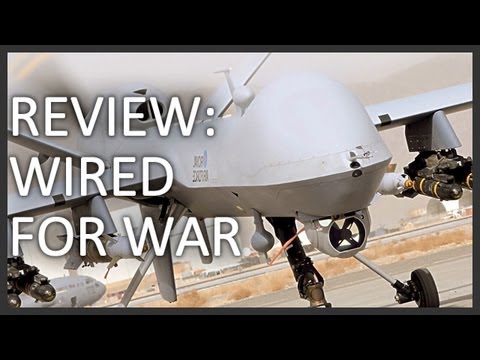
Aerial systems carry the most cultural weight. Predator and Reaper drones, flown by pilots sitting in trailers at Creech outside Las Vegas, do most of the work of the targeted-killing campaign that the Bush and then Obama administrations ran in Pakistan’s tribal areas. Singer interviews pilots who describe a strange double life: a workday spent watching a family in Waziristan through an infrared camera, occasionally releasing a Hellfire missile, then a commute home through Nevada traffic. He coins, or at least popularises, the term “cubicle warriors” and treats the psychological dimension seriously without sensationalising it — some pilots report symptoms of post-traumatic stress that look very much like those of soldiers who deployed conventionally; others describe the work as nothing more than a job. He also reports the rise of Global Hawk, the high-altitude reconnaissance drone, and the early development of the X-45 and X-47, the combat-drone prototypes that anticipated the carrier-launched programmes that would follow.
Beyond the deployed systems, Singer spends time on the laboratory frontier. Big Dog, the four-legged pack robot then under development at Boston Dynamics on a DARPA contract, is described as a prototype that staggers across rocky terrain with a disconcertingly animal-like gait. MARCBOT, a small wheeled robot improvised by soldiers in Iraq to scout suspicious objects, becomes a parable of bottom-up innovation; troops occasionally tape Claymore mines to it and use it as a single-use offensive weapon, a use case its inventors never imagined. He profiles roboticists at MIT, Carnegie Mellon, and Georgia Tech, and travels to DARPA’s Grand Challenge, the autonomous-vehicle competition that helped seed what would later become the self-driving-car industry. Some of the most evocative passages are the human ones — soldiers who name their PackBots, hold informal funerals for ones destroyed in the field, and request that “Scooby-Doo” be repaired and returned rather than replaced. Singer treats these stories as ethnography, not as colour, and they end up reinforcing his structural argument: the line between tool and teammate is already blurring.
For context, the book reaches out widely. Singer interviews Ray Kurzweil on the technological-singularity thesis, Bill Joy on the dangers of self-replicating systems, and a range of science-fiction novelists — among them Vernor Vinge and Orson Scott Card — on the way fiction has shaped how generals and engineers imagine future combat. The treatment is reportorial rather than credulous; Singer notes how often Pentagon planners cite Ender’s Game or Starship Troopers in conversation. He also looks back, sketching the longer history of automated weaponry: the V-1 cruise missile, the AEGIS combat system on US Navy cruisers and its 1988 shoot-down of Iran Air 655, the Phalanx and Patriot point-defence systems that had already been operating in semi-autonomous modes for decades. The point is that “autonomous weapons” did not arrive in 2009; they had been creeping into service since the Cold War, and the public conversation had simply not noticed.
On ethics and law, Singer is careful not to pose as a philosopher but lays out the dilemmas as they reach the doctrinal level. He covers the debate that Ronald Arkin at Georgia Tech was then initiating — Arkin’s proposal that battlefield robots, properly programmed, might actually outperform humans on the laws of armed conflict by not panicking, not seeking revenge, and not committing the small atrocities that exhausted soldiers occasionally commit. Singer pairs that argument against the counterview, articulated by groups that would later coalesce as the International Committee for Robot Arms Control, that allowing machines to make targeting decisions was a moral line that could not be uncrossed. He also walks through the accountability problem: when a Predator strike kills civilians, the legal chain runs from the pilot at Creech through the commander in theatre through the manufacturer to the software engineer, and existing law was not designed to apportion blame across that distance.
Wired for War landed in a defense-policy conversation that had been waiting for it. The book was widely read inside the Pentagon — Singer reported being invited to brief at war colleges and command staffs for years afterwards — and it became a standard reference for journalists covering the drone campaign, which expanded sharply under the first Obama administration. Within the field that grew up around the questions he raised, his book is generally treated as the readable, narrative front door. Later authors built on it: Paul Scharre’s Army of None, published in 2018, picked up the autonomy question and pushed it forward into the era of machine-learning targeting; Hugh Gusterson’s Drone took an anthropologist’s view of the remote-operator question; Andrew Cockburn’s Kill Chain offered a more sceptical account of the targeted-killing campaign that Singer described in earlier and more neutral terms. Pushback on the book has tended to focus less on its reporting than on its framing — some critics argue that Singer takes the inevitability of the technology too much for granted and downplays the ethical case for restraint; others within the defense community argue, conversely, that he overstates the disruptive force of the systems then in service, which were tethered, fragile, and dependent on satellite links that a serious adversary could deny.
For a reader assembling a shelf on AI and warfare today, Wired for War is the historical anchor. It captures the moment just before the public discovery of the drone war, written by someone who saw the technology being normalised inside the military before most outside observers were paying attention. It pairs naturally with Scharre’s Army of None, which extends the autonomy discussion into the deep-learning era, and with broader transhumanist surveys by writers like Joel Garreau. It is less useful for readers seeking deep technical content on the machine-learning side — the term “neural network” barely appears, and the artificial intelligence of 2009 was largely rule-based — but it remains the best single account of how the institutions, soldiers, and contractors who would build the autonomous-weapons supply chain first started talking to each other.
What ages well is the human reporting and the institutional analysis. The bureaucratic inertia Singer documents — the services’ reluctance to give up manned platforms, the procurement system’s preference for billion-dollar exquisite systems over thousand-dollar attritable ones, the cultural unease in the officer corps about pilots who never leave Nevada — has persisted into the era of Ukraine’s FPV-drone war, where many of his observations look more prescient now than they did at publication. What has dated is the technology catalogue: the specific Predators, TALONs, and SWORDS have been retired or eclipsed, the autonomy paradigm has shifted from teleoperation to machine learning, and the cast of leading firms has rotated. Wired for War is no longer the field’s frontier, but it is the field’s first chapter, and the questions it raised about the political and moral consequences of taking the human out of the loop are the questions every subsequent book has had to answer.
Publisher's description
Publisher data is pending — Google Books quota deferred until 2026-10-17T02:30:11.165593+00:00.
Watch & listen


Podcasts
Last researched .