Denys Shtilierman
Co-founder, majority owner and chief designer of Fire Point, the maker of the FP-1 attack drone, the Flamingo cruise missile and the FP-7 ballistic missile.
architectFire Point (2022-)
Profile
Why they matter
Denys Shtilierman is the co-founder, majority owner and chief designer of Fire Point, the Kyiv company that builds most of the long-range drones Ukraine flies into Russia. His name is spelled several ways in English, most often Shtilierman or Shtilerman.
From Moscow to Kyiv
His story runs through Russia. According to a profile in The Atlantic, summarised by Meduza in July 2026, he grew up in Ukraine in a family of engineers and in 1991 went to Moscow to study theoretical physics at the Moscow Institute of Physics and Technology, graduating with honours. He stayed, worked in software and computer games, and invested in land and property. In the 2000s he worked for or with a Moscow defence research institute on contracts for the Russian Defence Ministry, and he says he was asked in 2007 to draft a concept for automated military command systems that was never put into use. He says he broke with the ministry after the 2008 war with Georgia but went on living and doing business in Russia (Meduza).
He held both Ukrainian and Russian citizenship; Russia, he says, revoked his in 2016. He says he spent time in Russian detention twice, in the late 1990s in a dispute over shares in an oil company and in 2018, when he says FSB officers demanded money from him; the 2018 case was closed without charges. In 2019 he moved back to Ukraine and worked on public-space projects in Kyiv with the architect Iryna Terekh.
Fire Point
In 2022 Shtilierman, Terekh and his school friend Yehor Skalyha, a former film producer, founded Fire Point. He says he put in several million dollars he had made from property deals in Russia. The company built its first long-range drone in late 2022, began selling to the army in 2023 and won large state contracts in 2024. For most of that time he stayed out of sight while Skalyha was the registered owner; Terekh has said this was because of his Russian past. On 18 November 2025 the company registry showed him holding 97.5% of Fire Point, and three days later he appeared on stage at the company’s first public briefing (Kyiv Independent).
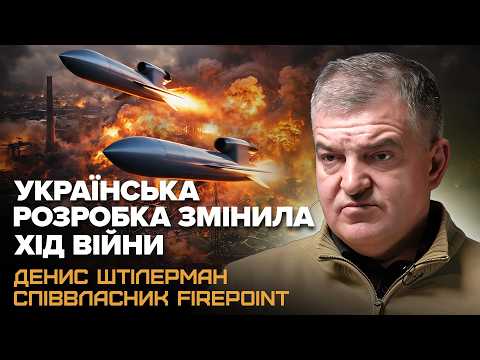
As chief designer he is behind the FP-1 attack drone and its long-winged successor, the FP-6, the FP-5 Flamingo cruise missile, the FP-7 and FP-9 ballistic missiles and the FP-7.X interceptor at the heart of the European Freyja programme. He talks about them freely and with ambition, promising strikes on Moscow and a ballistic-missile interception for under a million dollars. On 17 November 2026, after the strike on the Kerch Bridge, he posted a video of a Flamingo launch and said FP-1 drones and FP-5 missiles had hit the bridge and brought the arch down “as a result of numerous hits” (NV), a broader claim than the official account, which credits the fallen road span to Palianytsia missile-drones.
Scrutiny
Shtilierman’s dealings with Tymur Mindich, the businessman at the centre of the National Anti-Corruption Bureau’s “Midas” case, are the main source of questions about Fire Point. He has confirmed that Mindich wanted to buy half the company, first offering $100 million for 50% and later, by his account, nearly $1 billion, and that he refused; he has said he “can’t say anything bad” about Mindich, who he says helped the company get access to Soviet missile blueprints in Ukrainian archives. Both men deny that Mindich owns or profits from Fire Point. In May 2026 anti-corruption campaigners accused the company of becoming a near-monopoly through ties to former defence minister Rustem Umerov; Shtilierman answered that the state buys every long-range drone that works and that his FP-1 costs about a third of the state-built An-196 Liutyi (Babel). He has not been charged with any offence.
Watch & listen

Related figures
Mentioned in
Last researched .