Three Russian cruise missiles come down in south-east Poland
On the morning of 20 November three Kh-101 cruise missiles crossed into south-east Poland and came down in a field, a wood and on farmland. Nobody was hurt. Warsaw first spoke of two missiles and a jet drone; military prosecutors now say all three were Kh-101s, made in Dubna this autumn. The defence minister calls the timing, during a Coalition of the Willing exercise 35 km away, "not a coincidence".
Episode 3 8 min
Three Russian cruise missiles come down in Poland
The Robot War Debrief episode about this report. Claire and Tom talk you through the story in 8 minutes.
About the special report Three Russian cruise missiles come down in south-east Poland
Tap play to start listening
The scoop
0:00 / 7:53
Controls, chapters and transcript
Chapters
Read the transcript
Claire Picture a quiet field in south-east Poland just before daybreak on the Friday morning of 20 November. In about three minutes, three objects cross the border at more than 800 kilometres an hour. One comes down in a field by a forest, one in a wood, one on farmland. Nobody is hurt. And 35 kilometres away, a NATO exercise is at its high point.
Tom And two days later, Polish military prosecutors say all three were Russian cruise missiles, made in Dubna a few weeks before.
Claire This is Robot War Debrief. I'm Claire, and with me is Tom, who's been reading everything on this one. Today, three Russian Kh-101 cruise missiles down in Polish fields, a Coalition of the Willing exercise 35 kilometres away, and why nothing was shot down. Tom, where do we start?
Tom I'd start with how quickly this story changed.
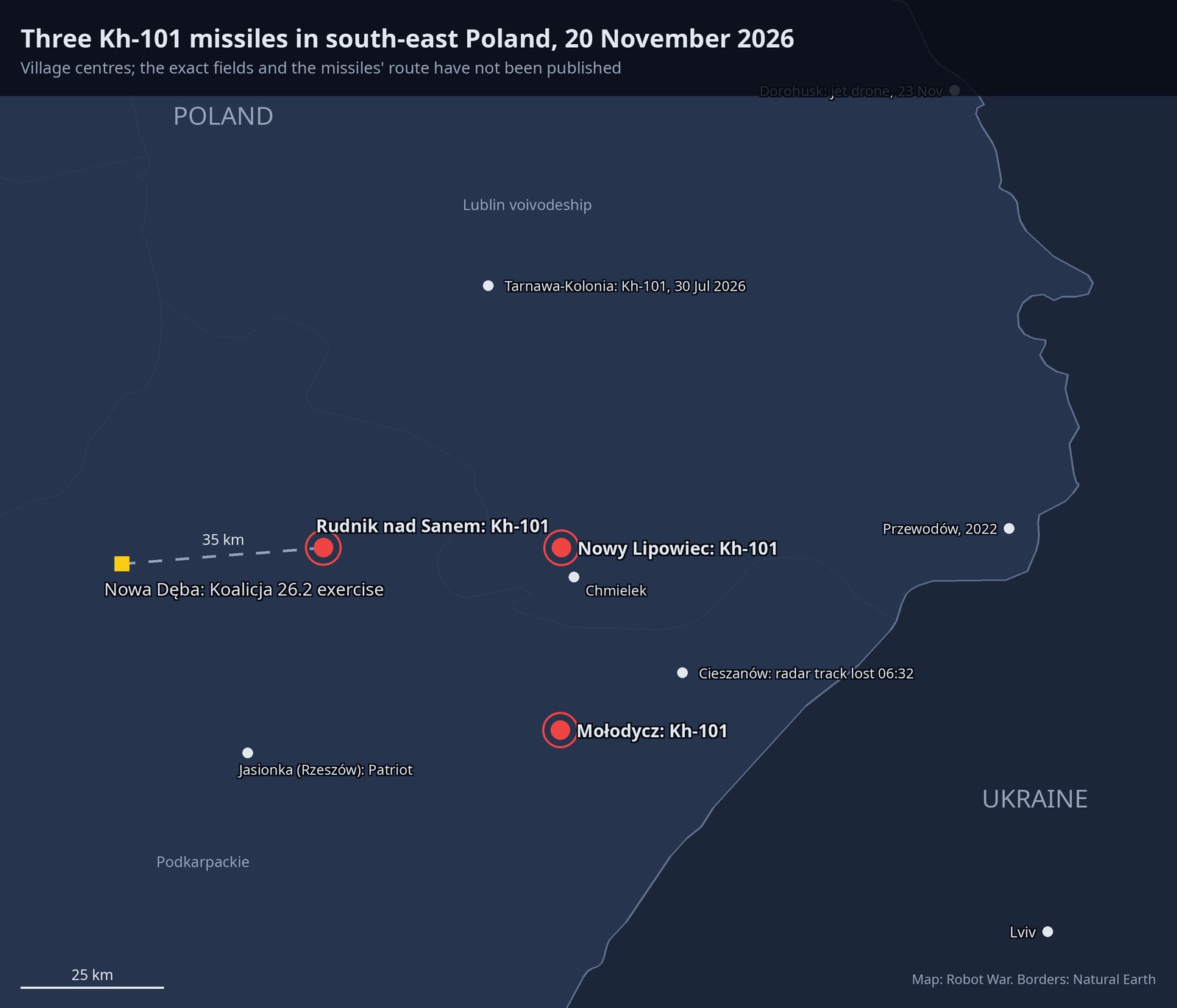
Tom So, 20 November, Friday morning, about half past six Polish time. Poland's Operational Command tracks eleven objects approaching the border overnight, and three of them cross. They're in Polish airspace for about three minutes, going over 800 kilometres an hour, and they come down at three places in the south-east. Nowy Lipowiec in Lublin, a field by a forest. Rudnik nad Sanem in Podkarpackie, woodland. And Mołodycz, also Podkarpackie, farmland beside a crater several tens of metres across. Nobody's hurt, no buildings damaged. Prime Minister Donald Tusk tells reporters, quote, we know for certain that what fell on Polish soil is from Russia.
Claire And the context matters, because this is also the night after the attacks we covered in our Crimean bridge episode.
Tom Right. Putin had promised what he called a much more painful answer, and Ukraine's Air Force puts that night's assault at 84 cruise missiles and 404 drones, 123 of them jet-powered. Poland's own count is higher: 72 Kh-101s, 26 Kalibrs, and 503 drones. Neither side explains the gap of about a hundred drones.
Claire So that's the shape of the morning. But the Polish account of what actually fell changed.
Tom Twice, actually. On day one, the defence ministry says it was two Kh-101 cruise missiles and, quote, most probably a jet drone. By the Sunday, military prosecutors close the question: all three are Kh-101 air-launched cruise missiles. There was no drone. And here's the detail that stood out to me. They say the missiles were made, quote, in the fourth quarter of 2026, in Dubna near Moscow. That's the home of the Raduga design bureau, which makes the Kh-101. So we're talking about missiles a few weeks old at most, fired at Ukraine, and found in a Polish forest.
Claire Fresh off the line.
Tom Fresh off the line.
Claire And the thing everyone keeps coming back to is where this happened.
Tom Right. Rudnik nad Sanem, one of the three impact sites, is about 35 kilometres from a place called Nowa Dęba. And at Nowa Dęba, from 9 to 22 November, the Polish army was hosting an exercise called Koalicja 26.2. It's the Coalition of the Willing drill, testing how fast they could deploy a force to Ukraine. By Polish numbers, around 2,800 troops from ten countries, plus 2,000 Polish soldiers. And Friday 20 November was the high point: foreign defence ministers were arriving that day. Poland's defence minister, Władysław Kosiniak-Kamysz, says, quote, in my view the date is not a coincidence. The Institute for the Study of War goes further and judges that Russian forces intentionally fired missiles and drones into Polish airspace. The military prosecutors have not reached a conclusion.
Claire So Warsaw and ISW say deliberate, the investigators are still investigating.
Tom That's where it stands.
Claire The other question I had reading this was how all three got through. Because there were jets in the air.
Tom There were. Two Polish F-16s, two Swedish Gripens, a Swedish early-warning plane, a Dutch tanker, Patriot batteries at Rzeszów and Świdnik on alert. Nothing fired. And the telling detail comes from Sweden. According to the Swedish broadcaster TV4, one of the Gripen pilots had NATO's permission to shoot down a suspected missile, but, quote, difficult weather made it impossible to identify the target. The Swedish armed forces say only that the operation went on for several hours in difficult weather and darkness. ISW reports that the Polish commander said the conditions did not meet Poland's rules of engagement.
Claire Cleared to fire, couldn't see what to fire at.
Tom That's how it reads.
Claire There's one more piece worth pulling out, because it fills in what the missiles were actually aimed at.
Tom Yes. This came from the Russian side after the fact. The pro-war channel Rybar says one of the Kh-101s missed its intended target, the Lviv Aircraft Plant in western Ukraine, by metres, and struck the asphalt in front of the building. They say local residents filmed it. Another Russian military channel, Voenacher, names the same aircraft plant and the Sknyliv railway station in Lviv as the main targets of that morning salvo. And a translator account, WarTranslated, points to Ukrainian NV footage of a Kh-101 hitting Sknyliv station, quote, meters from passing cars. If the Russian channels are right, these were missiles aimed at Lviv that overshot and kept going into Poland. That's a Russian claim, and prosecutors are still examining why the missiles ended up where they did.
Claire Jamming, fuel, navigation, deliberate, they're looking at everything.
Tom Everything, yes.
Claire Let's spend a minute on the weapon itself, because the Kh-101 keeps coming up and most listeners haven't met it.
Tom The Kh-101 is Russia's main long-range air-launched cruise missile, and it's the weapon Russia's bombers fire most often at Ukrainian cities and power stations. We have a page on it on robotwar.io. It's made by MKB Raduga in Dubna, Moscow Oblast, which is exactly why that Dubna detail from the Polish prosecutors fits. It's carried by two bombers: the Tu-95MS, a slow Soviet turboprop that takes up to eight of them under the wings, and the Tu-160, which carries twelve inside. On the night of 20 November, Poland says seven Tu-95s and four Tu-160s were in the air. These aircraft never need to come near the front line. They fire from deep inside Russia.
Claire So old plane, modern missile, fired from a long way away.
Tom That's it.
Claire Before we wrap up, Tom, what are the open questions here? What should we watch for next?
Tom Several. We don't know whether the missiles were aimed at Poland, strayed, or were pushed off course by jamming. We don't have an official route or the exact impact points. We don't know whether any of the warheads exploded. We don't know what the North Atlantic Council decided on 23 November, and Poland hasn't yet summoned Russia's ambassador. And then there's that Monday evening, when a Russian observation drone crossed near Dorohusk for a few minutes, and turned back east.
Claire The full report, with the day-by-day timeline, the map, the photos and every source, is up at robotwar.io. We'll be back when the next special report lands. Thanks, Tom.
Tom Thanks, Claire. Until next time.
Latest
Russian military channels have published footage and commentary naming the targets of the 20 November Kh-101 strike. Pro-war channel Rybar says one missile missed the Lviv Aircraft Plant by metres and struck the asphalt in front of the building, filmed by local residents. Channel Voenacher names the Lviv Aircraft Plant (LDARZ) and the Sknyliv railway station as the main targets of the morning salvo, and WarTranslated reports NV footage of a Kh-101 hitting Sknyliv station meters from passing cars.
Sources: Telegram channel, Russian side:rybar, Telegram channel, Russian side:rybar_in_english, Telegram channel, Russian side:Voenacher, Telegram channel:WarTranslated, Telegram channel, Russian side:Военный осведомитель (Military Informant)
Three Russian cruise missiles crossed into south-east Poland at about 06:30 on Friday 20 November and came down in a field, a wood and on farmland in the Lublin and Podkarpackie regions. Nobody was hurt and no buildings were damaged. “We know for certain that what fell on Polish soil is from Russia,” Prime Minister Donald Tusk said (Interia). It happened during one of the largest Russian attacks on Ukraine of the war, the night after Vladimir Putin promised a “much more painful” answer to the strikes on the Crimean Bridge, and about 16 hours after a drone came down behind the Dutch embassy in Kyiv. Our Kerch bridge report covers both.
On the first day Warsaw spoke of two missiles and a jet drone. Two days later military prosecutors said there had been no drone: debris from Kh-101 air-launched cruise missiles was found at all three sites (Notes from Poland).
Day by day: what became clear
Times are Polish time (CET).
Thursday 19 November, evening. Russia’s attack on Ukraine began at 18:00 Kyiv time, according to Ukraine’s Air Force.
Friday 20 November: three missiles in Poland.
- Poland’s Operational Command declared a yellow warning at 01:40 and a red alarm from 05:49 to 07:00. At 04:25 Ukraine’s Air Force reported cruise missiles launched from strategic bombers.
- At about 06:30 three objects crossed the border. They were in Polish airspace for “about three minutes, travelling at more than 800 km/h”, said Gen. Ireneusz Nowak, the operational commander; eleven objects had come close to the border and three crossed it (RMF FM).
- Sirens sounded in the Lublin region, Rzeszów airport stopped flights and the staff of its control tower were evacuated. Residents of Nowy Lipowiec and Rudnik nad Sanem heard explosions; a farm camera near Chmielek filmed a flash.
- After 07:00 the returning bombers fired another salvo, and F-16s took off from Krzesiny. By 10:00 the government crisis centre said the attack was over.
- At midday the defence ministry said a Kh-101 had come down at Nowy Lipowiec, a missile at Rudnik nad Sanem and “most probably a jet drone” at Mołodycz (RMF FM). Tusk called it an “intentional provocation” (AP).
Saturday 21 November. NATO Secretary General Mark Rutte, in Warsaw, said the alliance “will defend every inch of Polish territory”. Swedish TV4 reported that a Gripen pilot had been given permission to fire but could not identify the target.
Sunday 22 November. Military prosecutors: all three objects were Kh-101 missiles, made “in the fourth quarter of 2026” in Dubna near Moscow.
Monday 23 November. Investigators finished at the three sites and the North Atlantic Council met in extraordinary session at Poland’s request. That evening a Russian jet-powered observation drone crossed near Dorohusk for a few minutes (RMF FM).
Where they came down
- Nowy Lipowiec (gmina Księżpol, Biłgoraj county, Lublin voivodeship). The missile “fell in a field by a forest and caught fire”, the police said, a few hundred metres from houses. The Operational Command first named nearby Chmielek, 5.5 km away; the regional crisis centre said in the morning that “the object is still burning” (Interia).
- Rudnik nad Sanem (Nisko county, Podkarpackie). An object “fell in a wooded area”, the police said; they had more than a dozen calls before 07:00 and found metal fragments at about 10:00 (RMF FM). Two primary schools stayed closed.
- Mołodycz (gmina Wiązownica, Jarosław county, Podkarpackie). Fragments lay “on unused farmland over a large area”, near the Miłków ponds, with charred metal next to a gash “several tens of metres” across, RMF FM reported.
The distances from the Ukrainian border reported by the media range from about 38 km (Mołodycz) to about 100 km (Rudnik nad Sanem); sources disagree on Nowy Lipowiec (50 or 62 km). No official route has been published. A Ukrainian radar-monitoring channel tracked a Kh-101 heading from the Lviv region towards Poland at 06:28 and lost it near Cieszanów at 06:32, according to Euromaidan Press.
Two missiles and a drone, then three missiles
The account changed twice. In the morning the Operational Command’s spokesman said the object at Nowy Lipowiec “may be a Kh-101 cruise missile or a jet drone”, because the Russians had used both against Ukraine that night. At midday Defence Minister Władysław Kosiniak-Kamysz settled on two missiles and “most probably a jet drone” at Mołodycz. ISW reported that Nowak called it a possible Geran-5; we found no Polish source for that.
On 22 November the military department of the Lublin district prosecutor’s office closed the question: “Military prosecutors and the Military Gendarmerie have established that Russian Kh-101 cruise missiles came down in Nowy Lipowiec, Rudnik and Mołodycz. They were made in the fourth quarter of 2026 at plants in Dubna near Moscow.” Dubna is home to the Raduga design bureau, which makes the Kh-101. As published, the date means missiles a few weeks old at most.
The prosecutors are investigating “causing an event that endangers the life or health of many people … by an explosion of explosives” and breaches of aviation law. They want to know whether there was “a technical failure, fuel exhaustion, interference with the navigation systems or the action of defence systems”, and whether the missiles were sent into Poland “deliberately or not” (RMF FM). Prosecutor Marcin Kozak: “We know it is a Kh-101 cruise missile, but we want to learn the technical details of its propulsion, its navigation systems and the warhead it carried.” Whether any warhead exploded has not been said.
The night’s attack: how many drones?
The numbers depend on who counts.
| Ukraine’s Air Force | Poland’s Operational Command | |
|---|---|---|
| Cruise missiles | 84 (Kh-101, Kalibr, Iskander-K) | 72 Kh-101 and 26 Kalibr |
| Drones | 404, of which 123 jet-powered | 503, of which 202 jet-powered |
| Other | Iskander-M and S-400 ballistic missiles, Zircon | Launched from 7 Tu-95MS and 4 Tu-160 bombers |
| Shot down | 462 targets, including 380 drones (102 jet) |
Ukraine’s figure is for the night from 18:00 on 19 November (Air Force); President Zelensky added 27 ballistic missiles and said eight people were killed (via ISW). Nowak’s figures come from the defence ministry’s press conference on 20 November. Neither side explains the gap of about a hundred drones; the Polish count may include decoys. Kosiniak-Kamysz called it “one of the largest [attacks] since the start of the full-scale war”. In Kyiv, ballistic missiles damaged two bridges over the Dnipro.
Thirty-five kilometres from the Coalition of the Willing
From 9 to 22 November the Nowa Dęba training ground in Podkarpackie hosted Koalicja 26.2, an exercise to test how fast the Coalition of the Willing could deploy its planned Multinational Force–Ukraine. According to the Polish think tank OSW, 2,800 troops from France, Britain, Belgium, Estonia, Spain, the Netherlands, Lithuania, Germany, Sweden and Turkey took part, supported by 2,000 Polish soldiers; Kosiniak-Kamysz spoke of 5,000 to 6,000. Friday 20 November was the exercise’s high point, with foreign defence ministers and commanders arriving. Days earlier Maria Zakharova had called the coalition’s plans preparation for an “unacceptable military intervention”.
Rudnik nad Sanem is about 35 km from Nowa Dęba. “We are dealing with another Russian provocation. In my view the date is not a coincidence. Today the Coalition of the Willing is exercising at Nowa Dęba, near the places where our air force was operating,” Kosiniak-Kamysz said. Tusk wrote that it was “no coincidence” that the objects landed near the exercise (UPI). ISW judged that Russian forces “intentionally fired missiles and drones into Polish airspace”. The prosecutors have not reached a conclusion. We found no Russian or Belarusian exercise near the route at the time.
Who flew, and why nothing was shot down
Two Polish F-16s from Łask, two Swedish Gripens, a Swedish SAAB 340 early-warning aircraft and a Dutch MRTT tanker were in the air, Nowak said; Patriot batteries around Rzeszów airport and near Świdnik were activated. Nothing was fired. According to TV4, a Swedish Gripen pilot had NATO’s permission to shoot down a suspected missile but “difficult weather made it impossible to identify the target”; the Swedish armed forces said only that the operation lasted several hours “in difficult weather and darkness”. ISW reported that Nowak said the conditions did not meet the Polish rules of engagement.
Reactions
- Poland. Kosiniak-Kamysz asked NATO for more for Operation Eastern Sentry, naming AWACS and F-35s. The foreign ministry will summon Russia’s ambassador, but only once the military and services have finished: “The aim is not a summons for its own sake,” spokesman Maciej Wewiór said on 23 November (WP).
- NATO. Rutte called the incident “clearly dangerous” and, in Warsaw: “I can guarantee that NATO will defend every inch of Polish territory.” The North Atlantic Council met on 23 November; Poland did not invoke Article 4, and no outcome has been published.
- Russia. No official comment. RIA Novosti called the minister’s words “baseless accusations” and quoted a former ambassador saying Poland “has never presented evidence” (claimed by Russia).
- Washington. The day before, President Trump had said that “Putin has been landing drones in Poland and a couple of little missiles, by mistake.” Tusk, on Trump calling Putin his friend: “God, protect us from such friends” (Kyiv Independent).
Not the first time
In November 2022 a Ukrainian air-defence missile killed two people at Przewodów. In September 2025 about twenty Russian drones crossed Poland’s border and Warsaw invoked Article 4; NATO launched Eastern Sentry days later. On 30 July 2026 a single Kh-101 came down at Tarnawa-Kolonia, also in Biłgoraj county. In early November, Poland said it had foiled a staged provocation on its border with Kaliningrad (our report).
What we do not know
- Whether the missiles were aimed at Poland, strayed or were thrown off course by jamming.
- The route and entry point, and the exact impact sites.
- Whether any warhead exploded.
- Why the official count changed from two missiles and a drone to three missiles, and whether a jet drone was in Polish airspace as well.
- Why Ukraine’s and Poland’s drone counts differ by about a hundred.
- What the North Atlantic Council decided, and when Russia’s ambassador will be summoned.
Timeline
Times are Amsterdam time. Each line names the side that reported it.
A single Kh-101 comes down at Tarnawa-Kolonia, Biłgoraj county, without damage or casualties; the previous incident with this missile in Poland. source
Russian sourceExercise Koalicja 26.2 begins at the Nowa Dęba training ground: 2,800 troops from ten countries test how fast the Coalition of the Willing could deploy a force to Ukraine, with 2,000 Polish troops in support. source
Western sourceUkraine’s Air Force later dates the start of the night’s attack to 18:00 Kyiv time. Telegram channel:source
Ukrainian sourcePoland’s Operational Command declares a yellow warning; it lasts until 05:49 CET. source
Western sourceUkraine’s Air Force: air-launched cruise missiles “have probably been fired from strategic bombers”. Telegram channel:source
Ukrainian sourceRed alarm in Poland until 07:00 CET, linked to an alert for the population of Lublin and Podkarpackie. source
Western sourceThe objects cross into Polish airspace. Operational Command spokesman Lt Col Jacek Goryszewski: “We know for certain it was around 6:30.” source
Western sourceA Ukrainian radar-monitoring channel posts “Missile in Poland” and loses the track near Cieszanów, according to Euromaidan Press. source
Ukrainian sourceFirst report to the Lublin voivode; sirens sound. Flights at Rzeszów airport are halted at about 06:40 CET. source
Western sourceRussian bombers heading home fire another salvo of cruise missiles; F-16s from Krzesiny are scrambled. source
Western sourceOperational Command reports a suspected airspace violation by unidentified objects and says radar records are being checked. source
Western sourceUkraine’s Air Force: 84 cruise missiles and 404 strike and decoy drones (123 jet-powered) since 18:00, plus ballistic and Zircon missiles; 462 targets shot down or suppressed. Telegram channel:source
Ukrainian sourceDefence Minister Władysław Kosiniak-Kamysz: a Kh-101 at Nowy Lipowiec, a missile at Rudnik nad Sanem, “most probably a jet drone” at Mołodycz. “We are dealing with another Russian provocation. In my view the date is not a coincidence.” source
Western sourcePrime Minister Donald Tusk: “We know for certain that what fell on Polish soil is from Russia.” NATO’s Mark Rutte calls the incident “clearly dangerous”. source
Western sourceRussian military channel Voenacher names the Lviv Aircraft Plant (LDARZ) and the Sknyliv railway station as the main targets of the morning Kh-101 strike; pro-war channel Rybar says one missile missed the aircraft plant by metres and hit the asphalt in front of the building, filmed by local residents. Telegram channel, Russian side:source
Russian sourceDefence Minister Władysław Kosiniak-Kamysz tells RMF24 that Poland put Patriot, POPRAD and Pilica Plus air defence systems on combat alert, kept helicopters airborne and involved three Territorial Defence brigades in the operation. Telegram channel:source
Western sourceRutte in Warsaw: NATO “will defend every inch of Polish territory”. Swedish TV4 reports that a Gripen pilot had permission to shoot but could not identify the target in bad weather. source
Western sourceMilitary prosecutors: Kh-101 debris at all three sites, missiles made “in the fourth quarter of 2026” in Dubna. There was no drone. source
Western sourceExtraordinary meeting of the North Atlantic Council at Poland’s request. The foreign ministry says Russia’s ambassador will be summoned once the military and services have finished their checks. source
Western sourceInvestigators finish at all three sites; the debris goes to laboratory tests. Prosecutor Marcin Kozak: “We know it is a Kh-101 cruise missile, but we want to learn the technical details.” source
Western sourceRMF FM: a Russian jet-powered observation drone entered Polish airspace near Dorohusk that evening for a few minutes. Permission to shoot it down was given, but it turned back east. source
Russian source
Photos
From the channels
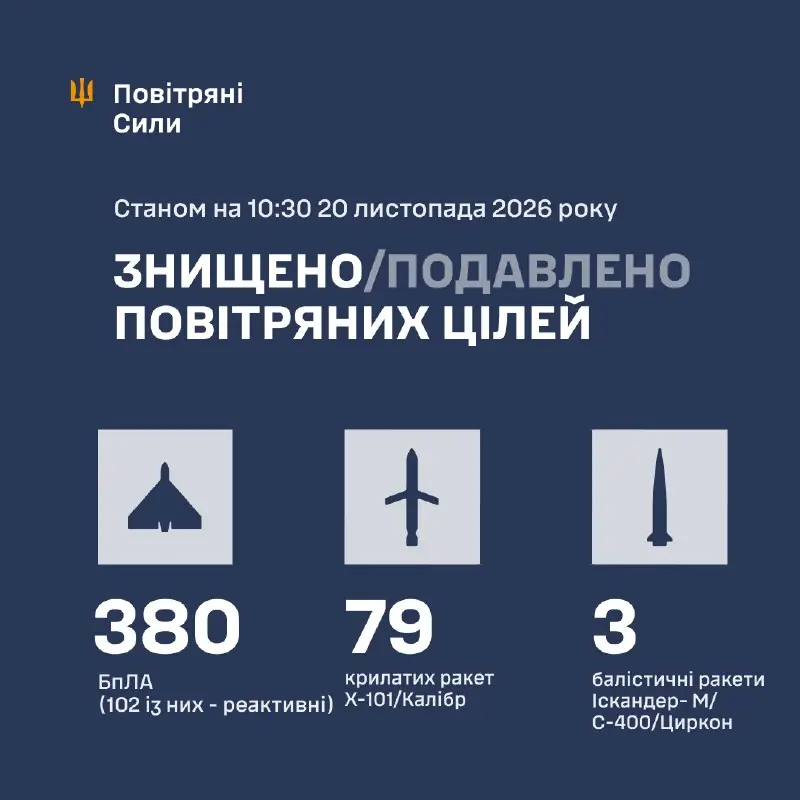
chart Ukraine's Air Force
Video

Szef MON potwierdza: To była rakieta Ch-101RMF24

Tajemniczy obiekt spadł 200-300 metrów od domówRMF24

"Odgłos przypominał bardziej silnik rakietowy, a nie drona". Relacja mieszkańca Rudnika nad SanemTVN24

Polska potwierdza obecność pocisku Ch-101 w przestrzeni powietrznejTVP World

Russian missiles land in Poland as Europe held military drills nearbyAssociated Press

How will Nato respond to a Russian missile landing in Poland?BBC News

Trzy rakiety Ch 101 spadły w Polsce. Nowe ustaleniaBiełsat PL
Sources
- Poland confirms three objects that struck its territory were all Russian missiles · Notes from Poland · 2026-11-23
- Szef MON potwierdza: To była rakieta Ch-101, data nie jest przypadkowa · RMF FM · 2026-11-20
- Rakieta Ch-101. Co wiemy o rosyjskim pocisku, który spadł w Polsce? · RMF FM · 2026-11-20
- Rudnik nad Sanem. Odnalezione szczątki to rakieta Ch-101 · RMF FM · 2026-11-20
- Koniec pracy śledczych w Mołodyczu. Teren pozostanie pod nadzorem służb · RMF FM · 2026-11-23
- Przestrzeń powietrzna Polski naruszona przez rosyjski bezzałogowiec · RMF FM · 2026-11-23
- Chmielek. Podejrzenie naruszenia przestrzeni. "Obiekt wciąż płonie" · Interia · 2026-11-20
- Rosja. Głosy ws. naruszenia przestrzeni powietrznej Polski. "Bezpodstawne" · Interia · 2026-11-20
- Naruszenie przestrzeni powietrznej RP. Komunikat Dowództwa Operacyjnego · Kanał Zero · 2026-11-20
- 2 Russian Kh-101 missiles, drone, fall in Poland during Russian attack on Ukraine · Kyiv Independent · 2026-11-20
- A farm camera caught a flash: Russia's missile barrage on Ukraine may have reached Poland · Euromaidan Press · 2026-11-20
- Russian Offensive Campaign Assessment, November 20, 2026 · Institute for the Study of War · 2026-11-20
- NATO calls Russian missiles landing in Poland a 'grave violation' of airspace (AP) · PBS NewsHour · 2026-11-20
- Russian Kh-101 Missiles Crash Near Training Coalition Troops in Poland · Kyiv Post · 2026-11-20
- Svensk pilot fick skjuta ned misstänkt rysk robot · TV4 · 2026-11-21
- Ambasador Rosji zostanie wezwany do MSZ. Jest jednak warunek · Wirtualna Polska · 2026-11-23
- Poland Turns to Extraordinary NATO Council Meeting After Russian Missile Enters Its Airspace · United24 · 2026-11-23
- Polish investigators identify three Russian Kh-101 missiles that entered Poland on 20 November · Ukrainska Pravda · 2026-11-22
- Exercise 'Koalicja 26.2': a test of readiness to deploy the Multinational Force–Ukraine · OSW Centre for Eastern Studies · 2026-11-17
- Two Russian Kh-101 missiles and jet-powered Shahed crash in Poland · Militarnyi · 2026-11-20
- Telegram channel:Повітряна атака у ніч на 20 листопада · Ukraine's Air Force (Telegram) · 2026-11-20