Russia planned a false-flag attack from Poland into Kaliningrad, Polish sources say
Rzeczpospolita reports that Russian services planned a sabotage raid on the Kaliningrad border at the turn of October and November, staged so Ukraine would be blamed, with many casualties expected. Warsaw sent police, special forces and counter-intelligence officers to the border on 2 November. Officials confirm a "real threat" but not the scenario, and no evidence has been made public.
Episode 2 9 min
Kaliningrad: the plot Poland says it stopped
The Robot War Debrief episode about this report. Claire and Tom talk you through the story in 9 minutes.
About the special report Russia planned a false-flag attack from Poland into Kaliningrad, Polish sources say
Tap play to start listening
The scoop
0:00 / 9:19
Controls, chapters and transcript
Chapters
Read the transcript
Claire Picture the Polish border with Kaliningrad, on a night in early November. Polish special forces are already in position. On the other side, on Russian soil, flashlights are moving in the dark near a small town called Sępopol. Nobody crosses. And according to a Polish newspaper, that is the night an attack was supposed to happen, blamed on Ukraine, with many casualties expected.
Tom And months of warnings that it was coming.
Claire This is Robot War Debrief. I'm Claire, and with me is Tom, who has been through everything published about this one. In our previous episode we looked at the Kerch Bridge, a Dutch missile and a drone at the embassy. Today, a very different story on NATO's eastern flank: a plot the Polish press says was Russian, and was stopped before it began. Tom, where do we start?
Tom We start with the newspaper, because without one Polish paper we wouldn't be having this conversation.
Tom On 18 November, the Polish daily Rzeczpospolita published a report by its defence correspondent Marek Kozubal. Citing senior people in Poland's uniformed services, he says Russian intelligence planned a sabotage attack on Polish soil close to the Kaliningrad border, with a possible crossing and a simulated attack on a target inside Russia. All of it under a false flag, to blame Kyiv. His sources say, quote, the Russians were preparing a provocation with many casualties. And the goal, they say, was to halt aid to Ukraine.
Claire So the plan was to make it look like Ukraine was attacking Russia from NATO soil, and Poland, somehow, saw it coming.
Tom They say they did. On 2 November Poland launched a police special operation along that border. And the Institute for the Study of War, ISW, picked the report up as a key takeaway of its daily assessment. Its judgement is that the warnings and the Polish deployment, quote, likely deterred, or at minimum disrupted the planned attack.
Claire So that's the broad outline. What I'd like to understand is what the sources told the paper the operation was actually meant to look like.
Tom One source gave a historical comparison, and it's a heavy one. They said it was supposed to resemble the Gleiwitz incident, which is the staged German attack on a radio station that Hitler used as a pretext to invade Poland in 1939. The idea here, as the sources describe it, was that people would cross from Polish soil into Russian territory. Those attackers, quote, would most likely have been shot, or evidence would have been found on them that they were from Ukraine. That's the Russian independent outlet Agentstvo's translation. Who exactly was meant to carry it out isn't known: Ukrainians living in Poland, or people brought in from another country.
Claire And what were they supposed to hit?
Tom Accounts differ. The Telegraph says a border crossing and a facility inside the exclave. The Independent reports civilian targets on both sides of the border. Hromadske quotes a source saying, quote, we had information about specific facilities where an attack was supposed to take place, and that the Russians anticipated a large number of casualties. Rzeczpospolita itself only writes, quote, Russian services. Only The Telegraph names Russia's GRU military intelligence. No unit, no named officer and no weapon has appeared in any report.
Claire You said Warsaw saw this coming. How?
Tom Two channels, according to Rzeczpospolita. Partner intelligence services warned Warsaw, and Polish analysts reached the same conclusion on their own. What alarmed them was Russian intelligence officers coordinating sabotage activity on the Russian side of the border. Lithuania, Latvia and Estonia got similar warnings. And there's a longer run-up here. Back in July, Foreign Minister Radosław Sikorski said publicly, quote, we suspect he is planning to prepare Ukrainian drones and use them to attack a NATO member country or Russia. He added, quote, we know what you are planning, do not do it. And on 10 September, Prime Minister Donald Tusk said he had received, quote, a fairly precise report directly from the CIA regarding possible events in the coming months.
Claire And Ukraine itself had flagged something.
Tom Yes. On 23 October, Ukraine's military intelligence, the HUR, warned that Moscow was preparing false-flag operations to pin on Kyiv, and named the Kaliningrad enclave as one of the possible sites. ISW thinks the CIA report Tusk mentioned, quote, likely refers to this plot, though Tusk himself didn't say so.
Claire So Polish forces moved to the border. What actually happened on the ground?
Tom On 2 November Poland's police chief Marek Boroń launched the operation across the two provinces along the exclave. Around 180 riot police and a counter-terrorist unit went north. The special forces units GROM, NIL and AGAT exercised in the region, and the ABW, Poland's internal security agency, sent extra officers. Units were on full readiness from 2 to 8 November, and the operation was later extended to 15 November. The only visible incident came shortly after midnight on 3 November. Border guards near Sępopol saw people with flashlights on the Russian side, nobody crossed, and the group withdrew. Tusk later said, quote, we managed to prevent an attempted provocation, while adding that he couldn't be certain it was one.
Claire Flashlights, and that's really all anyone saw.
Tom That's really all anyone saw on the ground. No arrests have been made, no suspects named, no prosecution announced. Everything known about the plot itself comes from anonymous sources in one newspaper. The ministers confirm a threat and a response, not the scenario. The head of military counter-intelligence, General Jarosław Stróżyk, told Radio ZET on 19 November, quote, such information certainly existed, but, quote, it is sometimes hard to assess the credibility.
Claire And the other side of all this is what Russia itself has been saying. Have they responded to the Polish report?
Tom Not officially. As of the morning of 20 November, we hadn't found any comment from the Kremlin, the Foreign Ministry or the SVR, Russia's foreign intelligence service. Pro-war Telegram channels called it fabricated. The channel Two Majors wrote, quote, not a single piece of evidence was presented. But there's a pattern worth noting. On 11 November, Poland's Independence Day, the FSB claimed it had broken up a Polish spy network in Kaliningrad. Poland's services called that, quote, yet another provocation and act of disinformation. And on the evening of 18 November, hours after Rzeczpospolita published, a pro-Kremlin channel claimed that Kyiv was preparing more than 100 captured Russian drones to strike Poland and make it look as if they came from Kaliningrad. No evidence was offered.
Claire So Moscow's own version is the same plot, with the roles reversed.
Tom That's the shape of it.
Claire Just so listeners can place where all this is happening, what is Kaliningrad, and what's inside it?
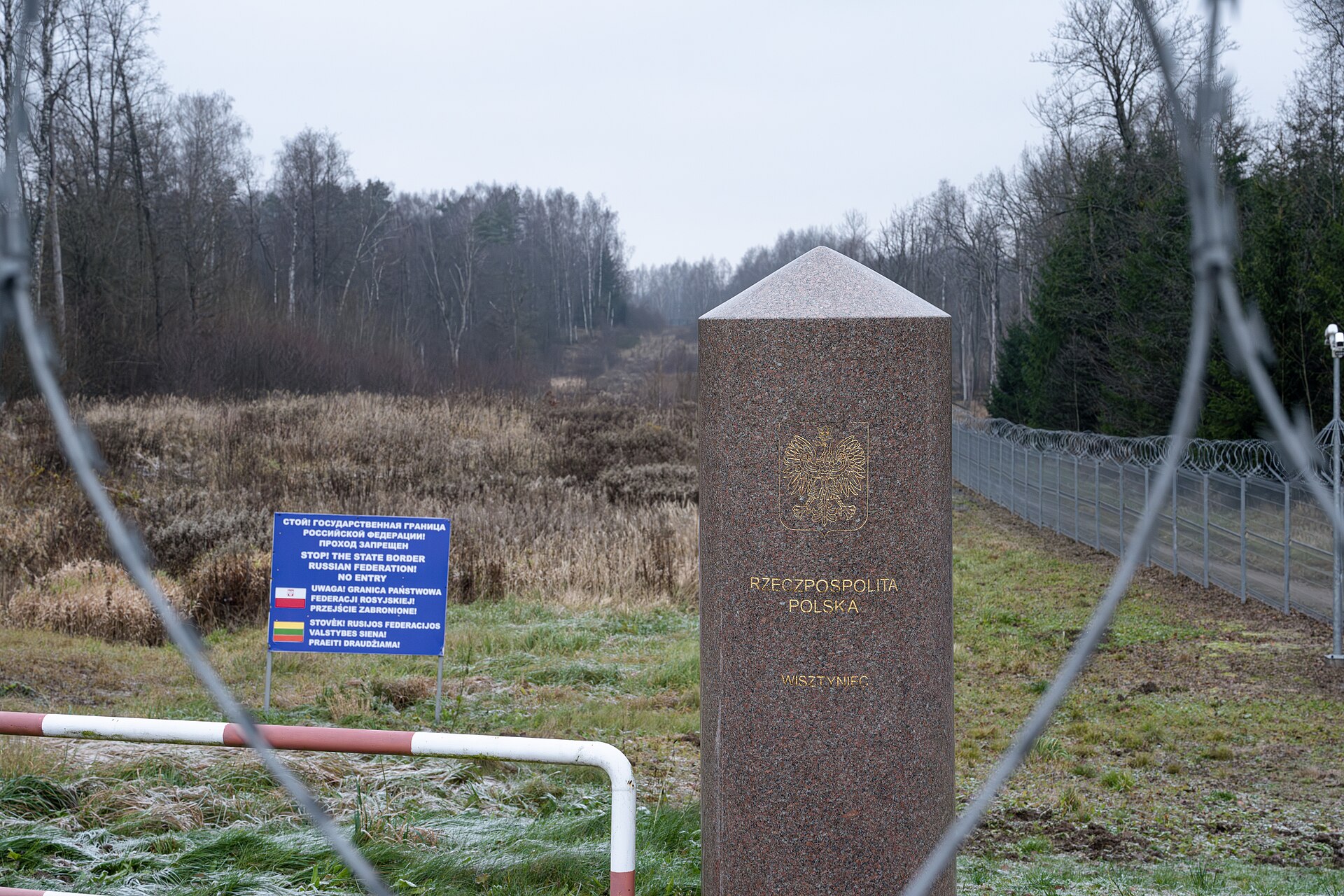
Tom It's a Russian exclave, cut off from the rest of Russia and from Belarus by Poland and Lithuania. And it's armed. It hosts Iskander-M missiles, which are Russia's road-mobile short-range ballistic missiles. We have a page on the Iskander-M on robotwar.io: a single launcher carries two missiles, range around 500 kilometres, and it's one of the hardest weapons for Ukrainian air defence to stop. It also hosts S-400 air defence, and Russia has spread GPS jamming from the exclave across the Baltic. The border itself has been active this autumn. On 23 September a Russian Mi-8 helicopter from Kaliningrad spent 42 seconds in Polish airspace, and Polish jets were scrambled. And in late September Moscow warned NATO it would use, quote, the entire arsenal, including nuclear weapons, if Kaliningrad were blockaded.
Claire So what's still not clear?
Tom Quite a lot. We don't know what the targets actually were, or whether casualties were expected on the Polish side or the Russian side. We don't know which Russian service ran it, because only one outlet names the GRU. We don't know whether the flashlights near Sępopol on 3 November were part of this operation at all, which allied service first raised the alarm, or whether Polish prosecutors have opened a case. And one thing to watch: on 21 November Kaliningrad's governor Alexei Besprozvannykh declared a region-wide drone-danger alert, saying a suspicious object had been detected approaching from Lithuania. Later that day he said specialists had found no threat.
Claire The full report, with the timeline, the photographs and every source, is on robotwar.io. We'll be back with the next episode following the next special report. Tom, thanks for walking us through this one.
Tom Thanks, Claire. Take care, everyone.
Latest
Western governments pushed back on Russian accusations around the Kaliningrad incidents on 22 November. Poland's disinformation centre is monitoring fake Russian reports of an alleged Ukrainian attack on Kaliningrad, Deputy Minister Paweł Olszewski told Ukrainska Pravda. Lithuanian Foreign Minister Kęstutis Budrys denied Vilnius had any role in the attack and said Lithuania had never sanctioned the use of its territory for strikes on Russia, after the Kaliningrad governor said a suspicious object had been detected coming from Lithuania.
Sources: Ukrainska Pravda (EN), Telegram channel, Russian side:baltnews, Telegram channel:baltic_signal_monitor
On 21 November Kaliningrad Governor Alexei Besprozvannykh declared a region-wide "drone danger" alert, saying a suspicious object had been detected approaching from Lithuania, TASS reported. Khrabrovo airport temporarily halted arrivals and departures, according to pro-war channel Barantchik citing Rosaviatsia. Besprozvannykh later said specialists' checks had found no threat to the region and that the alert would be lifted shortly. The same day Leningrad region Governor Alexander Drozdenko said two drones had attacked a cargo ship bound for Kaliningrad in international waters of the Gulf of Finland, about 5.6 km from Russia's border.
Sources: Telegram channel:Faytuks_Network, Telegram channel, Russian side:barantchik, Telegram channel, Russian side:SolovievLive, Telegram channel, Russian side:Два майора (Two Majors)
Lithuania's President Gitanas Nausėda said on 16 November that Vilnius could follow Tallinn and close its border with Russia, LRT reported. He added that Lithuania is a transit country serving Kaliningrad and that all circumstances would have to be weighed, but said that if efforts to destabilise the region continued, Russia should face a response.
Sources: Telegram channel:BalticNewsNetwork, Telegram channel, Russian side:baltnews
Russian intelligence planned to stage an attack from Polish soil into the Kaliningrad exclave and blame it on Ukraine, according to a report in the Polish daily Rzeczpospolita on 18 November. “The Russians were preparing a provocation with many casualties,” the paper’s defence correspondent Marek Kozubal wrote, citing “high-ranking people connected with the uniformed services”. A Polish security operation at the turn of October and November, the paper says, stopped it.
That evening the Institute for the Study of War made it a key takeaway of its daily assessment: Russian services “reportedly planned but did not execute a sabotage operation in late October or early November that would have blamed Ukraine for conducting an attack from Poland into the Russian exclave of Kaliningrad Oblast in order to undermine Western political support for Ukraine”. ISW’s only source for the plot itself is Rzeczpospolita.
What was planned
According to Rzeczpospolita’s sources, “Russian services” planned “a sabotage operation on Polish territory close to the border with Kaliningrad Oblast, combined with a possible border crossing and a simulated attack on a facility located also in the Russian Federation”, carried out “under a false flag in order to blame Kyiv”. The rest of the article is behind a paywall. Other outlets that read it quote more:
- The model. “It was supposed to resemble something like the Gleiwitz incident,” one source said, recalling the staged German attack on a radio station that Hitler used as a pretext to invade Poland in 1939 (Kyiv Independent).
- The attackers. Those who crossed the border “would most likely have been shot, or evidence would have been found on them that they were from Ukraine”, according to the Russian independent outlet Agentstvo’s translation. Who was to carry it out is not known: Ukrainians living in Poland, or people brought in from another country.
- The targets. “We had information about specific facilities where an attack was supposed to take place,” and “the Russians anticipated a large number of casualties” (Hromadske). Accounts differ on what they were: a border crossing and a facility in the exclave (The Telegraph), or “civilian targets on both sides of the border” (The Independent).
- The goal. “The goal was to halt aid to Ukraine.”
- Who. Rzeczpospolita writes only “Russian services”. The Telegraph alone says the plot “appeared to have been plotted by Russia’s GRU military intelligence”. No unit, no named officer and no weapon appears in any report.
ISW adds its own reading: the attack would have let Moscow accuse NATO of backing Ukrainian strikes on Russian soil, or paint Ukraine as a reckless partner willing to attack from NATO territory, and it would have fed existing tensions between Warsaw and Kyiv.
How it was spotted
The warning came from “partner intelligence services”, and Polish analysts reached the same conclusion on their own, Rzeczpospolita’s sources say; Lithuania, Latvia and Estonia received similar warnings. What alarmed the Polish services was the appearance of Russian intelligence officers “coordinating sabotage activity” on the Russian side of the border. On 2 November Poland’s police chief Marek Boroń cited warnings from Polish and allied services, among them military intelligence (SWW), of possible sabotage and armed border violations in the first half of November (United24).
There were earlier signals. In July Onet and The Telegraph reported US warnings that Russia might stage an armed provocation in Poland, including “an incident made to look like Ukrainian responsibility”, to test NATO’s response. Foreign Minister Radosław Sikorski said publicly that month: “We suspect he is planning to prepare Ukrainian drones and use them to attack a NATO member country or Russia … we know what you are planning – do not do it” (Ukrainska Pravda). On 10 September Prime Minister Donald Tusk said he had received “a fairly precise report directly from the CIA regarding possible events in the coming months” (Ukrainska Pravda); ISW thinks it “likely” referred to this plot, though Tusk did not say so. On 23 October Ukraine’s military intelligence, HUR, warned that Moscow was preparing “false flag” operations to pin on Ukraine and named “the Kaliningrad enclave” among the places.
Poland moves to the border
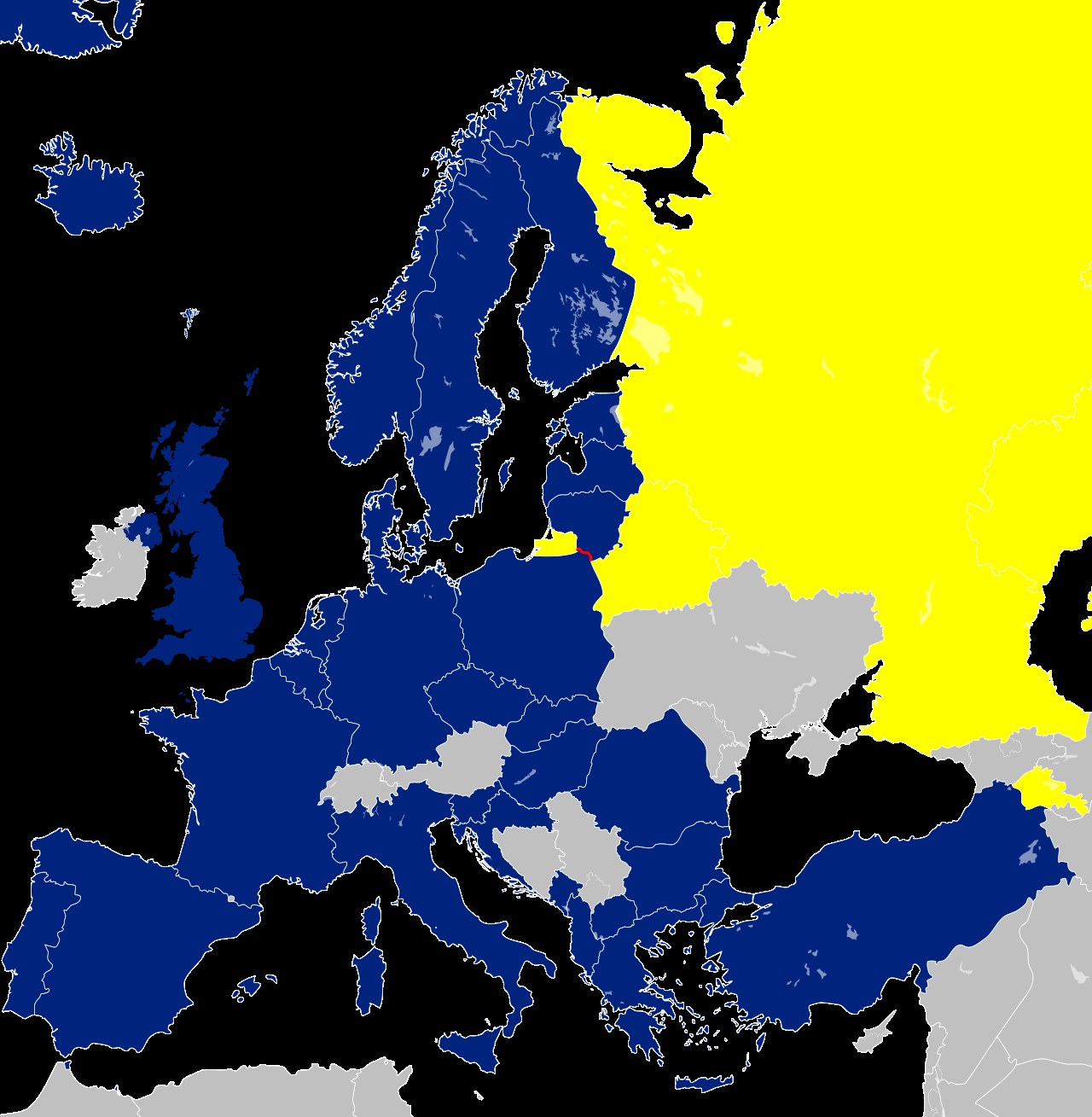
On 2 November the police launched a special operation in Warmia-Masuria and Podlasie, the two provinces along the exclave, with a command centre at national headquarters: “Police are putting security measures in place around the Kaliningrad region in anticipation of possible incidents that could lead to acts of sabotage,” Boroń said (Notes from Poland). Units were put on full readiness from 2 to 8 November. According to Rzeczpospolita, about 180 riot police and a counter-terrorist unit went north, border posts and police stations were reinforced, the internal security agency ABW sent extra officers, and the special forces units GROM, NIL and AGAT exercised in the region. The Independent reports that GROM was deployed at the end of October. “The aim was deterrence, but also to ensure the ability to take pre-emptive action,” a source told it.
The only incident came shortly after midnight on 3 November. Border guards near Sępopol saw people with flashlights on the Russian side; nobody crossed, and they withdrew. “We mobilized the necessary personnel and resources very quickly and managed to prevent an attempted provocation,” Tusk said (Meduza), while adding that he could not be certain it was one. On 12 November the operation was extended to 15 November; RMF FM reported “no additional signals” and no intrusion into Polish territory. ISW has seen no report of it running beyond that date.
Lithuania had already put about 100 soldiers on its own Kaliningrad border on 8 October, alongside the border guard. On 17 November its chief of defence proposed physical barriers along that border and kept the troops there until the end of November, though officials said the threat level had not risen (LRT). No source links the Lithuanian deployment to this plot.
What Warsaw confirms, and what it does not
The ministers confirm a threat and a response, not the scenario. Tomasz Siemoniak, the minister who coordinates the special services, told Rzeczpospolita: “If we took certain steps, it is because we determined that there was a real threat.” Defence Minister Władysław Kosiniak-Kamysz said on 18 November that “many acts of sabotage were foiled” and asked for the army’s Operation Horyzont, which guards railways and critical infrastructure, to be extended (PAP via Rzeczpospolita). The next morning the head of military counter-intelligence (SKW), Gen. Jarosław Stróżyk, told Radio ZET: “Such information certainly existed. There is a lot of such information every day.” Polish and allied sources confirmed it in the daily exchange of intelligence, he said, but “it is sometimes hard to assess the credibility of such information, but we cannot dismiss it” (Rzeczpospolita). Later that day Siemoniak told Super Express that if threats appear, “an adequate response from the services and the army is necessary”. Asked whether the Russians had been preparing an attack on a site with many people, he called that speculation: “Nothing more can be said about the details.”
No evidence has been made public. Nobody has been arrested or named, and no prosecution has been announced. Everything known about the plot itself comes from anonymous sources in one newspaper.
Moscow’s mirror story
Russia has not answered the report. By the morning of 20 November we had found no comment on it from the Kremlin, the Foreign Ministry or the SVR foreign intelligence service. Pro-war channels called it fabricated; Two Majors wrote that “not a single piece of evidence was presented” (Telegram).
Moscow has been telling the opposite story for months. In late September it warned NATO it would use “the entire arsenal … including nuclear weapons” if Kaliningrad were blockaded (Al Jazeera). In October Foreign Ministry spokeswoman Maria Zakharova claimed Poland’s General Staff was planning pre-emptive strikes on the exclave with HIMARS, Homar-K launchers and F-16 jets. On 11 November, Poland’s Independence Day, the FSB said it had broken up a Polish spy network in Kaliningrad; Poland’s services called it “yet another provocation and act of disinformation” (Notes from Poland), and Agentstvo found that the “Polish” chat the FSB published reads like a translation. On the evening of 18 November, hours after Rzeczpospolita’s report, a pro-Kremlin channel claimed that Kyiv was preparing more than 100 captured Russian drones to strike Poland and make it look as if they came from Kaliningrad (BalticBridge). It offered no evidence. It is the plot Rzeczpospolita describes, with the roles reversed.
A pattern on NATO’s eastern flank
Kaliningrad has been a pressure point all autumn. On 23 September a Russian Mi-8 helicopter from the exclave spent 42 seconds in Polish airspace north of Braniewo and Polish jets were scrambled (Notes from Poland). The exclave hosts Iskander-M missiles and S-400 air defence, and Russia has spread GPS jamming from it across the Baltic. On 16 October Tusk warned that Russia could escalate hybrid attacks before Christmas (TVP World). In Estonia, the authorities say the GRU ordered an arson attack on the drone maker Threod Systems; Tallinn will close its road crossings with Russia from 1 December (Al Jazeera).
ISW places the plot within what it calls Moscow’s “overlapping military campaigns against Europe”, meant to break European support for Ukraine. It judges that public warnings and the extra Polish forces on the border “likely deterred, or at minimum disrupted” the attack, and argues that leaders should keep disclosing such threats. Whether the plot was a real operation called off, a contingency plan, or a test of how fast NATO’s eastern members react cannot be settled from what is public. What the record does show is that Poland, after months of allied warnings, moved police, special forces and counter-intelligence to the border within days, and that Warsaw chose to tell the public why.
What we do not know
- What the targets were, and whether casualties were expected on the Polish or the Russian side.
- Which Russian service ran it; only one outlet names the GRU.
- Whether the flashlights near Sępopol on 3 November were part of it.
- Which allied service first raised the alarm, and when.
- Whether Polish prosecutors have opened a case.
Timeline
Times are Amsterdam time. Each line names the side that reported it.
Onet and the Telegraph report US warnings that Russia may stage an armed provocation in Poland, including “an incident made to look like Ukrainian responsibility”, to test NATO’s response. source
Western sourceForeign Minister Radosław Sikorski: “We suspect he is planning to prepare Ukrainian drones and use them to attack a NATO member country or Russia … we know what you are planning – do not do it.” source
Western sourcePrime Minister Donald Tusk says he received “a fairly precise report directly from the CIA regarding possible events in the coming months”. source
Western sourceA Russian Mi-8 helicopter from Kaliningrad spends 42 seconds in Polish airspace north of Braniewo; Polish jets are scrambled. source
Russian sourceRussia warns NATO it will use “the entire arsenal … including nuclear weapons” if Kaliningrad is blockaded. NATO’s Mark Rutte: “Stop the nuclear threats.” source
Russian sourceLithuania puts about 100 soldiers on its Kaliningrad border alongside the border guard, as a preventive measure. source
Western sourceTusk warns that Russia may escalate hybrid attacks before Christmas. The same day Russia’s Foreign Ministry claims Poland plans pre-emptive strikes on Kaliningrad. source
Western sourceUkraine’s military intelligence (HUR) warns that Moscow is preparing “false flag” operations to blame Ukraine, naming “the Kaliningrad enclave” among the possible sites. Telegram channel:source
Ukrainian sourcePolish police launch a special operation in Warmia-Masuria and Podlasie, citing warnings from Polish and allied services of possible sabotage from the Kaliningrad region; “full readiness” until 8 November. source
Western sourceShortly after midnight on 3 November the Border Guard sees people with flashlights on the Russian side near Sępopol. Nobody crosses. Tusk: “We … managed to prevent an attempted provocation.” source
Russian sourceThe FSB claims it has broken up a Polish spy network in Kaliningrad. Poland’s services spokesman calls it “yet another provocation and act of disinformation”. source
Russian sourceRMF FM: the police operation is extended to 15 November; “there are no additional signals”, and there was no intrusion into Polish territory. source
Western sourceIn a separate case, Estonia says it will close its road crossings with Russia from 1 December after a GRU-ordered arson plot against the drone maker Threod Systems. source
Western sourceLithuania’s President Gitanas Nausėda says Lithuania could take the same step as Estonia and close its border with Russia, but notes that Lithuania is a transit country for Kaliningrad; if destabilisation efforts in the region continue, Russia should face a response, he tells LRT. Telegram channel:source
Western sourceLithuania’s chief of defence proposes physical barriers on the Kaliningrad border; troops stay on patrol until the end of November. source
Western sourceRzeczpospolita publishes: a Polish operation “prevented a Russian provocation” on the Kaliningrad border; “The Russians were preparing a provocation with many casualties.” source
Western sourceThe pro-war channel Two Majors dismisses the report: “not a single piece of evidence was presented”. Telegram channel, Russian side:source
Russian sourceA pro-Kremlin channel pushes the mirror story: Kyiv is said to be preparing more than 100 captured Russian drones to strike Poland “from Kaliningrad”. No evidence. Telegram channel, Russian side:source
Russian sourceDefence Minister Władysław Kosiniak-Kamysz: “Many acts of sabotage were foiled.” He asks for the army’s Operation Horyzont to be extended. source
Western sourceISW: the deployments and public warnings “likely deterred, or at minimum disrupted” the planned attack. source
Western sourceGen. Jarosław Stróżyk, head of military counter-intelligence (SKW): “Such information certainly existed”, confirmed by Polish and allied sources, though “it is sometimes hard to assess the credibility”. source
Western sourceSiemoniak to Super Express: asked whether the Russians were preparing an attack on a site with many people, he calls it speculation. “Nothing more can be said about the details.” source
Western sourceKaliningrad Governor Alexei Besprozvannykh declares a region-wide “drone danger” alert, saying a suspicious object has been detected approaching from Lithuania; sirens sound in the regional capital, TASS reports. Telegram channel:source
Western sourceLeningrad region Governor Alexander Drozdenko claims two drones attacked a cargo ship bound for Kaliningrad in international waters of the Gulf of Finland, about three nautical miles (5.6 km) from Russia’s border; the crew is being evacuated. Telegram channel:source
Ukrainian sourceFinnish President Alexander Stubb calls the attack on the Sparta II cargo ship serious and informs allies, the Telegram channel voin_dv reports. Telegram channel, Russian side:source
Russian sourceLithuanian diplomat Vytautas Bajarūnas tells 15min the Kaliningrad incident could be Russia’s own provocation. Telegram channel:source
Independent sourceLithuanian Foreign Minister Kęstutis Budrys denies Lithuania’s involvement in the drone attack on Kaliningrad and says Vilnius never sanctioned the use of its territory for strikes on Russia. Telegram channel:source
Independent sourcePoland’s disinformation centre is monitoring fake Russian reports of an alleged Ukrainian attack on Kaliningrad, Deputy Minister Paweł Olszewski tells Ukrainska Pravda. source
Western source
Photos
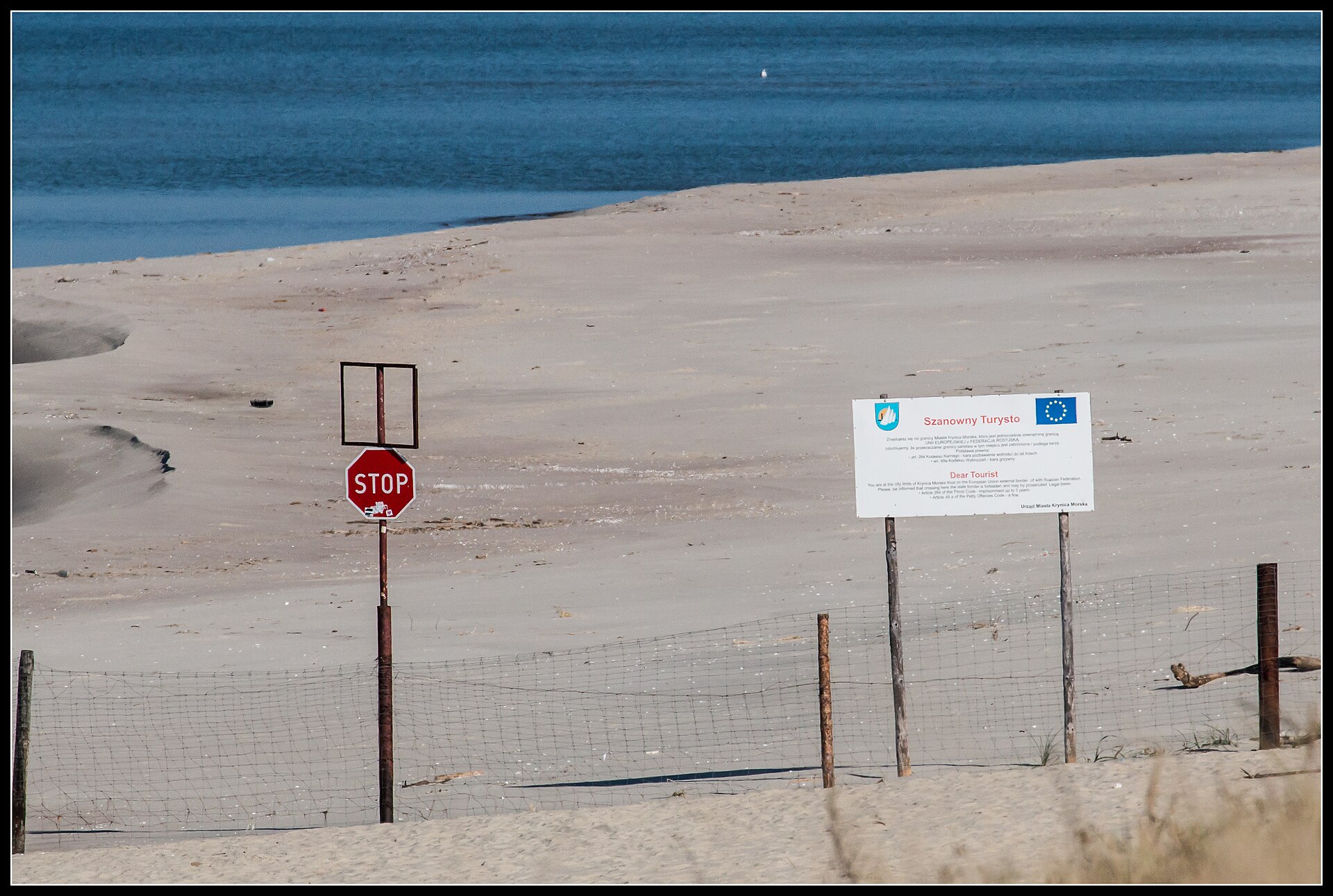
Photo: Manolo Gómez, via Wikimedia Commons (CC BY 2.0)
From the channels
map Agentstvo 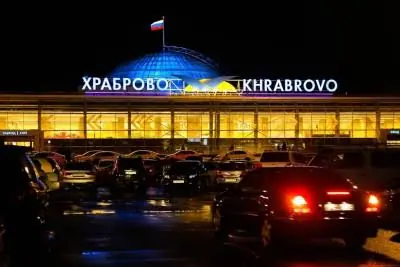
photo barantchikC 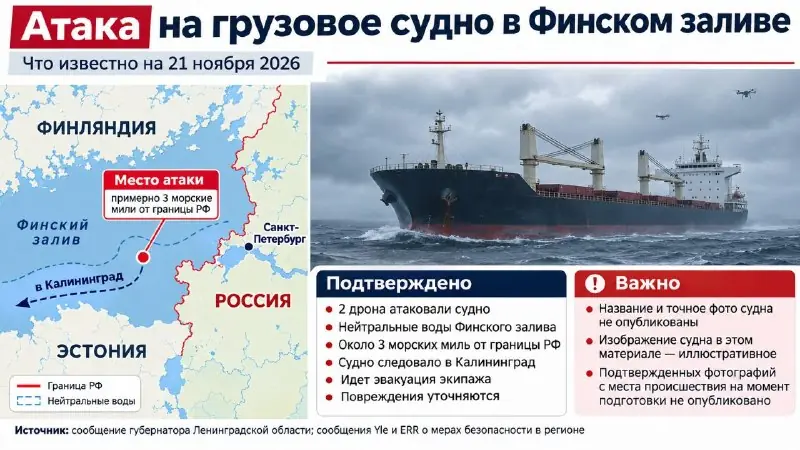
other Два майора (Two Majors)C 
photo zvezdanewsD 
photo tsaplienkoC 
Video tsaplienkoC 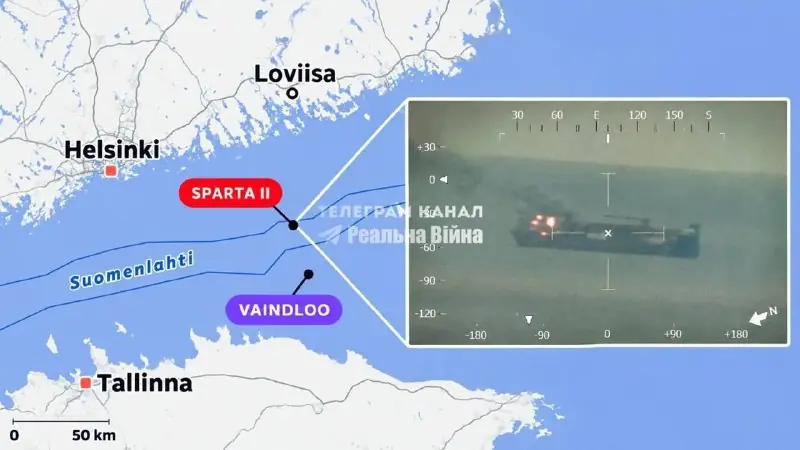
map tsaplienkoC 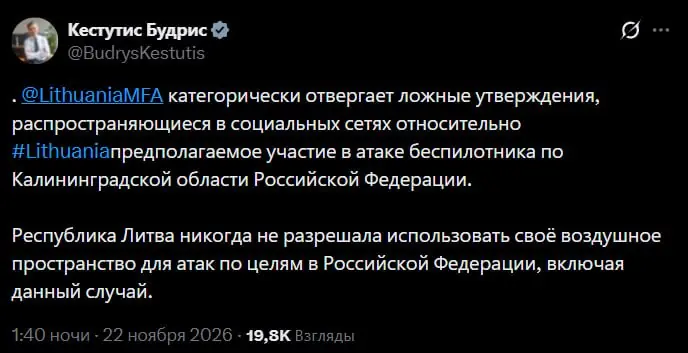
screenshot SolovievLiveD 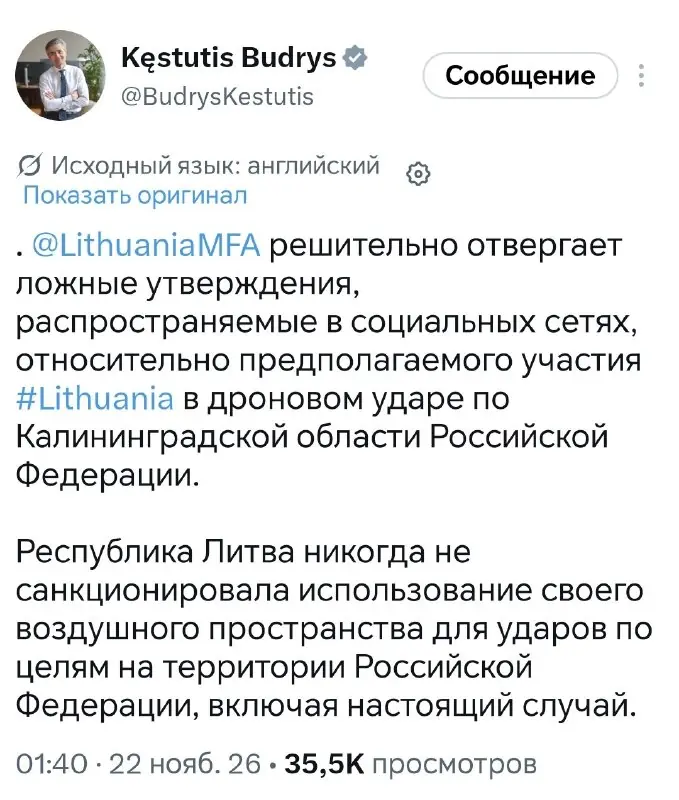
screenshot baltnewsD 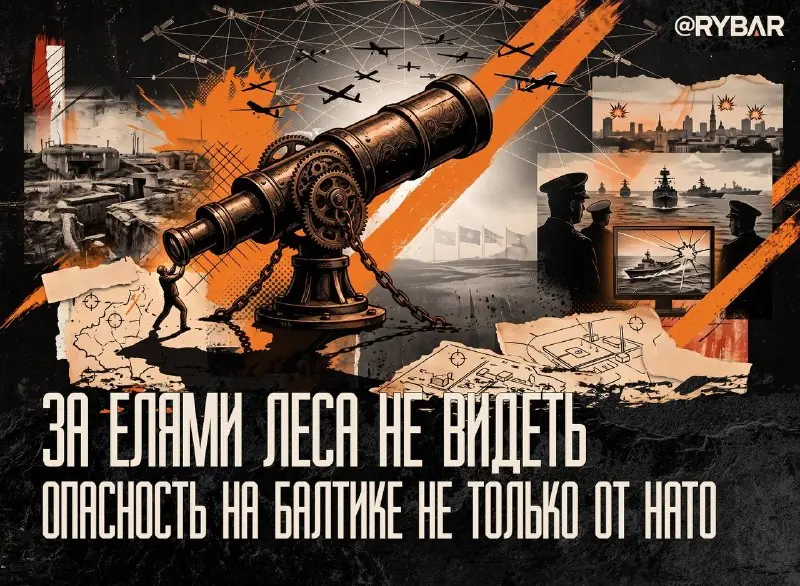
other rybar_in_englishC
Video

Russia reportedly planned a major mass-casualty provocation in PolandTVP World

As Putin attacks Europe, Europe must double down on backing UkraineTVP World

Tusk o groźbie wtargnięcia z Rosji. Ujawnia raportWirtualna Polska

Ludzie z latarkami przy granicy z Rosją. Donald Tusk o możliwej prowokacjiODSIEW

Poland deploys special forces near Kaliningrad after reports of suspicious activityMint

USA ostrzegły Polskę przed możliwą prowokacją RosjiTVN24
On Telegram
Sources
- Tomasz Siemoniak o bezpieczeństwie: Granice Polski z Rosją specjalnie chronione · Super Express · 2026-11-19
- Prowokacja na granicy. Zagraniczne media o doniesieniach „Rzeczpospolitej” · Rzeczpospolita · 2026-11-19
- Prowokacja z dużą liczbą ofiar i zrzuceniem winy na Ukrainę. Ustaliliśmy, co powstrzymało Rosję · Rzeczpospolita (Marek Kozubal) · 2026-11-18
- Szef MON potwierdza doniesienia „Rz". Polskie służby udaremniły rosyjską prowokację · Rzeczpospolita (PAP) · 2026-11-18
- Szef SKW o doniesieniach „Rz" ws. prowokacji na granicy: Takie informacje były · Rzeczpospolita · 2026-11-19
- Russian Offensive Campaign Assessment, November 18, 2026 · Institute for the Study of War · 2026-11-18
- 'The goal was to halt aid to Ukraine': Russia planned high-casualty false flag attack near Kaliningrad border, Rzeczpospolita reports · Kyiv Independent · 2026-11-18
- Poland thwarted suspected Russian false flag plot to blame Ukraine for deadly attack · Hromadske · 2026-11-18
- Russia ‘planned to kill own civilians’ in false-flag attack on Kaliningrad · The Telegraph (via Yahoo) · 2026-11-18
- Poland ‘foiled Russian false flag plot’ echoing Nazi hoax that triggered Second World War · The Independent (via Yahoo) · 2026-11-19
- A foiled Russian plot? Poland's Kaliningrad alert shows Putin's growing appetite for risk · TVP World · 2026-11-18
- Poland launches operation along Russian border in response to reports of planned sabotage · Notes from Poland · 2026-11-02
- Poland launches special operation on Kaliningrad border · United24 · 2026-11-02
- Tusk says Poland prevented a possible provocation on the Kaliningrad border · Meduza · 2026-11-03
- Wzmocnione patrole zostaną na granicy z Rosją nieco dłużej · RMF FM · 2026-11-12
- Poland dismisses Russia's claim of breaking up Polish spy network as "disinformation" · Notes from Poland · 2026-11-12
- Lithuania's military chief suggests building physical barriers along Kaliningrad border · LRT · 2026-11-17
- Lithuania's border with Kaliningrad calmer than Poland's, defence minister says · LRT · 2026-11-06
- US reportedly warned Poland that Russia may "test NATO" with hybrid attack · Ukrainska Pravda · 2026-07-03
- Russia may test NATO with Poland provocation plans · UK Defence Journal · 2026-07-03
- Russia may be preparing provocation using Ukrainian drones – Polish foreign minister · Ukrainska Pravda · 2026-07-15
- Polish PM: Poland expects Russia may attack border crossing points with Ukraine · Ukrainska Pravda · 2026-09-10
- Russian military helicopter violates Polish airspace · Notes from Poland · 2026-09-23
- Russia warns NATO of possible nuclear response if Kaliningrad is cut off · Al Jazeera · 2026-09-30
- Poland's Tusk: Russia could escalate hybrid attacks before Christmas · TVP World · 2026-10-16
- Estonia to close border crossings with Russia after attack on drone maker · Al Jazeera · 2026-11-15
- Telegram channel:False flag operation — Moscow is preparing new provocations · Defence Intelligence of Ukraine (HUR) · 2026-10-23
- Poland flags Russian disinformation over alleged Ukrainian attack in Kaliningrad Oblast · Ukrainska Pravda (EN) · 2026-11-22