Products Tactical Missiles Corporation
FAB with UMPK glide kit
Clamp-on wing and satellite-guidance kit that turns Soviet FAB free-fall bombs of 250 to 3,000 kg into glide bombs released from tens of kilometres away.
weaponAdversary capabilityby Tactical Missiles CorporationIntroduced 2023 · Updated 2026
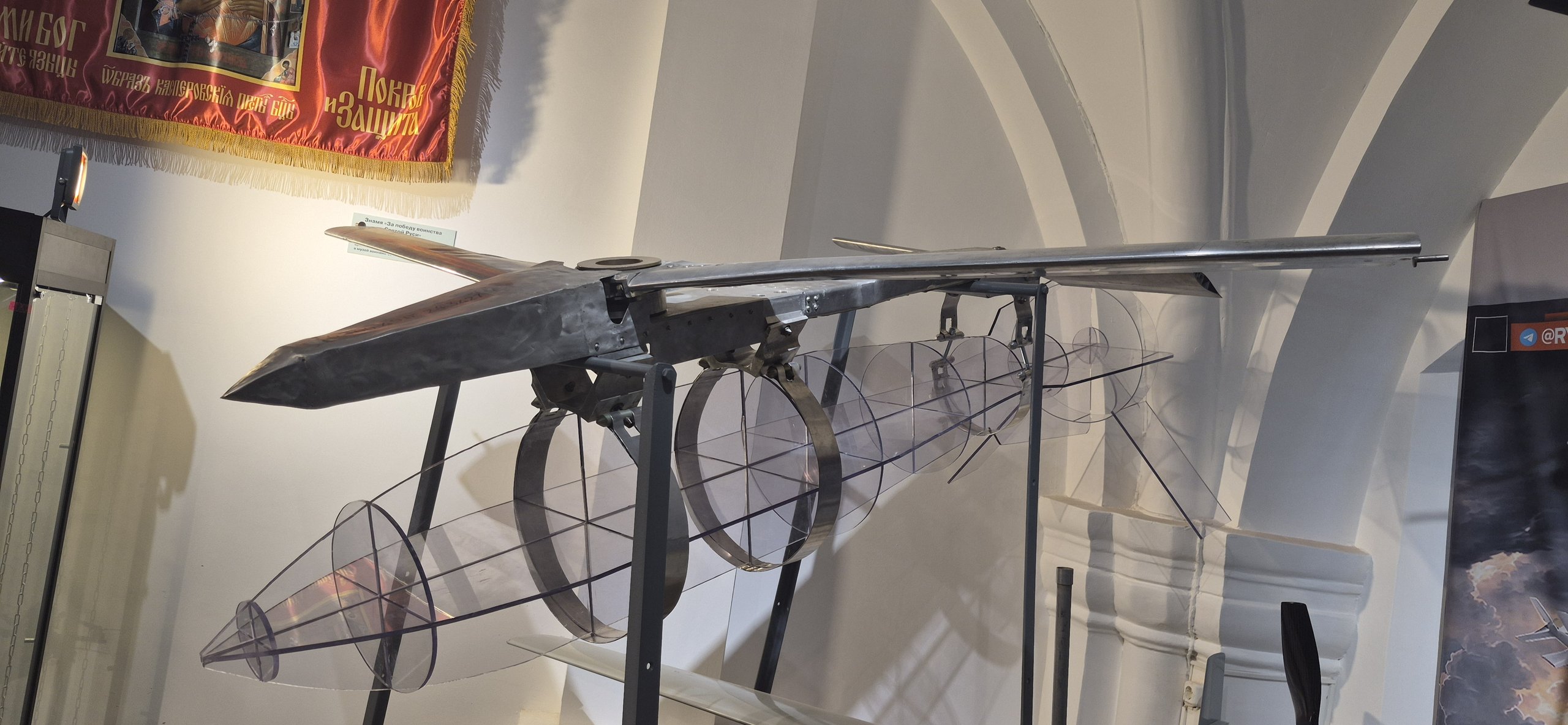 UMPK kit at the Military Historical Museum of Artillery, Engineers and Signal Corps, Saint Petersburg
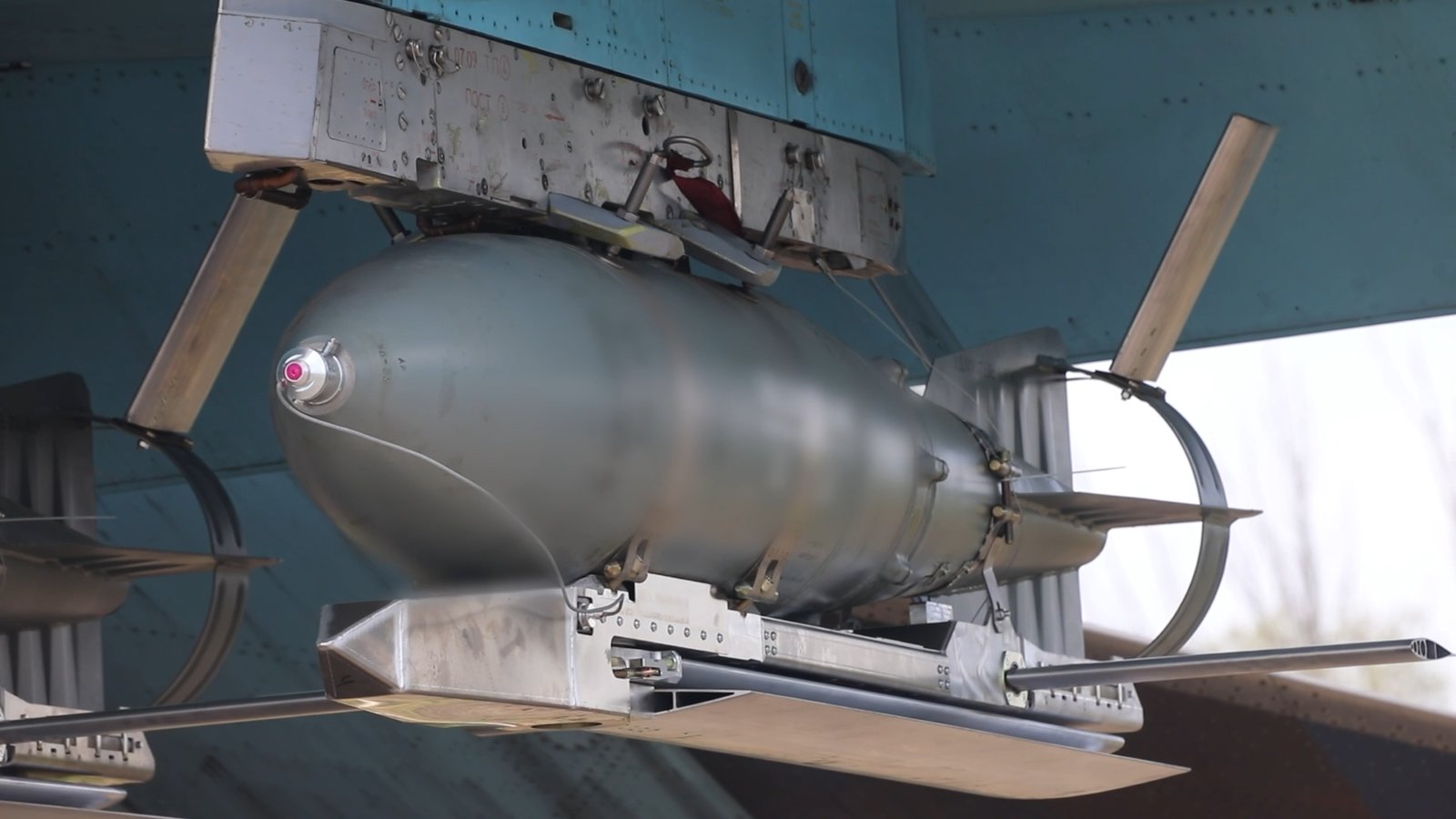 FAB-500T with UMPK kit under the wing of an Su-34
Photos: F.Alexsandr / Wikimedia Commons · Ministry of Defence of the Russian Federation / Wikimedia Commons
Videos



Overview
The UMPK (универсальный модуль планирования и коррекции, “universal gliding and correction module”) is a bolt-on kit of folding wings, tail control surfaces and satellite-aided navigation. It turns Russia’s huge Soviet-era stock of FAB free-fall bombs into glide bombs that can be released tens of kilometres from the target. Since 2023 it has been one of the most heavily used weapons of the war in Ukraine. Ukraine’s defence ministry counted about 40,000 guided bombs in 2024 and almost 44,000 in the first eleven months of 2025, according to Gwara Media. Kyiv Post, citing Ukrainian Air Force data, reported a record 8,266 in June 2026.
In Ukrainian usage these weapons are usually called KABs, for “guided aerial bombs”. The main carrier is the Su-34 fighter-bomber from Sukhoi, which often releases salvos of four, eight or twelve bombs.
Who makes it
The idea is two decades old. NPO Bazalt, Russia’s main bomb maker, proposed wing kits for the FAB-500 at Farnborough in 2002 in four tiers of capability, but none was produced, Wikipedia notes. The wartime kit is a different matter. In February 2026 Ukraine’s military intelligence (HUR) published the extended-range UMPK-PD on its War & Sanctions portal and named Tactical Missiles Corporation (KTRV) as its main designer and manufacturer. Militarnyi reported HUR’s view that KTRV is “the main developer and contractor for the state order”, coordinating 31 enterprises. JSC NPO Kurganpribor does final assembly of the UMPK-250 and UMPK-500, and Bazalt still supplies bombs such as the FAB-500T.
How it works
The kit is a welded frame clamped around the bomb body, with a nose fairing, spring-deployed wings and elevons at the tail. Unlike the American JDAM, it does not replace the bomb’s tail, so it can be fitted in the field. Once released at altitude, the bomb glides towards set coordinates. Its range depends on the height and speed of release.
HUR’s breakdown lists the main subsystems and their Russian makers:
- a SMART glider control unit from ANPP Temp-Avia;
- Kometa jam-resistant satellite navigation from VNIIR-Progress, a 12-element Kometa-M12 adaptive antenna on the UMPK-PD and four or eight elements on earlier kits;
- a strapdown inertial navigation system;
- servo drives from KST Digital Technology, batteries from UPKB Detal and Uralelement, and a wing-unfolding system from Severny Press.
The electronics are not Russian. HUR found a Swiss u-blox GNSS module inside the Kometa-M12, along with an Altera Cyclone FPGA, an Analog Devices converter dated January 2024, a Linear Technology power module dated June 2024, a Sipex transceiver, a Chinese inertial module from MT Microsystems and a Chinese XLSEMI converter. Two years earlier, Conflict Armament Research had found the SMART controller and Kometa-M module in recovered kits, with markings deliberately removed, as Euromaidan Press reported. The Kometa family also guides the Geran-2 drone.
Cost is the point. The Russian channel Fighterbomber, which has links to the air force, put a kit at about 2 million roubles, roughly US$24,000.
From 250 kg to three tonnes
The first photo of a FAB-500M-62 with a kit circulated in January 2023. Ukraine’s Air Force reported regular use of winged 500 kg bombs by March, and Russia’s defence ministry acknowledged the UMPK in May. The kit then spread across the bomb inventory: the FAB-250 by May 2023, the RBK-500 cluster bomb by November 2023, the FAB-1500 by September 2023, and the ODAB-500 and ODAB-1500 thermobaric bombs in early 2024. Fighterbomber claimed the first combat use of the three-tonne FAB-3000 on 20 June 2024, a claim the Kyiv Independent could not verify. The defence ministry released video of an Su-34 launching one on 14 July 2024.
Accuracy is modest, and the large warheads make up for it. Kyiv Post reports that Russian planners treat misses of 100 feet or more as possible and hits within 20–30 feet as the best case.
Longer reach
Each Ukrainian countermeasure has been met with more range. The original FAB-500M-62 kit reached about 60–70 km, according to FDD’s Long War Journal. The UMPK-PD, fielded in 2024, has larger wings, a longer frame and the 12-element antenna. Defense Express put extended-range kits at up to about 95 km, Kyiv Post reported.
Jet propulsion followed. Wreckage of the UMPB D-30SN, a FAB-250-based munition with its own small jet engine and fuel tank, surfaced in March 2024. Ukrainian authorities revealed the UMPB-5 in July 2025. In October 2025 photos suggested that a jet-powered UMPB-5R used a Chinese Swiwin SW800Pro-Y commercial turbojet. HUR deputy head Vadym Skibitskyi said the new bombs have a range of 150–200 km, citing a 193 km test, along with better resistance to jamming. The Kharkiv regional prosecutor reported a strike on Lozova on 18 October 2025. In July 2026 a Russian channel reported the first use of extended-range kits against the port of Chornomorsk near Odesa. That is a Russian claim, not independently confirmed.
Countermeasures
Ukraine has no single answer to the UMPK. Its responses fall into four groups.
- Jamming navigation. In early 2025 Forbes reported that Ukrainian jammers, including the Lima system from the Night Watch team, were pushing bombs off target. Fighterbomber conceded misses of up to a kilometre, Kyiv Post noted. Jamming diverts a bomb rather than stopping it, and Russia has answered with longer-range releases and better antennas.
- Threatening the carriers. After Ukraine claimed three Su-34s in the south on 22 December 2023, ISW and the Ukrainian Air Force reported that Russian glide-bomb use there fell, Kyiv Independent wrote. The claims and the weapon used were not independently verified.
- Hitting stocks at airbases. Ukraine’s General Staff reported the destruction of a guided-bomb warehouse at Borisoglebsk on 5 July 2025. Earlier strikes hit UMPK-kitted bombs at Morozovsk in August 2024, and SBU sources reported glide-bomb stores hit at Marinovka in August 2025.
- The supply chain. HUR publishes the enterprises and foreign parts behind the kit to support sanctions enforcement. Six of the 31 enterprises it listed in February 2026 were then unsanctioned.
For civilians in Kharkiv, Zaporizhzhia and Sumy, the most common defence is still a warning and a shelter. Glide time is short, and the carriers stay out of reach.
Combat experience
Ukraine’s Air Force began reporting regular use of winged 500 kg bombs released from tens of kilometres away in March 2023, and Russia’s defence ministry acknowledged the UMPK in May 2023. Within a year the kit had been fitted to bombs from 250 kg to 3,000 kg. Ukrainian figures put use at about 40,000 guided bombs in 2024 and almost 44,000 in the first 11 months of 2025, with October 2025 a record of more than 5,300, per the defence ministry. Use kept climbing in 2026: Kyiv Post, citing Ukrainian Air Force data, reported 8,266 in June 2026 and a single-day record of 391 bombs in 127 sorties on 13 June.
The bombs have been used against front-line positions and against cities within reach of the border and the front, including Kharkiv, Zaporizhzhia and Sumy. Longer-range jet-assisted versions reached Lozova in Kharkiv region in October 2025.
Effectiveness
The UMPK’s value to Russia lies in quantity and stand-off distance rather than precision. A kit costing roughly 2 million roubles, according to the Russian channel Fighterbomber, turns stockpiled Soviet bombs into weapons that can be released 40 to 95 km away, outside the reach of most Ukrainian short-range air defence. Large warheads make up for limited accuracy: Kyiv Post reports best-case hits within 20–30 feet and misses of 100 feet or more.
Countermeasures have imposed costs without ending the campaign. Jamming lowered accuracy in 2025, carrier losses briefly suppressed use in the south in late 2023, and strikes on airbases have destroyed stocks. Russia responded by pushing release points further back with the UMPK-PD and jet-assisted UMPB-5R, which brings more Ukrainian cities into range.
Warhead upgrades
| Warhead | Type | Mass | Since | Notes |
|---|---|---|---|---|
| FAB-250 M-54/M-62 | high-explosive general-purpose bomb | 250 kg class | 2023 | Used with the kit at least as early as May 2023; also the core of the UMPB D-30SN source |
| FAB-500M-62 | high-explosive general-purpose bomb | 500 kg class | 2023 | The first and most widely used bomb fitted with the kit source |
| FAB-500T | high-explosive bomb, thick-walled | 500 kg class | 2024 | Made by NPO Bazalt; paired with the extended-range UMPK-PD from 2024 source |
| FAB-1500 M-54 | high-explosive general-purpose bomb | 1,500 kg class | 2023 | Used with the kit from at least September 2023; displayed in January 2024 during Defence Minister Shoigu's visit to Tactical Missiles Corporation source |
| FAB-3000 M-54 | high-explosive general-purpose bomb | 3,000 kg class | 2024 | First use claimed by Fighterbomber on 20 June 2024 near Liptsy, Kharkiv region (unverified by Kyiv Independent); Russian MoD released Su-34 launch video on 14 July 2024 source |
| ODAB-500 | thermobaric (fuel-air) bomb | 500 kg class | 2024 | Russian MoD video dated 4 April 2024 showed an Su-34 launching four with UMPK kits source |
| ODAB-1500 | thermobaric (fuel-air) bomb | 1,500 kg class | 2024 | Used with the kit from at least February 2024 source |
| RBK-500 | cluster bomb | 500 kg class | 2023 | Used with the kit from at least November 2023 source |
Variants
- UMPK (base kit)2023
Folding wings, tail surfaces, inertial plus four- or eight-element Kometa navigation; about 60–70 km reach with the FAB-500M-62; Russian MoD acknowledged it in May 2023 source
- UMPK-PD (extended range)2024
Larger wing area, longer power frame, 12-element Kometa-M12 antenna and upgraded SMART control unit; used mostly with the FAB-500T source
- UMPB D-30SN2024
FAB-250-based glide munition with inertial/satellite navigation, ailerons and an internal jet engine and fuel tank; wreckage surfaced March 2024; estimated range up to 90 km; Fighterbomber says it can also be launched from Tornado-S source
- UMPB-52025
Revealed in combat testing in July 2025; larger warhead and range "over 100" km per a Kharkiv prosecutor's official source
- UMPB-5R / jet-powered UMPK2025
Turbojet-assisted; HUR deputy head Vadym Skibitskyi cited 150–200 km range, a 193 km test and improved EW resistance; strike on Lozova reported 18 October 2025; unofficial names also include "UMPK-PD model 2025", UMPK-R, UMPK-UD source
Countering it
As reported publicly; each line links its source.
- Electronic warfare against satellite navigation — Ukrainian jammers, including the Lima system from the Night Watch team, reportedly degraded accuracy in early 2025; Fighterbomber acknowledged misses of up to a kilometre. Jamming diverts bombs rather than stopping them, and Russia answered with longer-range kits released beyond the jammers' coverage source
- Shooting down the carrier aircraft — Ukraine claimed three Su-34s downed in the south on 22 December 2023; ISW and Ukrainian Air Force said Russian glide-bomb use in the area fell afterwards. The War Zone could not verify the claims or the weapon used source
- Strike on Borisoglebsk guided-bomb warehouse — Ukraine's General Staff said a 5 July 2025 strike on Borisoglebsk airfield destroyed a guided-bomb warehouse, a trainer aircraft and possibly other aircraft source
- Strike on Morozovsk ordnance depot — Ukraine's General Staff said an August 2024 strike by the SBU, HUR and armed forces destroyed an aviation ordnance depot holding UMPK-kitted bombs at Morozovsk airbase source
- Strikes on Marinovka airbase — SBU sources said an August 2025 strike hit fuel, ammunition and glide-bomb stores at Marinovka, a Su-34 base source
- Civil warning and shelter — Air-raid warning networks and taking cover underground remain the most common defence for civilians in frontline cities source
- Sanctions on the supply chain — HUR published 31 enterprises in the UMPK programme, six then unsanctioned, and the Western and Chinese components found inside to support export enforcement source
Sources
- war-sanctions.gur.gov.ua/en/page-umpk-pd
- militarnyi.com/en/news/diu-umpks-contain-electronic-components-from-usa-and-switzerland-and-some-manufacturers-are-not-yet-subject-to-sanctions/
- en.defence-ua.com/industries/ukraines_defense_intelligence_reveals_component_level_breakdown_of_russian_umpk_modules-17371.html
- en.wikipedia.org/wiki/UMPK_(bomb_kit)
- www.longwarjournal.org/archives/2025/10/russia-deploys-new-longer-range-bombs-in-war-against-ukraine.php
- www.kyivpost.com/post/81487
- www.kyivpost.com/post/53959
- gwaramedia.com/en/defence-ministry-russia-dropped-44000-glide-bombs-at-ukraine-during-2025/
- www.kyivpost.com/post/47998
- euromaidanpress.com/2025/06/06/russias-glide-bombs-glide-farther-now/
- euromaidanpress.com/2023/12/21/upgraded-russian-guided-bombs-suggest-ongoing-access-to-foreign-electronics/
- kyivindependent.com/isw-russia-reducing-aviation-activity-in-ukraine-after-losing-several-su-34-jets/
- news.liga.net/en/politics/news/ukrainian-general-staff-confirms-strike-on-russian-airfield-in-borisoglebsk-aircraft-and-warehouse-damaged
- militarnyi.com/en/news/russia-has-lost-a-large-number-of-aviation-ordnance-at-the-morozovsk-air-base/
- ukrinform.net/rubric-ato/3897635-ukraines-strike-destroys-ammo-depots-with-glide-bombs-at-russias-marynivka-airfield-source.html
- t.me/barantchik/39057