Products KBP Instrument Design Bureau
Tornado-S
systemAdversary capabilityby KBP Instrument Design Bureau
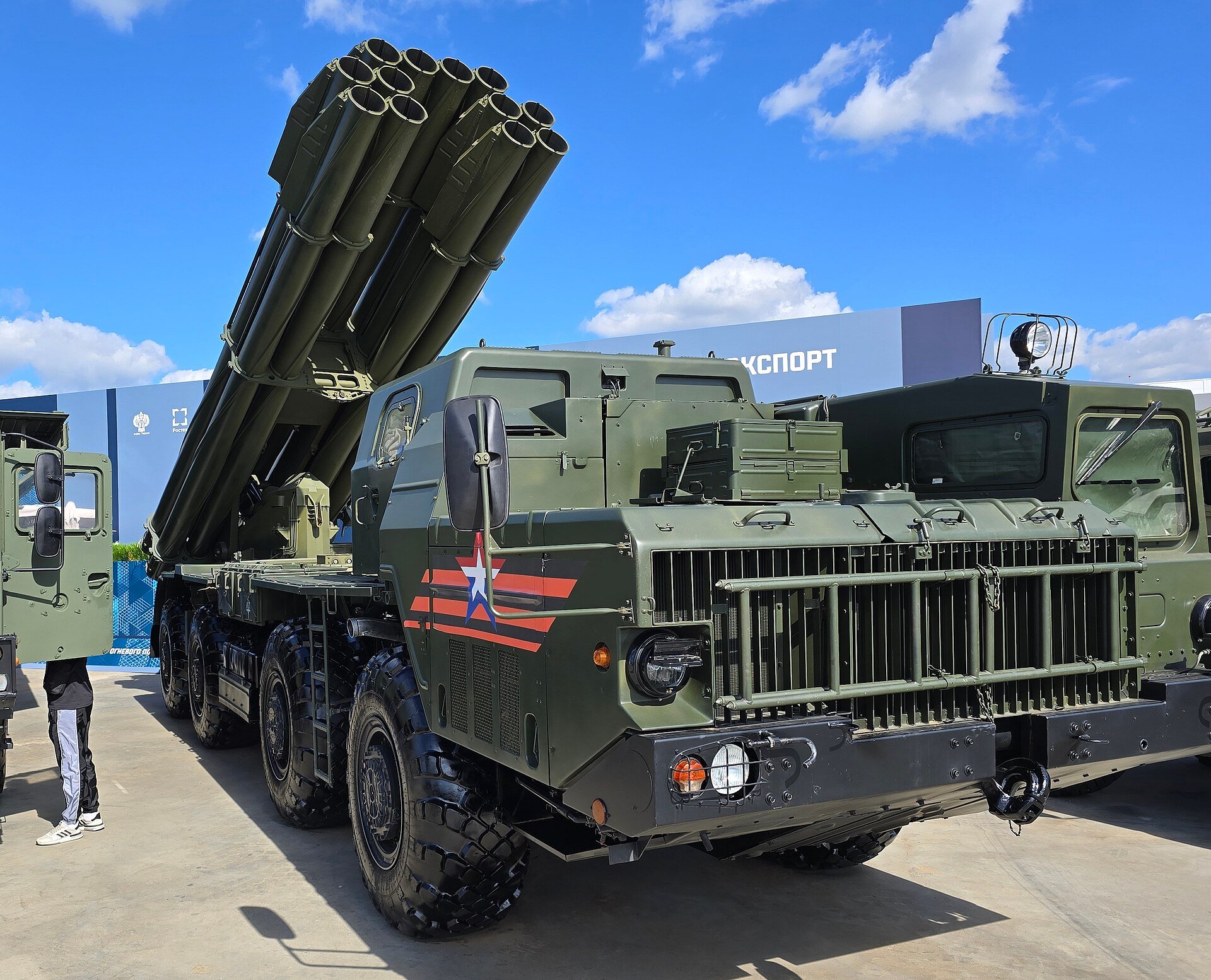
Photo: Nickel nitride
The Tornado-S is a Russian 300mm multiple-launch rocket system developed as a modernised successor to the Soviet-era BM-30 Smerch. Rocket development is credited to NPO Splav, the Tula-based artillery house that produces the system’s family of 300mm munitions under the state conglomerate Rostec. The launcher carries twelve 300mm tubes on a wheeled chassis and fires both guided and unguided rockets.
Russian state media and the manufacturer claim ranges of up to 120 km for the guided projectiles, with warhead masses in the region of 150 kg — figures that pro-Kremlin milblogger Yuri Podolyaka has used to argue that Tornado-S batteries can engage targets in the Zaporizhzhia area from positions deep inside Russian-held territory. Each guided rocket pairs inertial navigation with satellite correction, and Rostec asserts that the munitions can “break through echelons” of enemy air defence. A specialised 9M534 projectile, documented in Russian defence press, carries an Enics T90 reconnaissance drone in place of a warhead: a 40 kg pulse-jet-powered airframe with a 70 km data-link that is ejected near the target area, loiters for roughly half an hour, and is not recovered. A follow-on variant intended to carry an electronic-warfare payload — described by state-aligned reporting as capable of suppressing communications and radar links — was publicly announced by the head of Russia’s EW troops in 2022, though its testing status has not been confirmed. Fire-control automation supports rapid shoot-and-scoot cycles, which Russian commentators credit for the system’s survivability in a drone-saturated battlespace.
Russia is the primary operator. Russian war correspondents have identified the 79th Guards Rocket Artillery Brigade as a Tornado-S unit, publishing in September 2026 footage of what they describe as a Tornado-S strike on a Ukrainian HIMARS launcher in a treeline on the Kharkiv axis, with the target reportedly located by UAV reconnaissance. Through October 2026, Russian channels claimed Tornado-S strikes against the drone command post of Ukraine’s 54th Brigade, a Ukrainian temporary deployment point in the Chernihiv border village of Semenivka, air-defence positions in Zaporizhzhia Oblast, and the Sumy combined heat-and-power plant run by Sumyteploenergo — reported by milblogger Kotenok as struck by two Tornado-S rockets on 8 October 2026, leaving the plant offline. Independent corroboration of individual hit assessments is limited, and specific damage claims originate with the firing side.
Rostec frames Tornado-S as outperforming the American HIMARS in artillery-duel scenarios on the strength of its larger calibre and heavier rocket, though Western assessments generally credit the American system with tighter precision and faster integration into networked sensor-to-shooter chains. Pressure on the supply chain is visible: in August 2026 Ukraine’s General Staff reported strikes on the Kamensky Kombinat plant in Rostov Oblast, which it identified as a producer of solid rocket fuel for Uragan, Smerch and Tornado-S.
Recent development has focused on munitions rather than launchers — the drone-carrying 9M534 and the electronic-warfare variant — pointing to a trajectory from a conventional long-range fires platform toward a hybrid strike, reconnaissance and jamming role.
Sources (13)
- Telegram channel, Russian side:t.me/yurasumy/29743
- Telegram channel, Russian side:t.me/voenkorKotenok/76153
- Telegram channel, Russian side:t.me/voenkorKotenok/75974
- Telegram channel, Russian side:t.me/Voenacher/97592
- Telegram channel, Russian side:t.me/rostecru/12881
- Telegram channel, Russian side:t.me/mod_russia/68080
- Telegram channel, Russian side:t.me/intelslava/96191
- Telegram channel, Russian side:t.me/epoddubny/29105
- Telegram channel, Russian side:t.me/boris_rozhin/228556
- topwar.ru/201320-tornado-s-poluchit-novyj-snarjad-s-bpla.html
- /osint-hetzner/2026-08-22--russian-geran-drones-strike-ukrainian-railway-logisti …
- /osint-hetzner/2026-08-22--russian-floating-fire-platform-p-47-for-drone-defense …
- /osint-hetzner/2026-08-16--ukrainian-strikes-hit-russian-rocket-fuel-and-polymer …