Su-34
Two-seat Russian fighter-bomber derived from the Su-27, and the main carrier of the UMPK glide bombs that strike Ukrainian front-line towns daily.
AircraftAdversary capabilityby SukhoiIntroduced 2014 · Updated 2026
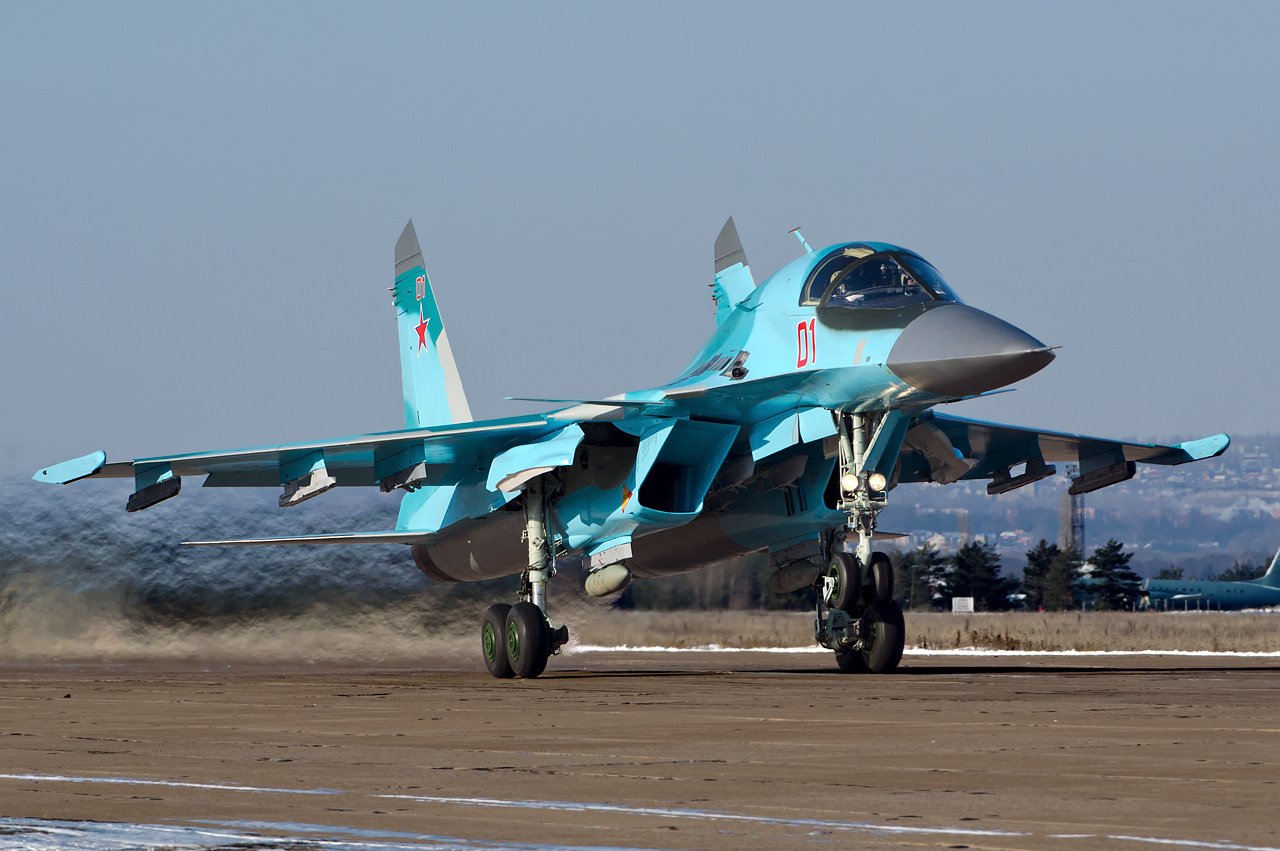
Photo: Alex Beltyukov / Wikimedia Commons
Videos


Overview
The Su-34 (Су-34, NATO reporting name Fullback) is a two-seat fighter-bomber built by Sukhoi at its Novosibirsk plant. It is a deep redesign of the Su-27 Flanker: a wider nose holds two crew side by side in an armoured cockpit, and the airframe is built to carry heavy loads a long way. Two Saturn AL-31FM1 afterburning turbofans give it a top speed of about Mach 1.8, and twelve hardpoints carry up to 12 tonnes of weapons, according to Wikipedia’s compilation of manufacturer and press data.
In Russia’s war on Ukraine it has become one of the most important aircraft on either side, not for its speed or sensors but for one job: it is the main carrier of FAB bombs fitted with UMPK glide-and-correction kits. Ukraine’s military intelligence (HUR) describes it as the primary carrier of these weapons, which strike front-line towns and positions every day.
Development
The prototype first flew on 13 April 1990, but money ran short after the Soviet collapse and the type was only formally accepted into Russian service on 20 March 2014. Export versions have been offered as the Su-32 and Su-34E. Algeria ordered 14 Su-34ME aircraft, and the first were reported delivered in 2025.
The Centre for Analysis of Strategies and Technologies (CAST) counts 212 Su-34s received by the Russian Aerospace Forces by early 2026, including seven prototypes and pre-production aircraft. It estimates output at about 16 production aircraft in 2024 and 18 in 2025, figures reported by Defence Blog. Rostec announces deliveries in small batches without numbers; GlobalMilitary.net logged the batch of 7 October 2026 as only the second announced that year.
Sensors, self-protection and suppliers
The aircraft carries a V004 passive electronically scanned array radar, an L150 Pastel radar warning receiver and the Khibiny electronic-warfare suite. In 2019 Shephard reported that the 47th Bomber Aviation Regiment at Voronezh-Baltimor had begun receiving KNIRTI’s pod-mounted Khibini-2 system, taking on more than 30 pods. The crew sits on K-36DM ejection seats. These are built and repaired by Avitek in Kirov, a plant Ukraine struck with a Flamingo missile in July 2026, according to Euromaidan Press.
In March 2026 HUR’s War & Sanctions project published a 3D model of the aircraft and a list of 79 enterprises behind it, about a third of them under no coalition sanctions. Named examples include Navigator, maker of RSBN-85V short-range navigation equipment; Kotlin-Novator, which repairs radar antennas; OKB Zenit for onboard power supply; and the trading arm of titanium producer VSMPO-Avisma, ArmyInform reported.
From dumb bombs to glide bombs
The Su-34 flew over Ukraine from the first day of the full-scale invasion, and the first was shot down near Buzova on 28 February 2022. Short of guided weapons, crews made low-altitude runs with unguided bombs into Ukrainian air defences, and losses were heavy.
The UMPK kit, deployed in 2023, changed that. It bolts pop-out wings and satellite-navigation guidance onto Soviet-era FAB bombs and lets the aircraft release them tens of kilometres from the target. Early Russian figures quoted 40–70 km. In July 2024 the Russian defence ministry released video of a Su-34 dropping a 3,000 kg FAB-3000 with a UMPK kit from its centreline, with smaller UMPB D-30SN glide bombs under the wings. The War Zone noted that until then the heaviest weapon the type was known to carry was in the 1,500 kg class.
In July 2026 ministry videos showed Su-34 NVO aircraft carrying four FAB-500T bombs on a new, elongated kit, variously labelled UMPB-5, UMPK-5R or UMPK-PD. The Aviationist noted that the longer body could hold a small jet engine. Wreckage found in Poltava Oblast in October 2025 contained what appeared to be a Chinese Swiwin SW800Pro-Y turbojet. Russian newspaper Kommersant claims ranges of up to 100 km, or 200 km with a booster. These are Russian claims and remain unverified.
The scale is the point. Ukraine’s General Staff reported 8,766 glide bombs dropped in August 2026, the highest monthly figure of the war, per migflug. The Su-34 is not the only carrier, but it carries most of them.
Variants
The modernised Su-34M, also known as Su-34NVO, adds upgraded avionics and radar and the ability to use longer-range munitions. An armed-reconnaissance version entered service in July 2025. Its exact differences from the baseline have not been published in detail.
Losses and Ukraine’s response
Oryx, which counts only losses confirmed by photographs or video, had recorded at least 41 Su-34s destroyed or damaged by July 2025. Ukrainian claims run higher. On 22 December 2023 Ukraine’s Air Force commander said three were destroyed at once over the south. Analysts pointed to Patriot, which Kyiv neither confirmed nor denied, and Russia confirmed nothing, The War Zone reported.
Because glide bombs are released from behind the front, Ukraine’s responses work at range. Long-range surface-to-air missiles force carriers to launch from further back, and drones strike the bases they fly from. Morozovsk, home of the 559th Bomber Aviation Regiment, was hit repeatedly in 2024. After an August strike HUR said satellite imagery showed one Su-34 destroyed and two likely damaged, Kyiv Post reported. On 27 June 2025 drones struck Marinovka in Volgograd Oblast. The General Staff said four Su-34s were hit and the SBU said two were destroyed, The Kyiv Independent reported. Russia did not confirm either loss.
For European air-defence planners, the lesson is that against a standoff glide weapon the launch aircraft and its airfield matter as much as the bomb itself. Russia’s strategic bombers, such as the Tu-95MS with its Kh-101 cruise missiles, strike deep into Ukraine. The Su-34 does the daily bombing close to the front.
Combat experience
Effectiveness
Warhead upgrades
| Warhead | Type | Mass | Since | Notes |
|---|---|---|---|---|
| FAB-500 with UMPK | unguided general-purpose bomb with glide-and-correction kit (satellite navigation, pop-out wings) | ~500 kg class | 2023 | The workhorse of Russia's glide-bomb campaign; UMPK kits were deployed in 2023, ending the low-level unguided bombing runs that had cost Su-34s heavily in 2022 source |
| FAB-1500 with UMPK | general-purpose bomb with glide-and-correction kit | ~1,500 kg class | 2023 | Until July 2024 the heaviest weapon known to be carried by the Su-34 was in the 1,500 kg class source |
| FAB-3000 with UMPK | general-purpose bomb with glide-and-correction kit | over 3,000 kg | 2024 | Russian MoD video published in July 2024 showed one carried on the centreline and released from a Su-34, with UMPB D-30SN glide bombs under the wings; earlier footage had shown only impacts source |
| FAB-500T with elongated UMPB-5 / UMPK-PD kit | glide bomb with extended-range kit | ~500 kg class | 2026 | Russian MoD videos of 15 and 24 July 2026 show Su-34 NVO aircraft carrying four of these; the longer body could hold a small turbojet. Kommersant claimed up to 100 km, or 200 km with a booster, which is unverified source |
| UMPB D-30SN | small-diameter guided glide bomb | ~250 kg class (seen on FAB-250-270 bodies) | 2024 | Carried under the wings alongside a FAB-3000 UMPK in July 2024; seen again on FAB-250-270 bombs in a July 2026 image source |
Variants
- Su-34 (basic)2014
Production two-seat strike aircraft built in Novosibirsk; formally accepted into service on 20 March 2014 source
- Su-34M / Su-34NVO2020s
Modernised version with upgraded avionics, radar and longer-range munitions; an armed-reconnaissance version entered service in July 2025. One Su-34M was among the visually confirmed losses by February 2025 source
- Su-34ME / Su-34E2025
Export version; Algeria ordered 14, with first deliveries reported in 2025 source
Countering it
As reported publicly; each line links its source.
- Long-range surface-to-air missiles — Ukraine's Air Force claimed three Su-34s downed in the southern sector on 22 December 2023; analysts suggested Patriot, which Ukraine neither confirmed nor denied. Russia did not confirm the losses source
- Strikes on airfields (Morozovsk) — SBU drones hit Morozovsk, home of the 559th Bomber Aviation Regiment, in April 2024; HUR said satellite imagery after an August 2024 strike showed one Su-34 destroyed and two likely damaged, plus a munitions store destroyed source
- Strikes on airfields (Marinovka) — On 27 June 2025 Ukraine's General Staff said drones struck four Su-34s at Marinovka, Volgograd Oblast; the SBU said two were destroyed and two damaged. The General Staff said the aircraft are used to drop glide bombs source
- Strikes on the supply chain — Ukraine hit the Avitek plant in Kirov, which builds and repairs the K-36DM ejection seats for the Su-34 and Su-57, with a Flamingo missile in July 2026 source
- Sanctions targeting — HUR's War & Sanctions portal published a 3D model of the Su-34 and the 79 enterprises behind it in March 2026, naming those not yet under any coalition sanctions source
Sources
- en.wikipedia.org/wiki/Sukhoi_Su-34
- www.twz.com/air/russias-giant-6000lb-glide-bomb-seen-launched-from-su-34-for-the-first-time
- theaviationist.com/2026/07/25/russia-su-34s-jet-capable-umpk-glide-bombs/
- shephardmedia.com/news/defence-notes/khibini-2-ew-systems-russian-su-34-bomber-fleet
- armyinform.com.ua/en/2026/03/17/one-third-of-russian-su-34-aircraft-production-enterprises-are-still-not-under-sanctions-diu/
- www.ukrinform.net/amp/rubric-defense/4102102-ukrainian-intel-names-russian-manufacturers-of-su34-systems-and-components-not-yet-under-sanctions.html
- euromaidanpress.com/2026/07/24/one-plant-makes-the-seats-that-save-russian-pilots-ukraines-flamingo-missile-torched-it-1200-km-from-home/
- www.twz.com/ukraine-says-it-shot-down-three-russian-su-34-fullbacks
- www.kyivpost.com/post/36907
- kyivindependent.com/ukraines-drones-strike-4-su-34-fighter-jets-in-russias-volgograd-oblast-general-staff-says/
- www.pravda.com.ua/eng/news/2025/06/27/7519134
- defence-blog.com/?p=100617
- www.globalmilitary.net/air_forces/events/202610-1487/
- migflug.com/afterburner/umpk-glide-bombs-russia-august-2026-record/