SGR-A1
Autonomous sentry gun using computer vision to detect, classify, and engage targets — deployed on the Korean DMZ since the mid-2000s.
systemby Hanwha AerospaceIntroduced 2006

Photos: ici.exploratv.ca · www.koreaherald.com · english.defensearabia.com · Hanwha Aerospace
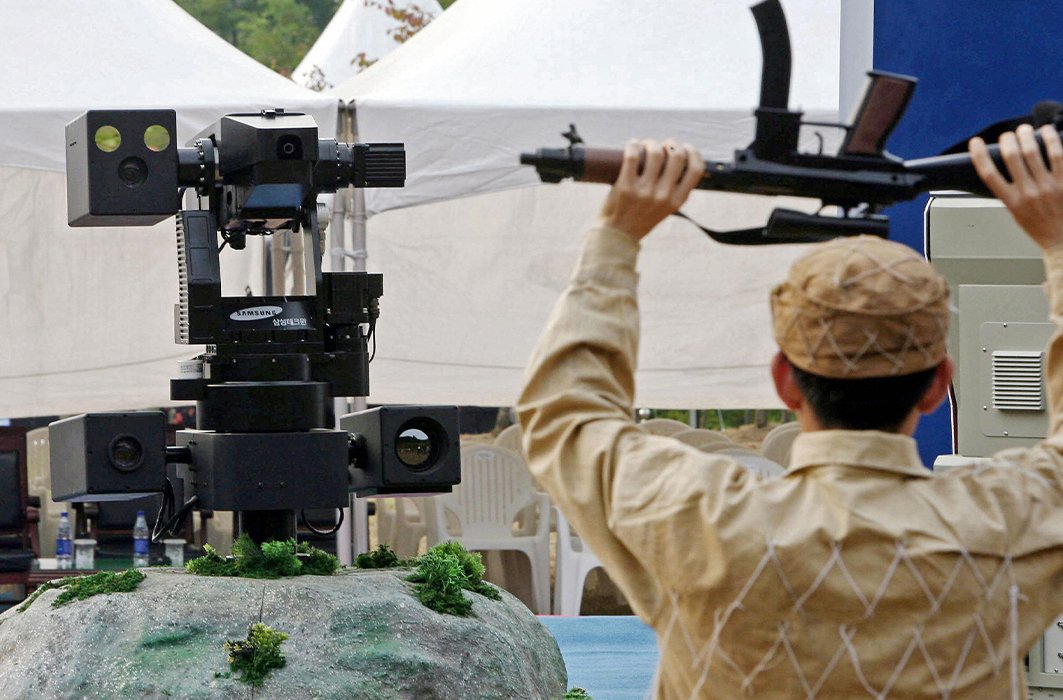
The SGR-A1 is a lethal autonomous weapons system (LAWS) designed as a stationary sentry gun to guard the Korean Demilitarized Zone (DMZ). Jointly developed by Samsung Techwin, now Hanwha Aerospace, and Korea University, the system entered service in 2006 following an initial government investment in 2003. It was engineered to replace human guards in one of the world’s most heavily militarized borders, aiming to reduce casualties and increase defensive firepower against North Korean incursions. The project’s primary objective, as stated by South Korean defense officials, was to transform traditional observation missions into an automated robot system capable of providing a “perfect guard operation.”
Technically, the SGR-A1 integrates surveillance, tracking, firing, and voice recognition into a single unit. The system weighs 117 kg and stands 120 cm tall. Its detection suite includes an uncooled infrared thermographic camera, an IR illuminator, and a laser rangefinder, allowing it to detect targets up to 4 km during the day and 2 km at night. Upon detecting a person, the system attempts to identify them via voice recognition. If no valid access code is provided, it can escalate from sounding an alarm to firing rubber bullets or engaging with lethal force. The weapon interface typically mounts a Daewoo K3 light machine gun, though it can accommodate other armaments. A digital video recorder captures footage for up to 60 days, and an operator can override the system’s actions via a built-in microphone and audio system. The unit costs approximately $200,000.
The Republic of Korea military is the primary operator of the SGR-A1. While units have been deployed along the 250-kilometer DMZ, the exact number remains unknown due to the project’s classified status. The system has never been used in combat. Its deployment has instead triggered significant international debate regarding the ethics and governance of unmanned military technology, particularly concerning the use of autonomous lethal force. The system represents one of the earliest practical applications of integrated autonomous sentry systems, predating many modern commercial and military drone-based defenses.