Products Almaz Antey
S-400
systemby Almaz Antey

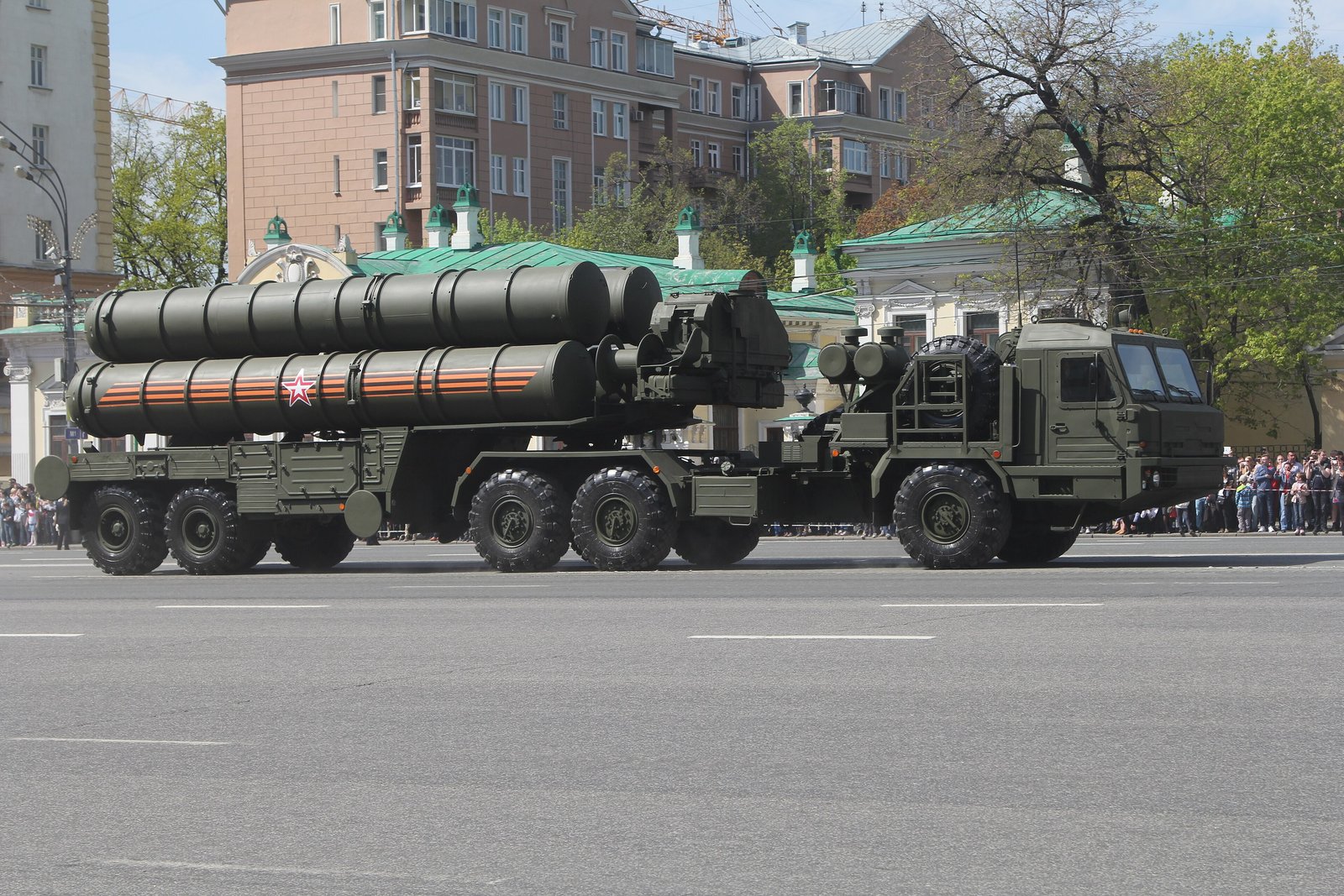
Photos: Vyacheslav Argenberg · Wikipedia
The S-400 Triumf, known in NATO reporting as the SA-21 Growler, is a long-range, mobile surface-to-air missile system built by Almaz-Antey and fielded by the Russian military from 2007 as the successor to the S-300 family. The manufacturer describes it as an integrated air- and missile-defence system able to engage aircraft, cruise missiles, unmanned aerial vehicles and short-range ballistic missiles simultaneously, and the design has become one of the most politically charged export items in the Russian defence catalogue.
A standard battery is built around the 91N6E “Big Bird” acquisition and battle-management radar, a 92N6E “Grave Stone” multi-function engagement radar, the 55K6E command post and a set of transporter-erector-launchers, typically the 5P85TE2 towed variant or the 5P85SE2 mounted on the BAZ-64022 tractor. It is designed around a family of missiles rather than a single round: the long-range 40N6, which Almaz-Antey claims reaches out to 400 km against high-altitude targets; the 48N6 series inherited and upgraded from the S-300, credited with around 250 km; and the shorter-range, more agile 9M96E and 9M96E2 for closer, faster-manoeuvring threats. Guidance combines command-uplink steering with active radar homing on the shorter-range rounds. The 40N6 in particular was announced repeatedly through the 2010s before Russian sources reported it as operational in 2018.
Russia is the principal operator, and the system has been exported to Belarus, China — the first foreign customer, taking deliveries from 2018 — and Algeria. India signed a roughly $5 billion contract in 2018 and has taken partial deliveries. Turkey’s 2019 purchase drew CAATSA sanctions from Washington and led to Ankara’s removal from the F-35 programme. Since 2022 the S-400 has been fielded around Crimea, Belgorod and occupied Ukrainian territory; Ukrainian officials and open-source analysts have documented strikes by ATACMS and, in one widely circulated case, a Neptune anti-ship missile against radars and launchers, damaging or destroying components on multiple occasions. Russian state media, in turn, credits S-400 batteries with heavy tolls against Ukrainian aircraft and missiles — claims that independent verification has not matched.
Development continues in parallel with the S-500 Prometey, which Almaz-Antey positions as a higher-tier system for ballistic and near-space threats rather than a replacement. Internationally, the S-400 sits opposite the US Patriot PAC-3, THAAD, the Israeli Arrow family and China’s HQ-9. Its brochure range and its performance under fire in Ukraine have diverged sharply, and much of the current reporting on the system is about that gap.