Products Almaz Antey
S-300
systemby Almaz Antey
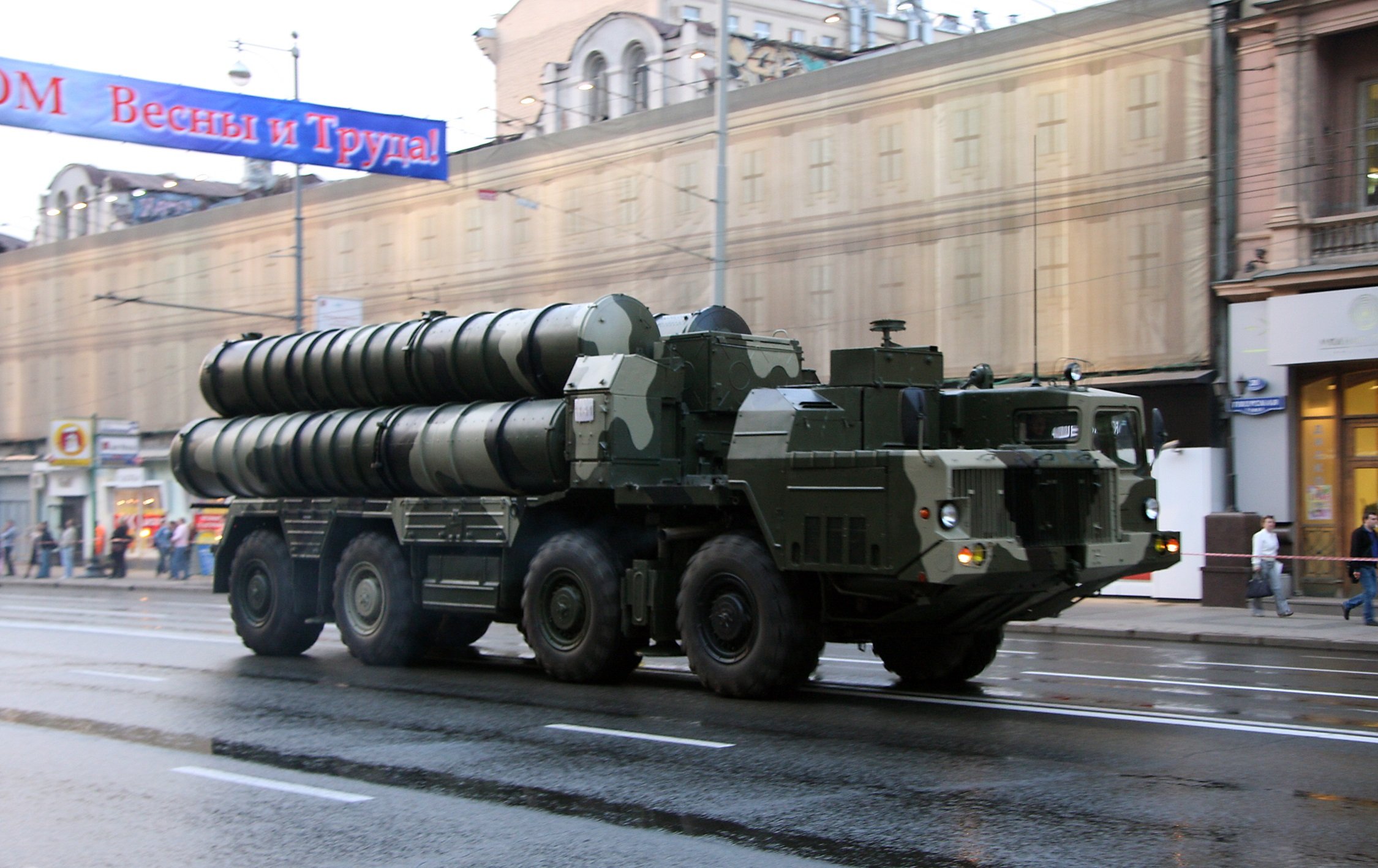
Photos: Wikipedia · Pusat Pendidikan Pusat Penerbangan Angkatan Darat
S-300 is a family of long-range surface-to-air missile systems developed in the Soviet Union in the 1970s and produced today by Almaz-Antey, the Russian air-defence conglomerate that consolidated the design bureaus behind it. The first variant, the S-300P, entered service with Soviet air defence forces in 1978. The design has since branched into three distinct lineages: the P-series for national air defence, the V-series developed by Antey for ground-forces cover against tactical ballistic missiles, and the F-series adapted for naval use. It occupies the tier of long-range area SAM that Western analysts most often compare with the Patriot.
At the heart of the system is a truck-mounted vertical launcher paired with an engagement radar — traditionally the 30N6 “Flap Lid” — and a longer-range acquisition radar such as the 64N6 “Big Bird” or the 96L6 “Cheese Board”. Missiles are cold-launched from sealed canisters, tipping over before igniting their solid-fuel motor in mid-air. Guidance is command-linked through most of the flight, switching to semi-active radar homing or track-via-missile in the terminal phase depending on the variant. The 48N6 missile family, standard on later S-300PMU variants, is credited by the manufacturer with a range of up to 200 kilometres against aircraft and the ability to engage short-range ballistic missiles; independent Western estimates generally place effective range against agile targets somewhat lower.
Operators outside Russia include Belarus, Kazakhstan, Bulgaria, Greece — which fields former Cypriot S-300PMU-1s on Crete — Slovakia, Vietnam, Algeria, Egypt, Venezuela, Iran, which received the S-300PMU-2 in 2016 after years of delay, and Syria. Ukraine inherited a large Soviet-era fleet and has relied on it as the backbone of its long-range air defence throughout Russia’s full-scale invasion. Slovakia transferred one of its S-300PMU batteries to Ukraine in 2022.
The war in Ukraine has been the most sustained combat test of the platform since it entered service. Ukrainian batteries have engaged Russian aircraft and cruise missiles while sustaining losses to Russian standoff strikes and Lancet drones, several of them documented in open-source footage. Russian forces, for their part, have repurposed S-300 rounds for ground-attack missions against Ukrainian cities — a role the missile was never designed for — exploiting the semi-ballistic terminal profile of the 5V55 and 48N6. Ukrainian officials and Western defence analysts have reported that dwindling interceptor stocks are a growing constraint on Kyiv’s long-range coverage, a shortage that has partly driven deliveries of Patriot and SAMP/T from Western partners.