Products Almaz Antey
Pantsir
systemby Almaz Antey
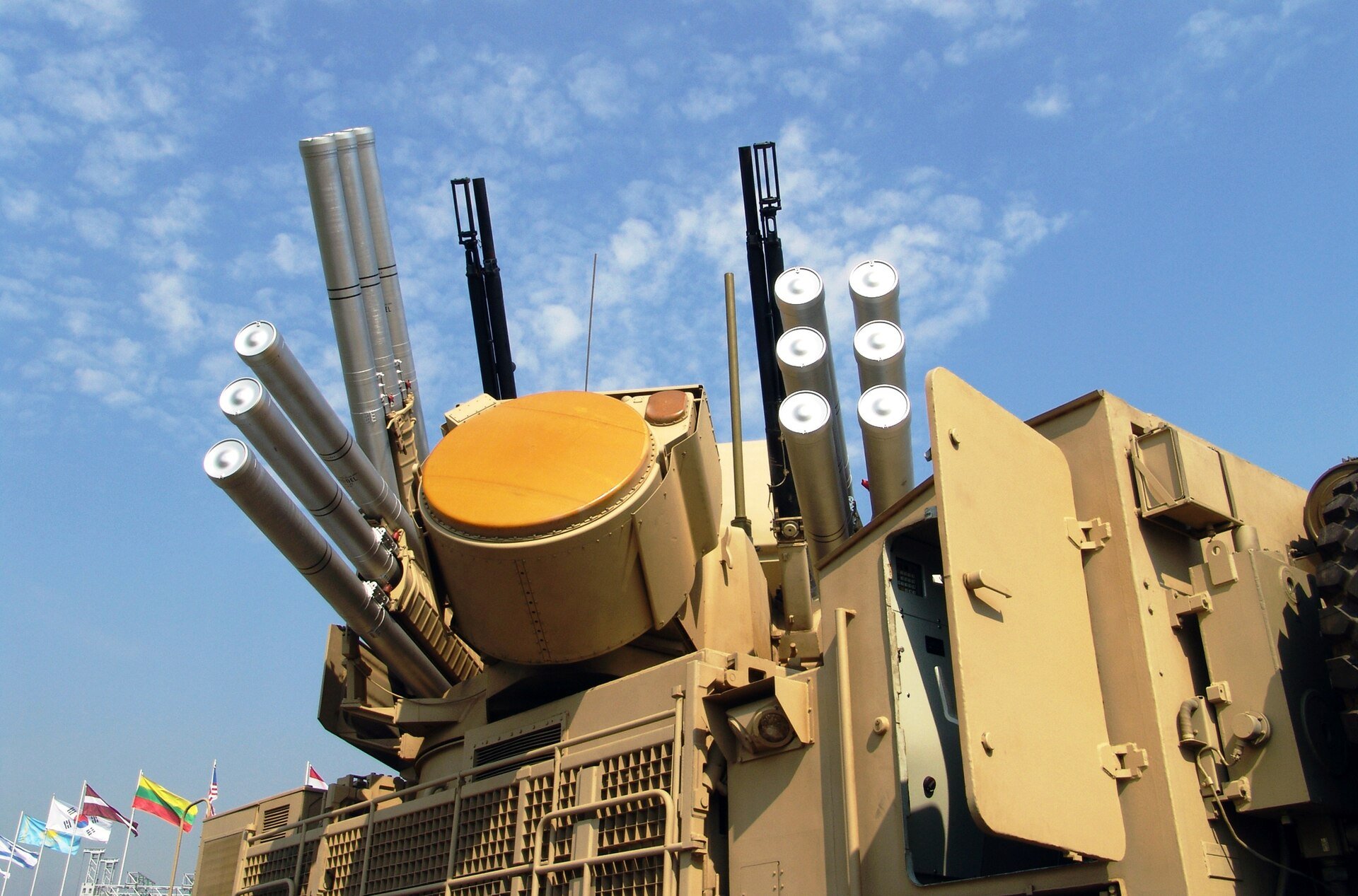
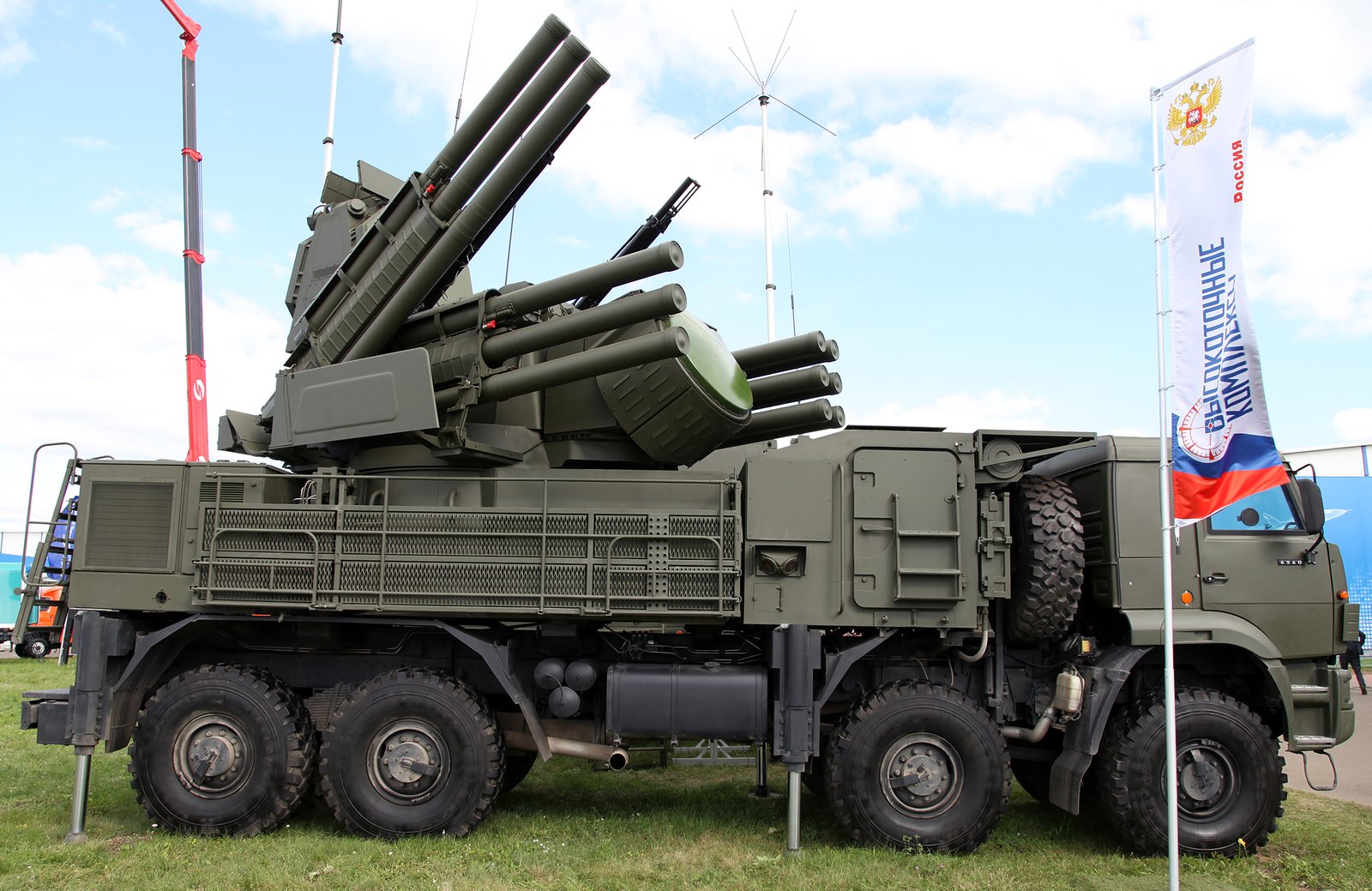
Photos: Vitaly V. Kuzmin · Wikipedia
Pantsir is a short-range air defence system that pairs twin 30 mm autocannons with surface-to-air missiles on a single wheeled chassis, developed by KBP Instrument Design Bureau in Tula and fielded by the Russian armed forces from around 2012. NATO reporting name SA-22 Greyhound. It is designed as a point-defence layer, protecting higher-value assets — including the longer-range S-300 and S-400 batteries — against aircraft, helicopters, cruise missiles, precision munitions and, increasingly, drones.
A single Pantsir-S1 vehicle carries twelve 57E6 two-stage command-guided missiles in ready-to-launch tubes alongside two 2A38M 30 mm autocannons. Tracking uses a Ka-band 1RS2 phased-array radar paired with a separate S-band acquisition radar, with an electro-optical sight available for radio-silent engagements. According to KBP, the missile reaches out to roughly 20 km at low altitude and closes to targets at hypersonic speed. The mount is normally a KamAZ-6560 8×8 truck, though the Pantsir-SA sits on a two-band tracked chassis for Arctic service and the Pantsir-ME is a shipboard variant. Autonomy is limited compared with newer Russian designs: the system is operator-in-the-loop, though the manufacturer says each vehicle can hand off tracks to others in a battery over a datalink.
Operators include Russia, the UAE, Algeria, Iran, Syria, Serbia, Iraq and — in a small early batch — Brazil. Russia has fielded the system extensively at the Khmeimim airbase in Syria and has made it the workhorse point-defence layer in Ukraine since 2022. Combat use has been contested. Russian milbloggers report successful engagements against Ukrainian drones and Storm Shadow / SCALP-EG cruise missiles, while Ukrainian and independent OSINT accounts, including satellite imagery reviewed by defence analysts, document dozens of destroyed Pantsir vehicles, often struck by HIMARS-launched GMLRS rounds or by long-range one-way attack drones that appear to slip under the system’s radar horizon. Turkish Bayraktar TB2 footage from Libya in 2020 similarly showed Pantsirs being knocked out on the ground.
KBP has iterated the platform through a Pantsir-S2 upgrade and the Pantsir-SM, which the manufacturer claims doubles missile range to about 40 km and adds a smaller anti-drone round said to fit four per tube. Russian state media has also shown a Pantsir-SMD-E variant marketed for counter-drone work.
Within the Russian air-defence architecture the Pantsir occupies the tier below the S-400 and above shoulder-fired systems. Its record in Ukraine has forced visible revisions to Russian short-range air-defence tactics, particularly as small drones have proven able to close on it before the radar’s minimum engagement range.