Palianytsia
Ukraine's turbojet "missile-drone" from the state-owned Luch Design Bureau, 650 km with a 100 kg warhead; credited with bringing down the road span of the Kerch Bridge on 17 November 2026.
Missile / loitering munitionby Luch Design BureauIntroduced 2024 · Updated 2026
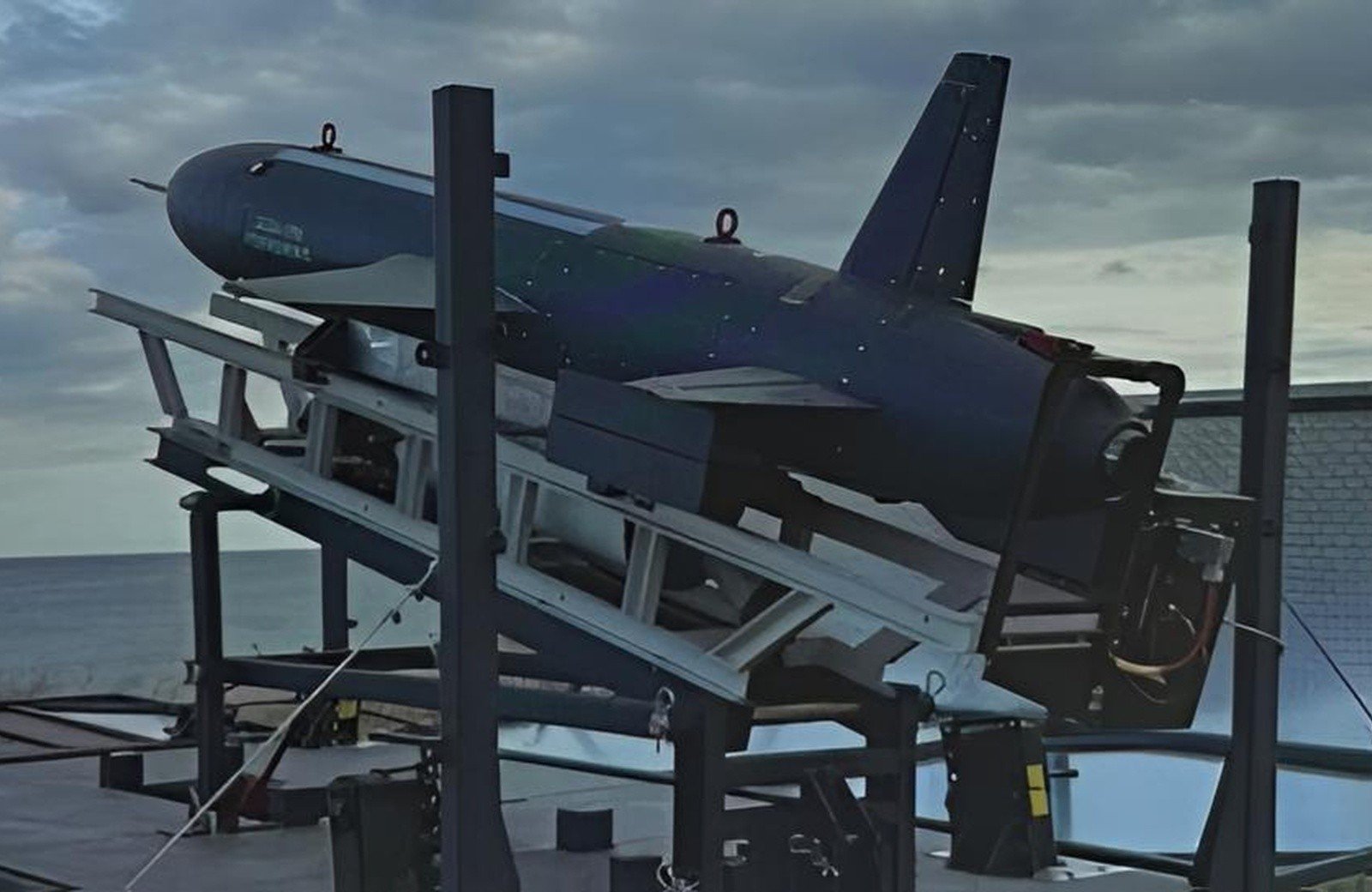
Photo: Ukroboronprom (via Militarnyi)
Videos


Palianytsia is a Ukrainian missile-drone: a small, jet-powered weapon that flies like a cruise missile but is built and priced closer to a long-range drone. It is developed and made by the state-owned Luch Design Bureau in Kyiv, the maker of the R-360 Neptune, and marketed abroad by Ukroboronprom as the UAV-290. The name is a type of Ukrainian bread, and a word Russian speakers famously struggle to pronounce. According to President Volodymyr Zelensky and the SBU, Palianytsia missile-drones brought down the road span of the Kerch Bridge on 17 November 2026.
How it works
Palianytsia is launched from a trailer or semitrailer by a solid-fuel booster, which falls away once a single-spool turbojet takes over. The figures Ukraine has released put the range at up to 650 km and the warhead at 100 kg. Shown at the MSPO fair in Kielce in September 2025, it was described as 3.5 m long with a 1.7 m wingspan and a launch weight of 320 kg, cruising at up to 900 km/h between 15 and 500 m above the ground (Militarnyi). Ukroboronprom’s own figures from MSPO 2026 give 350 kg and a cruising speed of up to 800 km/h (Militarnyi).
It navigates with an inertial system, which Ukraine describes as immune to electronic warfare, and uses satellite navigation to correct drift. Ukroboronprom says it is designed to “autonomously strike various stationary ground targets at the enemy’s tactical depth”. The engine type has not been officially disclosed.
Who builds it
Ukraine kept the maker quiet for more than a year. In December 2024 Defence Minister Rustem Umerov wrote that “a new start-up implemented the Palianytsia missile project” and that it had entered serial production with the ministry’s support (Kyiv Independent). The first public pointer to Luch came in January 2026, when Foreign Minister Andrii Sybiha posted a photo of a Palianytsia model he had received from Luch’s director, Oleh Korosteliov. Ukroboronprom showed a jet strike drone called the UAV-290 at Eurosatory in Paris in June 2026 (Ukrainska Pravda), and in September 2026 it confirmed that Palianytsia and the UAV-290 shown at trade fairs are the same weapon, “developed and manufactured by the state-owned Luch Design Bureau”.
Development took about 18 months from design to production. Digital Transformation Minister Mykhailo Fedorov said in August 2024 that it cost less than US$1 million a unit. Lithuania put €10 million into its production; President Gitanas Nausėda announced the money during Zelensky’s visit in September 2024. In January 2026 the National Bank of Ukraine issued a 5-hryvnia coin in its honour, calling it the first Ukrainian long-range weapon with a turbojet engine.
Combat use
Zelensky unveiled Palianytsia on Independence Day, 24 August 2024, calling it “a new class of weaponry” and saying it had already been used against a Russian target. He did not say which one; Ukrainian media pointed to a target in occupied Crimea. A video released the next day said “two dozen” Russian military airfields were within its reach.
On 12 August 2026 Zelensky said Palianytsia was used, with Neptune missiles and other Ukrainian missile-drones, in the strike on Russia’s naval base at Novorossiysk (UNITED24 Media).
Its most prominent use came on 17 November 2026, at the final stage of a weeks-long operation against the Kerch (Crimean) Bridge. Zelensky said that “Palianytsia drones performed exemplarily, striking the road section of the bridge”. The SBU said its Alpha special operations centre aimed Palianytsia missile-drones at the roadway, which collapsed into the water (Kyiv Post). Neptune missiles, Ruta missile-drones and the FP-5 Flamingo were sent at the rail section, which was damaged but still standing. The maker of the Ruta, Destinus, claimed its own missiles caused the collapse; Ukraine’s officials credit the Palianytsia. Full story: the Kerch bridge special report.
In Russia
Russian sources have claimed Palianytsia shoot-downs, with little to back them up. In September 2024 Russian channels posted wreckage of a jet-powered drone downed in the Kursk region, measuring 3.5 by 2.5 m with a 100 kg warhead, and called it a Palianytsia. Defense Express replied that the jet engine was the only reason for the identification and that the burnt wreckage did not settle the type (UNIAN). In December 2024 the pro-Kremlin Telegram channel Shot claimed that Ukraine had struck Taganrog with Palianytsia missile-drones (Vechernyaya Moskva). Neither claim has been confirmed. After the Kerch strike Russia’s Defence Ministry reported only drones shot down and did not name the weapon.
Combat experience
Effectiveness
Media
Articles
Ukroboronprom reveals designation of Palianytsia missile-drone
Militarnyi · 2026-09-09
Minister of Foreign Affairs revealed the developer and manufacturer of the Palianytsia missile drone: Design Bureau Luch
Militarnyi · 2026-01-13
From Flamingo to Neptune: Zelensky reveals details of Crimea Bridge strike
Kyiv Post · 2026-11-17
Inside the specs of Ukraine's long-range drone-missiles that struck Novorossiysk
UNITED24 Media · 2026-08-13
Ukraine's new Palianytsia missile drone enters serial production, defense minister says
The Kyiv Independent · 2024-12-04
Sources
- militarnyi.com/en/news/ukroboronprom-reveals-designation-of-palianytsia-missile-drone/ (2026-11-18) — Militarnyi, 9 Sep 2026 — Ukroboronprom confirms Palianytsia = UAV-290 (MSPO 2026), "developed and manufactured by the state-owned Luch Design Bureau"; 650 km, 100 kg, 350 kg, up to 800 km/h, INS+GPS, trailer launch with solid booster; used at Novorossiysk Aug 2026.
- militarnyi.com/en/news/minister-of-foreign-affairs-revealed-the-developer-and-manufacturer-of-the-palianytsia-missile-drone-design-bureau-luch/ (2026-11-18) — Militarnyi, 13 Jan 2026 — FM Sybiha posts a Palianytsia model from Luch director Oleh Korosteliov; MSPO 2025 figures 3.5 m, 1.7 m, 320 kg incl. ~100 kg warhead, 650 km, ~900 km/h, 15–500 m, single-circuit turbojet + solid booster.
- Telegram channel:t.me/V_Zelenskiy_official/21848 (2026-11-18) — Zelensky, 17 Nov 2026 — «взірцево себе показали безпілотники «Паляниця», які уразили автомобільну частину мосту».
- Telegram channel:t.me/OP_UA/20459 (2026-11-18) — Zelensky's evening address, 17 Nov 2026 — list of Ukrainian weapons used, incl. «Паляниця».
- www.kyivpost.com/post/90332 (2026-11-18) — Kyiv Post, 17 Nov 2026 — Zelensky quote; SBU says Alpha special forces targeted the roadway section with Palianytsia drone-missiles and it collapsed.
- united24media.com/war-in-ukraine/inside-the-specs-of-ukraines-long-range-drone-missiles-that-struck-novorossiysk-21643 (2026-11-18) — UNITED24 Media, Aug 2026 — Novorossiysk strike of 12 Aug 2026 with Palianytsia, Peklo, Bars and Long Neptune; 18-month development; under $1m.
- kyivindependent.com/ukraines-new-palianytsia-missile-drone-enters-serial-production-defense-minister-says/ (2026-11-18) — Kyiv Independent, 4 Dec 2024 — Umerov op-ed: "A new start-up implemented the Palianytsia missile project", in serial production with MoD support.
- www.ukrinform.net/rubric-ato/3898439-zelensky-ukraine-uses-its-palianytsia-drone-missile-for-first-time.html (2026-11-18) — Ukrinform, 24 Aug 2024 — Zelensky announces first combat use of the Palianytsia missile-drone.
- kyivindependent.com/ukraines-new-palianytsia-missile-drone-pictured-for-first-time/ (2026-11-18) — Kyiv Independent, Aug 2024 — first official images; video says "almost everything" is classified, "two dozen" Russian airfields in range.
- eng.obozrevatel.com/section-war/news-it-was-a-complex-operation-media-finds-out-where-palianytsia-drone-missile-was-first-used-02-09-2024.html (2026-11-18) — Obozrevatel, 2 Sep 2024 — conflicting reports on first target; a journalist says an attack on Crimea in August.
- commons.wikimedia.org/wiki/File:Lithuania_Announced_Readiness_to_Increase_Support_for_Ukraine%27s_Defense_Industry_%E2%80%93_President_of_Ukraine_Volodymyr_Zelenskyy_(113536015).jpg (2026-11-18) — Office of the President release, 12 Sep 2024 (copied to Commons) — Nausėda: "Lithuania is investing 10 million euros in the production of Ukraine's long-range “Palianytsia” weapon."
- www.unian.net/economics/finance/pamyatnye-monety-nbu-nacbank-vypustil-monetu-posvyashchennuyu-rakete-palyanicya-13271778.html (2026-11-18) — UNIAN, 30 Jan 2026 — NBU 5-hryvnia coin "Ukrainian cotton. Missile-drone Palianytsia"; first domestic long-range weapon with a turbojet.
- www.unian.ua/war/raketa-dron-palyanicya-rosiyani-hvalyatsya-shcho-zbili-unikalniy-bpla-foto-novini-vtorgnennya-rosiji-v-ukrajinu-amp-12763977.html (2026-11-18) — UNIAN / Defense Express, Sep 2024 — Russian claim of a Palianytsia downed in Kursk region; identification rested only on the jet engine.
- vm.ru/news/1190364-shot-vsu-atakovali-taganrog-raketami-dronami-palyanica (2026-11-18) — Vechernyaya Moskva (pro-Kremlin), 11 Dec 2024, citing Telegram channel Shot — claims Ukraine struck Taganrog with Palianytsia missile-drones. Lead only.
- www.twz.com/news-features/these-are-the-weapons-ukraine-used-to-drop-the-kerch-bridge (2026-11-18) — The War Zone, Nov 2026 — overview of the weapons Zelensky named; Palianytsia credited with the road section.
- www.pravda.com.ua/eng/news/2026/06/15/8039423/ (2026-11-18) — Ukrainska Pravda, 15 Jun 2026 — Ukrainian defence industry unveils UAV-290 jet-powered strike drone with 100 kg payload (Eurosatory 2026).