Products Special Technology Center
Orlan-10
Petrol-engined Russian reconnaissance drone built around consumer parts; the spotter behind much of Russia's artillery fire and Leer-3 jamming.
DroneAdversary capabilityby Special Technology CenterIntroduced 2010 · Updated 2026
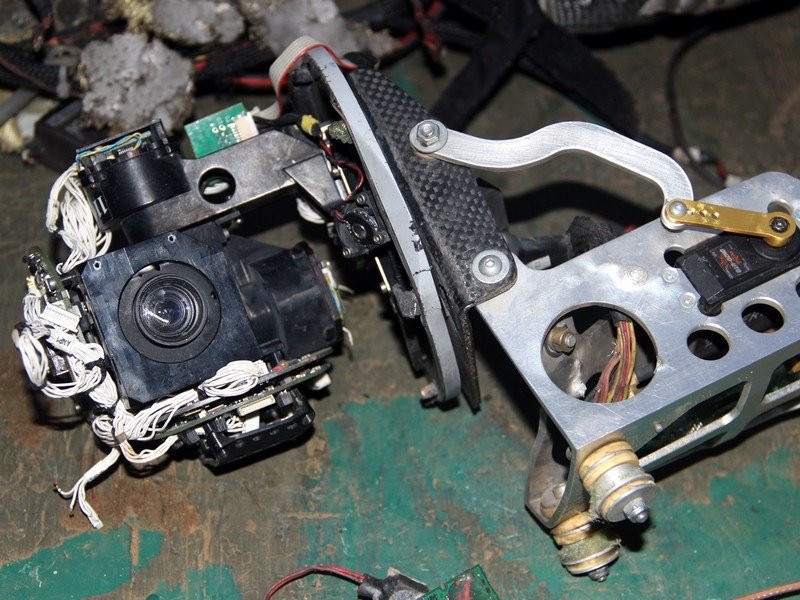 Wreck of a Russian Orlan-10 downed in Donbas, summer 2014 — internals visible
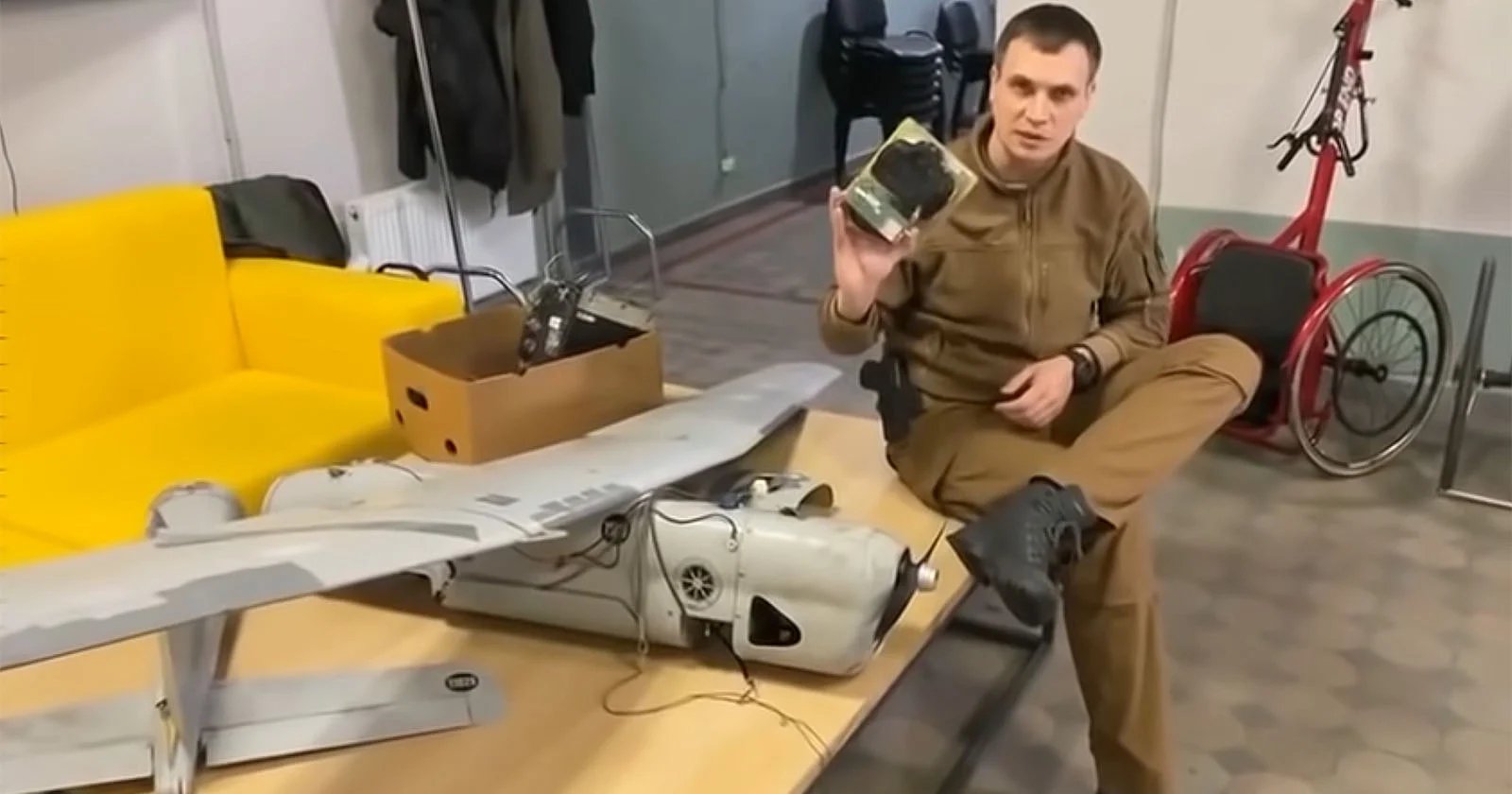 Teardown still showing the Canon DSLR inside the camera bay
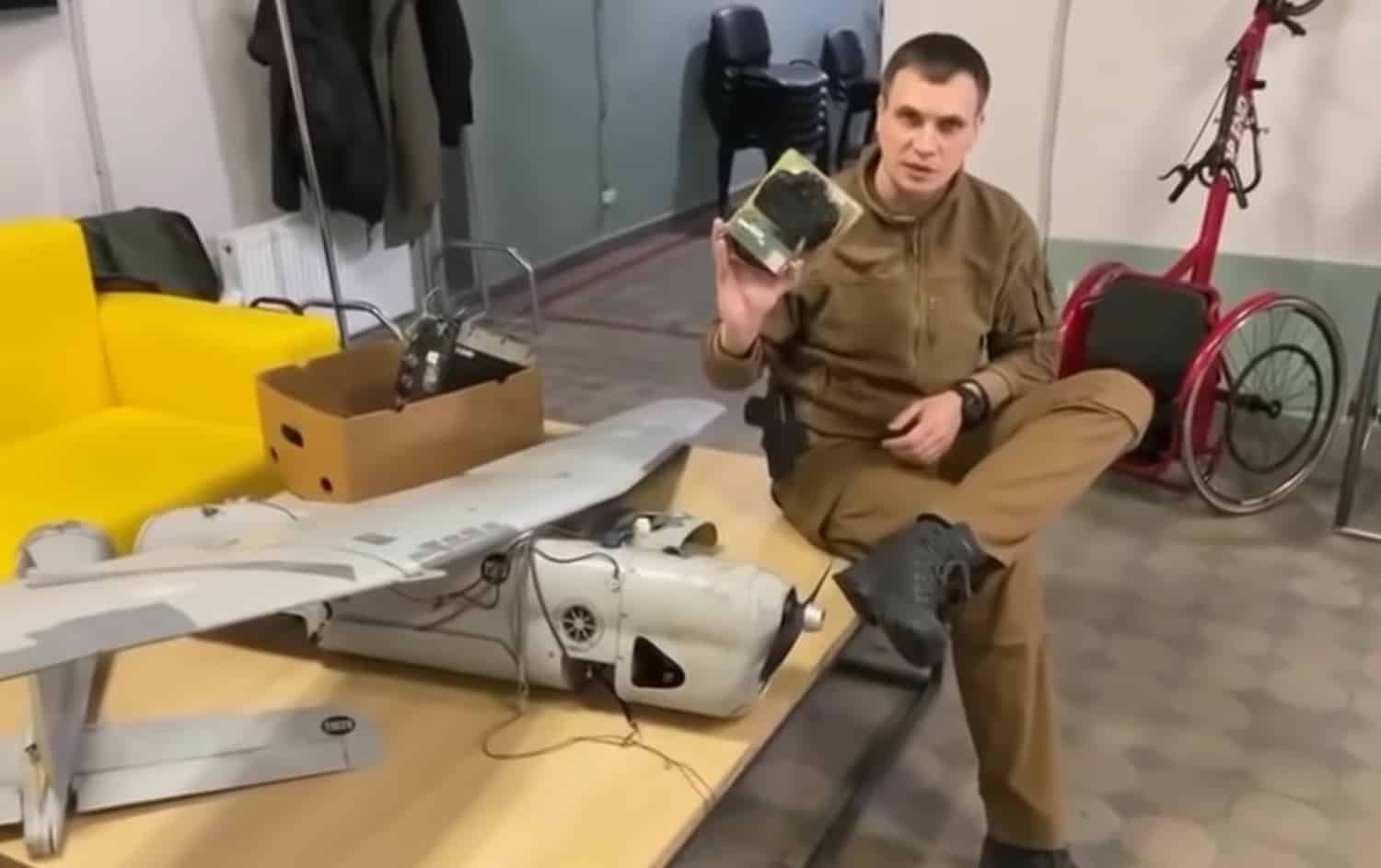 Teardown screenshot — camera mount and fuselage interior
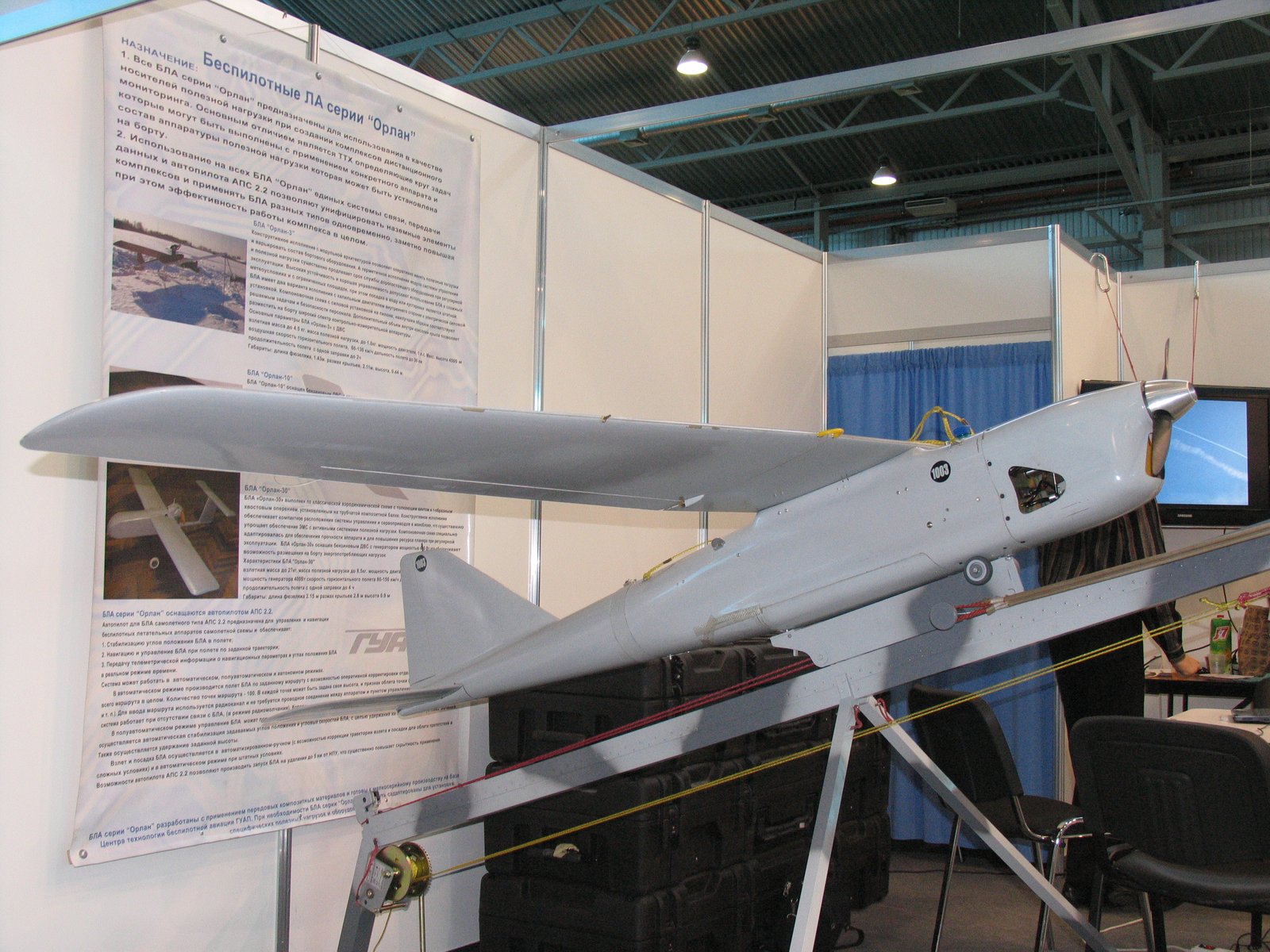 Orlan-10 No. 1003 at InterAeroCom 2010, St Petersburg
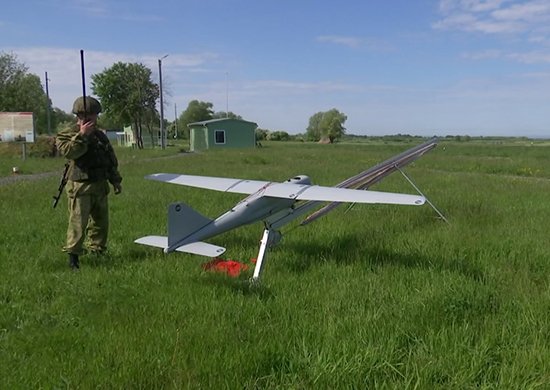 Orlan-10 on its folding launch catapult
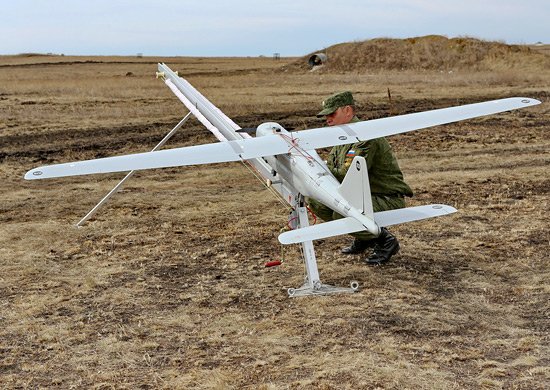 Orlan-10 airframe
Photos: Ministry of Defence of Ukraine / Wikimedia Commons · Ukrainian MoD / ArmyInform via PetaPixel · Ukrainian MoD video via DroneXL · Mike1979 Russia / Wikimedia Commons · Ministry of Defence of the Russian Federation / Wikimedia Commons
Videos


Overview
The Orlan-10 (Орлан-10) is a small fixed-wing reconnaissance drone made by the Special Technology Center (STC) in St Petersburg. It is not a weapon, but it directs a large share of the fire that is. Since 2014 it has spotted for Russian artillery over Donbas, mapped terrain in Syria and carried electronic-warfare payloads. Since 2022 it has been one of the most common Russian aircraft over Ukraine. An airframe was already on public display at InterAeroCom 2010 in St Petersburg. By 2018 more than 1,000 had been built across 11 variants, according to Russian reporting summarised on Wikipedia. In February 2024 TASS reported a manufacturer claim of more than 1,000 a year.
Design
The Orlan-10 is a conventional high-wing aircraft with a composite fuselage, launched from a folding catapult and recovered by parachute. Published figures give a maximum take-off weight of 15 kg, a payload of up to 6 kg, a top speed of about 150 km/h, a ceiling of 5,000 m and an endurance of up to 16 hours. Its practical working radius is about 110 km, and longer when another aircraft relays the signal. A full system of two aircraft, a launcher, a ground station and spares cost about 5 million rubles in 2013.
Power comes from a small Japanese model-aircraft engine. Ukraine’s military intelligence (HUR) lists a Saito FG-40 single-cylinder four-stroke petrol engine, serial ASSS8EAF4222, recovered from a June 2022 aircraft. Other reporting names the Saito FA-62B. Both may be accurate for different production lots. In 2022 the Japanese broadcaster ANN aired a full teardown of the engine section, filmed by the Ukrainian military.
Electronics and guidance
The Orlan-10 became a symbol of Russia’s dependence on imports in April 2022. A video from Ukraine’s defence ministry opened a crashed Orlan-10 and found that its main camera was a Canon EOS 750D, an entry-level consumer DSLR (sold as the Rebel T6i in North America). DroneXL noted that the camera was held on with Velcro, its mode dial was glued in place, and a plastic bottle cap served as a fuel-tank lid. Later units have been reported with thermal cameras, but the identification of the specific sensor is disputed.
The electronics are mostly Western. A December 2022 investigation by RUSI, Reuters and iStories found that only the airframe was Russian. Analog Devices supplied the RF transceiver and video encoder; Microchip the microcontrollers and flash memory; Texas Instruments the power, video and Wi-Fi parts; Xilinx and Altera the FPGAs; and Gumstix a computer-on-module. The navigation module came from u-blox and the microcontrollers from STMicroelectronics. TDK supplied a gyro stabiliser and NXP a pressure sensor. CBS News reported US and Swiss satellite-navigation chips able to use GLONASS, GPS and Galileo. Hacked documents analysed by InformNapalm in January 2024 showed STC turning to Chinese suppliers, including T-Motor propulsion parts, Radiolink flight controllers and GPS modules, and Gpixel image sensors, while still buying Sony cameras.
Navigation is satellite-based with a pre-programmed route. The operator flies it from a ground station, and the video link is the main product.
Warheads
The standard Orlan-10 carries no warhead. Wikipedia cites reports of a strike version carrying four small high-explosive fragmentation munitions, but no well-documented open source confirms its use. The drone’s lethal contribution is indirect: it finds targets for artillery and for loitering munitions such as the Lancet.
Variants
- Leer-3 (RB-341V): an electronic-warfare system in which up to three Orlan-10s carry jammers against cellular networks, controlled from a KamAZ-5350 command vehicle. The DFRLab documented it in eastern Ukraine in 2018. Once the local towers are suppressed, it can send text messages to phones in the area, and it has been used to send false messages to soldiers.
- Relay and jammer teams: Orlans flying in groups, with one aircraft relaying communications while another jams.
- Orlan-30: a larger aircraft of about 30 kg introduced in 2020, with a laser rangefinder and designator for Krasnopol guided artillery shells. An export version was shown at Army-2023.
- Orlan-10E: the export model, reported in Kyrgyzstan and, as “Orlan-E”, in Myanmar.
Combat use
From 2014 Ukrainian officials reported shooting down and capturing Orlans over Donbas, and the OSCE monitoring mission recorded Leer-3 systems there in 2018 and 2020. In Syria, Russian forces used the aircraft for mapping and reconnaissance, including the 2015 search for a downed Su-24 crewman. Units have also turned up in Libya and, operated by Wagner, in Mali.
Since 2022 the Orlan-10 has typically been used to spot for Russian artillery: the drone finds a target and the guns fire on it. A Ukrainian officer claimed more than 580 Orlans destroyed by December 2022. Oryx, which counts only losses confirmed by photographs, had at least 208 Orlan-10s, 19 Orlan-20s and 16 Orlan-30s by February 2025. Outside Ukraine, an Orlan was reported neutralised by Swedish electronic countermeasures over the Øresund in February 2026.
Countering it
Ukraine has used short-range air-defence missiles, including an SA-13 against an Orlan-30 and the British Martlet, as well as light aircraft: a Yak-52 crew brought one down in April 2024. Interceptor drones have since become a cheaper option. Electronic warfare has had mixed results. Reporting describes the Orlan as hard to jam, and Russia has moved it to new frequency bands as Ukrainian systems adapted.
Sanctions have been the slower lever. STC has been on the US sanctions list since 2016, but the RUSI investigation traced more than $25 million in Western parts bought through intermediaries in the first ten months of 2022 alone. That makes the Orlan-10 a test case for export-control enforcement as much as for air defence.
Combat experience
Effectiveness
Variants
- Leer-3 (RB-341V) EW configuration2015
Orlan-10s carrying GSM jammers and acting as relay; system of up to three drones with a KamAZ-5350 command post; can send SMS to subscribers source
- Relay / jammer group configuration2018
Flown in teams where one aircraft relays communications and another jams source
- Orlan-302020
Larger (~30 kg) sibling with laser rangefinder/designator for Krasnopol guided shells source
- Orlan-30 export with laser designation2023
Export version shown at Army-2023 source
- Orlan-10E
Export version (Kyrgyzstan order; Myanmar "Orlan-E") source
Countering it
As reported publicly; each line links its source.
- Air-defence missiles — Ukrainian forces have downed Orlans with short-range SAMs (e.g. an SA-13 against an Orlan-30) and a UK-supplied Martlet source
- Light aircraft — A Ukrainian Yak-52 crew reportedly brought one down in April 2024 source
- Electronic warfare — Reporting describes the Orlan as hard to jam and some Ukrainian EW as poorly matched to its bands, with Russia shifting frequencies in response source
- Supply-chain sanctions — STC sanctioned by the US since 2016 and by UK/EU/Japan/Canada since 2022, but kept buying Western parts via intermediaries source
Sources
- war-sanctions.gur.gov.ua/en/components/1744
- istories.media/en/stories/2022/12/15/the-west-has-banned-the-sale-of-components-for-weapons-production-to-russia-but-russia-is-still-buying-them/
- static.rusi.org/SR-Orlan-complex-web-final.pdf
- petapixel.com/2022/04/11/ukraine-opens-russian-drone-finds-canon-dslr-inside/
- dronexl.co/2022/04/12/russian-orlan-10-drone-canon-camera
- zmina.info/en/news-en/key-russian-drone-manufacturer-of-orlan-10-uavs-ramps-up-production-despite-sanctions-leaked-documents/
- en.wikipedia.org/wiki/STC_Orlan-10
- www.cbsnews.com/news/ukraine-war-russia-iranian-drones-us-made-technology-chips
- dfrlab.org/2018/08/23/minskmonitor-new-russian-electronic-warfare-systems-in-eastern-ukraine/
- www.c4isrnet.com/newsletters/unmanned-systems/2018/11/16/russian-drones-can-jam-cell-phones-60-miles-away
- www.airrecognition.com/index.php/focus-analysis-photo-report-aviation-defence-industry/aviation-defence-industry-technology/5503-russian-army-to-get-orlan-30-drone-in-2020.html
- tass.com/defense/1661863
- tass.com/defense/1746679
- www.armyrecognition.com/focus-analysis-conflicts/army/conflicts-in-the-world/russia-ukraine-war-2022/ukrainian-sa-13-gopher-air-defense-system-takes-down-advanced-russian-orlan-30-artillery-drone
- theaviationist.com/2024/04/27/ukrainian-yak-52-vs-russian-uav/
- www.oryxspioenkop.com/2022/02/attack-on-europe-documenting-equipment.html