Products Mikoyan
Kinzhal
systemby Mikoyan
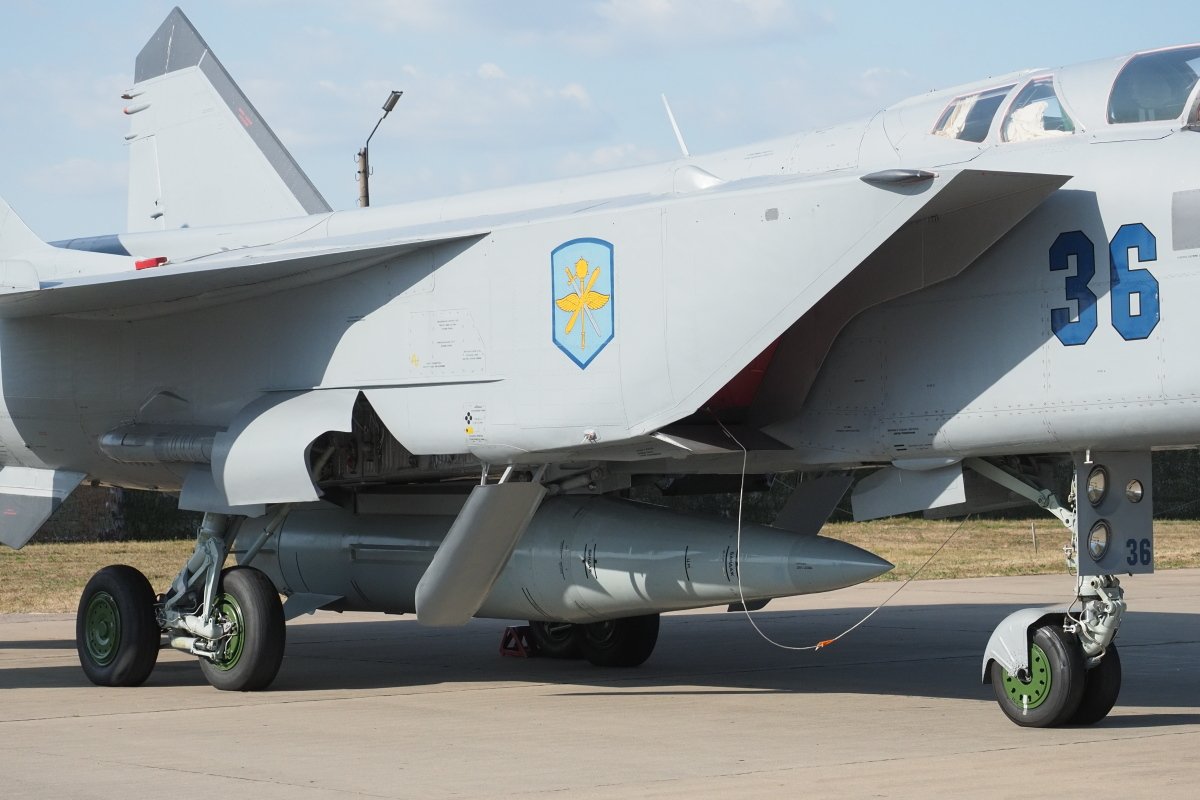
Photo: Boevaya mashina
The Kinzhal is a Russian air-launched ballistic missile, released at altitude and speed from a modified Mikoyan MiG-31K interceptor to extend its reach well beyond that of its ground-launched cousin. Western analysts and the CSIS Missile Threat profile describe it as a derivative of the 9K720 Iskander-M short-range ballistic missile; Wikipedia attributes the design to Russia’s Votkinsk Plant State Production Association and Tactical Missiles Corporation. President Vladimir Putin unveiled the system in a March 2018 address as one of six “next generation” weapons, and Russian sources date entry into service to 2017.
Published specifications are drawn largely from Russian state outlets and defence-press summaries. CSIS lists a length of about 8 metres, a body diameter of roughly 1 metre and a launch mass near 4,300 kg; Jane’s and Wikipedia give a shorter estimated length of 7.2 m. The missile is believed to use a solid-propellant rocket motor with inertial-navigation guidance and mid-course updates. Payload is reported at 480 kg, either a conventional high-explosive warhead or a low-yield nuclear warhead in the five-to-fifty kiloton range. After release it accelerates to roughly Mach 4 and is advertised by Russian state media as reaching up to Mach 10, though CSIS notes the “hypersonic” label is somewhat misleading, since nearly all ballistic missiles cross Mach 5 at some point in flight. Combined range of missile and launching aircraft is cited at 1,500–2,000 km, with Russian officials claiming the figure would exceed 3,000 km if the weapon were fitted to the Tu-22M3 bomber. Independent teardowns of recovered wreckage, reported by Ukrainian outlet UNITED24 in September 2026, have found the Kinzhal’s electronics continue to rely on Western-manufactured chips despite Russian claims of import substitution.
The weapon is operated by the Russian Aerospace Forces. By 2018, Russian reports indicated six MiG-31s had been modified to carry it, based at Akhtubinsk in southern Russia. The first known combat use came on 19 March 2022, when the Russian Ministry of Defence announced a Kinzhal strike on a munitions depot near Deliatyn in western Ukraine; CNN subsequently reported that U.S. officials had tracked the missile in real time. Since the full-scale invasion the weapon has featured in Russian strike packages against Ukrainian energy facilities and cities. Ukrainian air defences have reported shooting down Kinzhals on several occasions, including an engagement near the Polish border in February 2026, and Kyiv credits its U.S.-supplied Patriot batteries with intercepting large numbers of Russian ballistic missiles of various types. In August 2026, Ukrainian forces struck a Russian air base hosting MiG-31K carriers, part of a sustained campaign against the launch platforms themselves.
Beyond the MiG-31K, Russian sources describe trials with the Tu-22M3M bomber, reported integration with the Su-34 strike aircraft and planned carriage by the Su-57. Unit cost has been cited at around $10 million, and leaked Russian procurement records analysed by Ukrainian defence outlet Militarnyi in late 2025 point to a comparatively small production run — a constraint Russia has reportedly managed in part through aerial refuelling of its MiG-31K carriers to sustain strike cadence against Ukraine.