Khoryv
Aquatechnik's founding kamikaze sea-drone family — 3D-printed hull first combat used in 2023; Khoryv 2.0 scales to 30–40 units per month with multi-link comms.
Droneby AquatechnikIntroduced 2022
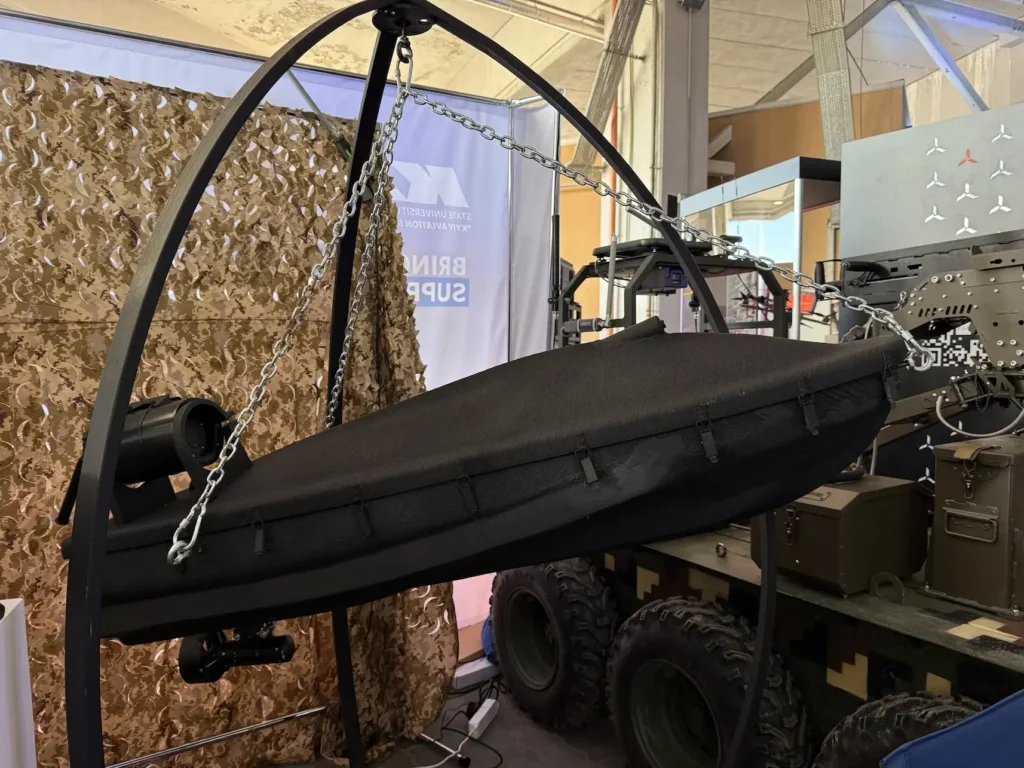
Photo: thedefender.media
Khoryv is a family of kamikaze surface drones built by Aquatechnik, a Ukrainian developer that emerged in the first year of the full-scale war as one of Kyiv’s specialised producers of naval strike craft. The founding vessel entered service in 2022 and saw its first reported combat use in 2023, placing it among the earlier Ukrainian sea drones to cross from prototype into operational deployment on the Black Sea and along the Dnipro estuary.
The first-generation Khoryv is small, cheap, and disposable. Its hull is 3D-printed — a choice Aquatechnik has publicised as central to how quickly the boat can be iterated and produced by a small workshop. The company states the Gen 1 boat carries a warhead in the twenty to twenty-five kilogram range and is guided through a fibre-optic tether. That is an unusual choice for a naval platform: it forfeits the range a radio link would give and constrains the boat to the length of its spool, but it also removes the electromagnetic signature Russian electronic warfare on the Black Sea approaches can attack. Propulsion, control electronics and payload sit inside a hull built to fail — the boat is not meant to come back.
Khoryv 2.0, unveiled subsequently, enlarges the hull and replaces the single tether with a multi-link communications suite giving operators several parallel channels, a common Ukrainian answer to jamming. Aquatechnik has said the second-generation platform is engineered for serial production at a stated capacity of thirty to forty units per month. Public reporting on autonomy features is thin; both generations are described as remotely operated, in line with most fielded Ukrainian USVs, with any on-board target-recognition still a claim rather than a demonstrated capability.
Ukraine is the sole known operator. The Khoryv family sits alongside more publicly discussed Ukrainian sea drones — Magura V5 from the Defence Intelligence Directorate’s programme, and the Security Service’s Sea Baby — in what has become the most consequential experiment in unmanned surface warfare of the past decade, and the campaign that pushed the Russian Black Sea Fleet from its historical base at Sevastopol. Aquatechnik occupies the lower-cost, higher-volume end of that spectrum.
Combat details tied specifically to Khoryv strikes remain sparse in open sources, and Aquatechnik, like most of Ukraine’s naval-drone shops, releases little on individual missions. The system’s significance is less any single attack than what it represents: a small, additively manufactured hull produced in the tens per month by a firm that did not exist before the war.