Kh-22
systemAdversary capabilityby MKB Raduga
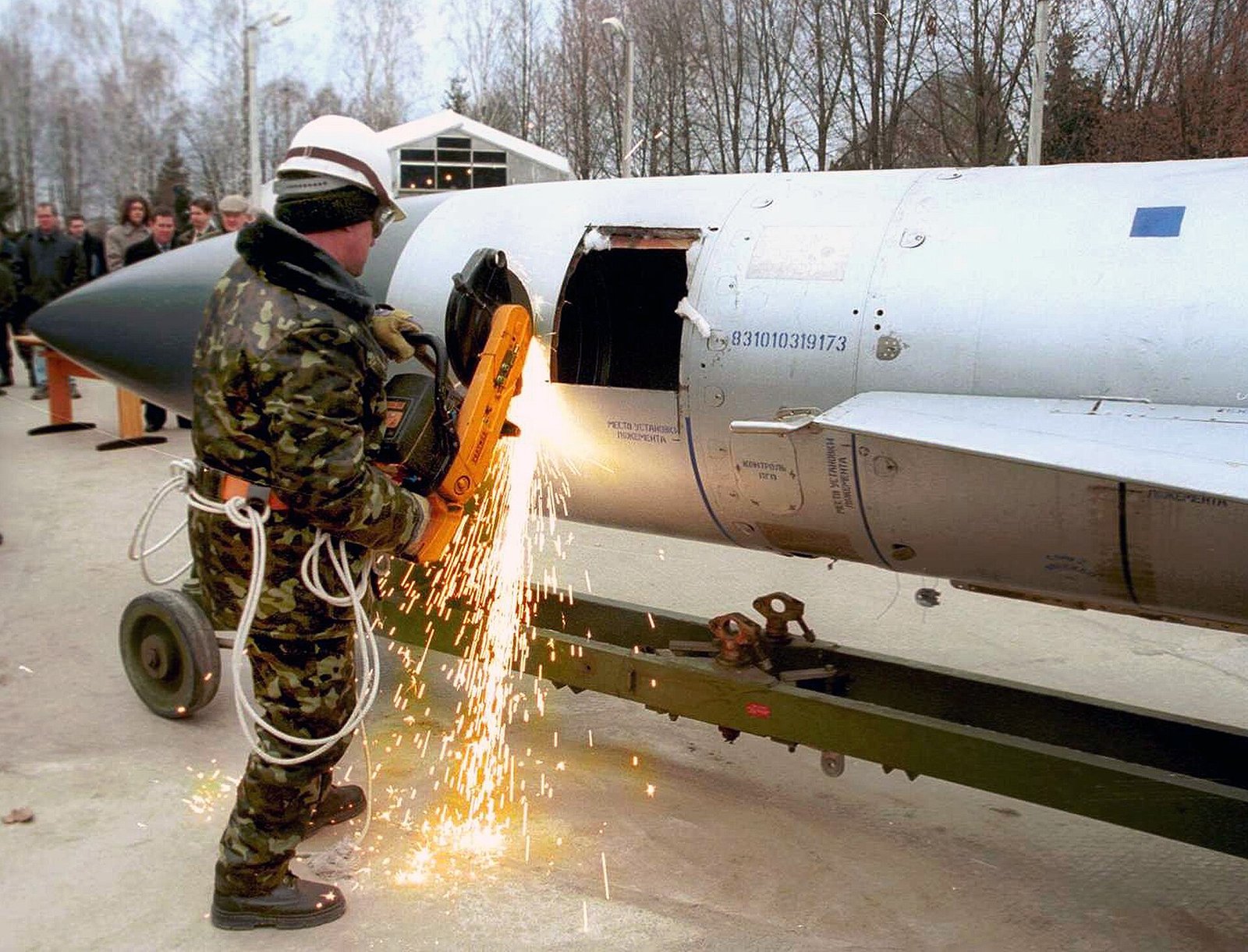
Photo: DTRA photo
The Kh-22 is a Soviet-era air-launched cruise missile that remains in Russian service nearly six decades after it entered the fleet. Designed by MKB Raduga at its Dubna bureau and accepted into service in 1968, the weapon (NATO reporting name AS-4 “Kitchen”) was built to kill American carrier battle groups from stand-off ranges. A single round weighs 5,820 kg, carries a 1,000 kg RDX warhead or a thermonuclear payload in the hundreds of kilotons, and is launched from the Tu-22M “Backfire” bomber, with the heavier Tu-95K-22 and the earlier Tu-22K also qualified to carry it.
What makes the missile distinctive is its speed and its propulsion. A liquid-fuel R-201 rocket motor, burning the toxic combination of Tonka-250 and IRFNA, pushes the airframe to roughly Mach 4.6 — around 5,600 km/h — and lofts it to altitudes between 24 and 27 km on a high-trajectory flight profile. Guidance is pre-microchip: inertial navigation during cruise, with an active radar seeker in the terminal phase that was originally designed to lock onto the enormous signature of a surface warship. Range in the Kh-22M/MA variant is about 600 km, and the accuracy Soviet engineers specified against ships — a circular error probable above 90 metres — is one of the central problems when the missile is fired at targets ashore. The upgraded Kh-32, accepted for service in 2016, keeps the airframe and launch platform but introduces a new rocket motor and a redesigned seeker head intended to be more jam-resistant and better suited to land targets.
Russia is the sole current operator. Both the Kh-22 and the Kh-32 have been used repeatedly in the Russo-Ukrainian war, with Ukrainian air defences so far unable to intercept the weapon in flight. Ukrainian military channels reported that none of the Kh-22/Kh-32 missiles fired in the overnight salvo of 17 October 2026 against Zaporizhzhia and Kryvyi Rih were shot down, with 22 confirmed impact locations across the broader strike. Russian channels covering the same raid claimed hits on the Zaporizhstal metallurgical works and the Zaporozhtransformator plant, alongside Kalibr and Iskander-M launches; the Ukrainian General Staff did not break out damage by weapon type. The missile’s size and the limited surviving stocks mean Russia uses it today for strategic effect against industrial and infrastructure targets rather than against the ships it was built for — a 1960s anti-ship rocket pressed into service as a long-range inland strike system, carrying both the throw-weight and the inaccuracy of its original design.
Sources (9)
- en.wikipedia.org/wiki/Kh-22
- en.wikipedia.org/wiki/Kh-22
- Telegram channel, Russian side:t.me/vysokygovorit/24016
- Telegram channel, Russian side:t.me/Voenacher/97814
- Telegram channel, Russian side:t.me/SolovievLive/389122
- Telegram channel:t.me/operativnoZSU/223845
- Telegram channel, Russian side:t.me/boris_rozhin/229964
- en.wikipedia.org/wiki/Kh-22
- commons.wikimedia.org/wiki/File:Kh-22_memorial_near_MKB_Raduga.jpg