SpaceCloud iX5-100
Radiation-tolerant AI edge computer built on NVIDIA Jetson, designed for on-board autonomy in small satellites and UAVs.
Hardwareby UnibapIntroduced 2019


Photos: www.linkedin.com · unibap.com · www.satnow.com
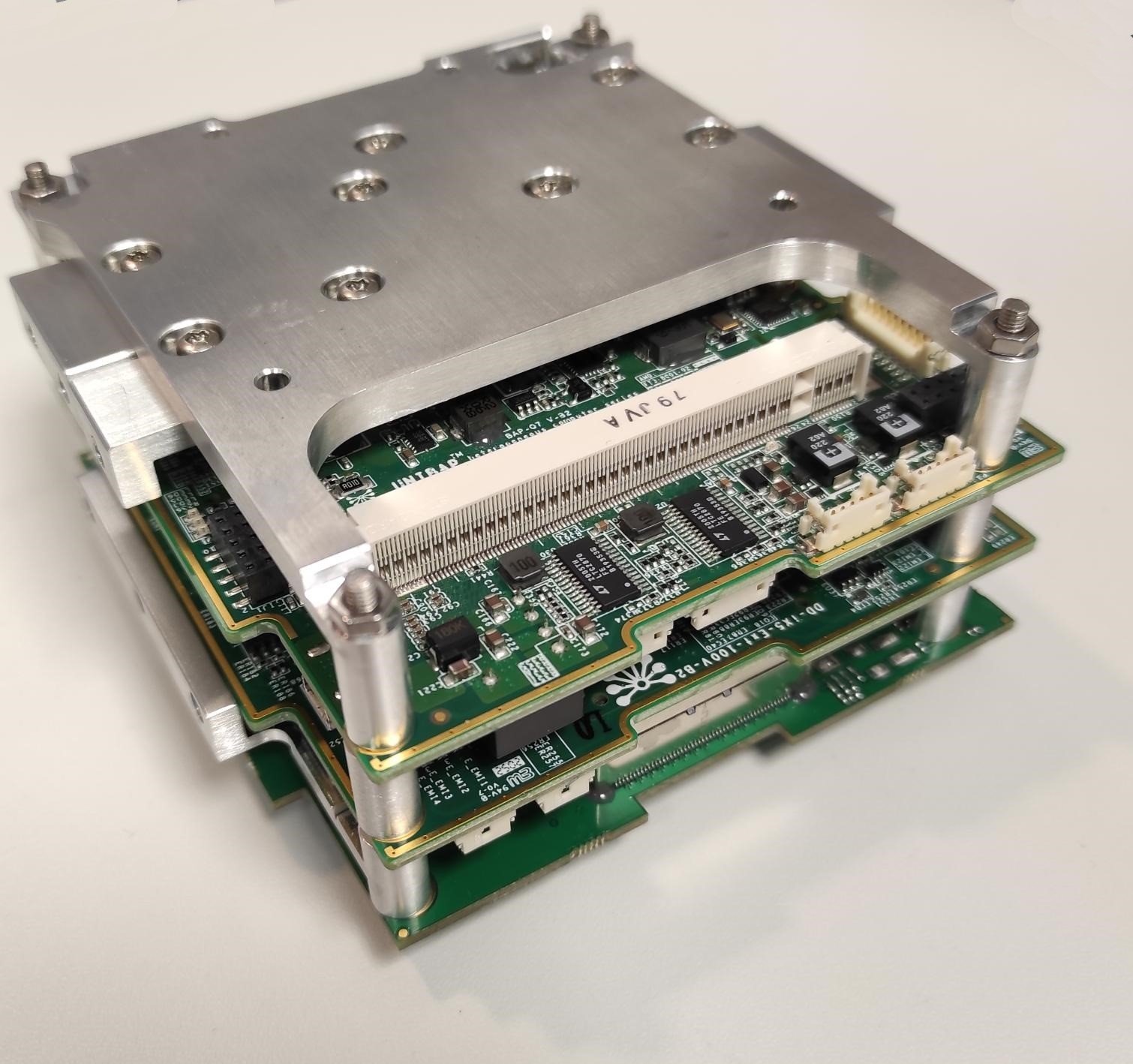
The SpaceCloud iX5-100 is an edge computing payload built by Unibap, a Swedish firm based in Uppsala, designed to run AI workloads aboard small satellites and increasingly on uncrewed aerial platforms. First flown in 2021, it packages compute hardware normally confined to ground data centres into a form intended to survive the radiation environment of low Earth orbit, where ionising particles routinely crash commercial processors.
The iX5-100 is a heterogeneous machine rather than a single-chip accelerator. According to Unibap, it combines an AMD CPU and GPU, a Microsemi FPGA, and an Intel Movidius Myriad X Vision Processing Unit, delivering roughly four Tera Operations per Second inside a power envelope under 20 watts. Workloads are split across the processors — the FPGA handles deterministic signal processing, the Myriad X accelerates computer-vision inference, and the AMD cores run the Linux-based SpaceCloud framework that orchestrates applications. That framework was developed with support from the European Space Agency and lets third-party software be uploaded, swapped, and chained in orbit, treating the satellite as a programmable node rather than a fixed-purpose instrument.
The system reached space on 30 June 2021 aboard D-Orbit’s ION Satellite Carrier “Dauntless David”, launched from Cape Canaveral on the Wild Ride mission. Unibap describes it as the first space mission to validate radiation-tolerant heterogeneous computing of this class in orbit, with D-Orbit’s then-COO Simon Reid citing it as the firm’s answer to flying modern commercial processors in the harsh space environment. During the one-year flight on a 500 km Sun-synchronous orbit, the iX5-100 hosted applications from Unibap, D-Orbit, US geospatial firm SaraniaSat, UK video-compression specialist V-Nova, and UK Earth-observation startup Trillium. SaraniaSat’s software, running on the L3Harris Geospatial ENVI and IDL platforms, demonstrated near-real-time onboard tracking and geolocation of aircraft within multi-spectral satellite imagery — a capability directly relevant to military ISR.
Defence early warning is one of the applications Unibap lists for the platform, alongside disaster monitoring, space domain awareness, and precision agriculture. The company has since pushed the SpaceCloud architecture toward tactical uses closer to the ground, pitching it as an onboard brain for UAVs that need autonomy and sensor fusion without a datalink back to a rear processor. The underlying argument is the same in both environments: moving inference to the sensor cuts latency and relieves bandwidth that satellites and small drones rarely have to spare.