Products Aurora Flight Sciences
GoldenEye
Family of ducted-fan autonomous UAVs capable of vertical take-off and high-speed forward flight.
Droneby Aurora Flight SciencesIntroduced 2004
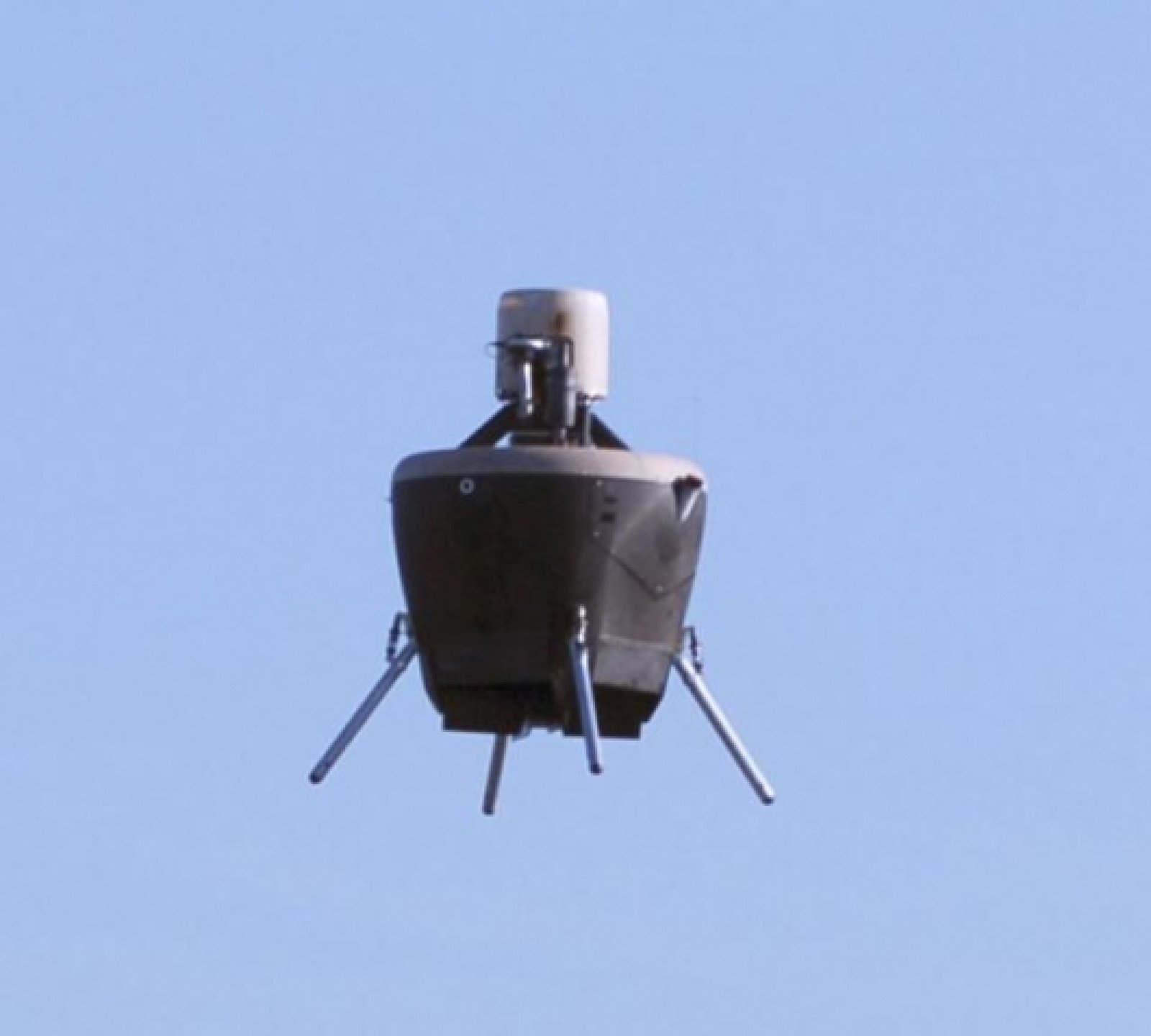
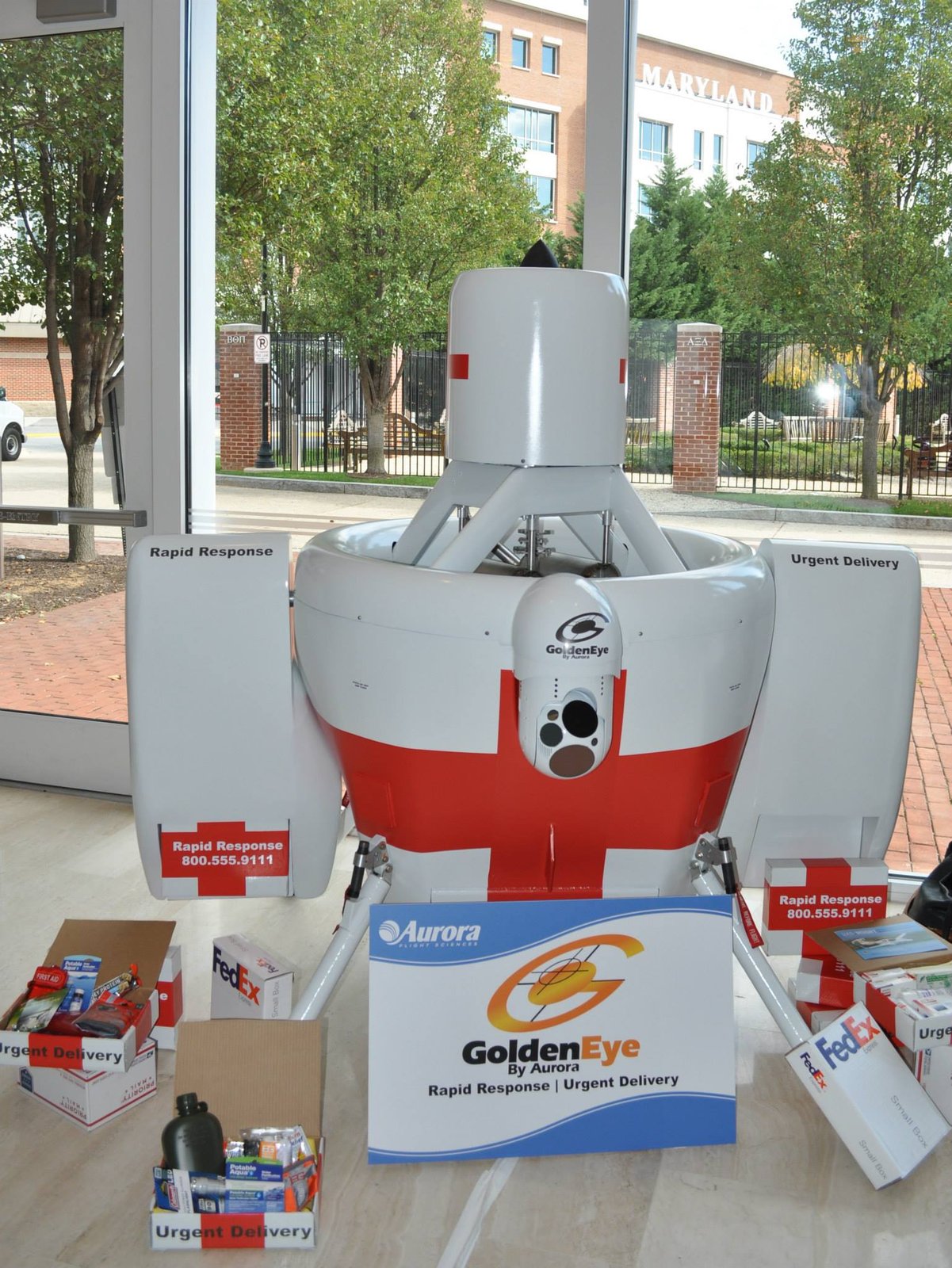
Photos: www.aurora.aero · newatlas.com · gallery.vtol.org
GoldenEye is a family of ducted-fan unmanned aerial vehicles developed by Aurora Flight Sciences, the Manassas, Virginia airframer acquired by Boeing in 2017. The line — principally the GoldenEye-50 and GoldenEye-80, named for their approximate airframe weights in pounds — emerged in the early 2000s from work Aurora carried out for the US Defense Advanced Research Projects Agency and the US Army under the Organic Air Vehicle programme, which sought a small, autonomous surveillance aircraft that a soldier or a Future Combat Systems ground vehicle could launch without a runway. First flights were reported around 2003–2004.
The design’s defining feature is a large shrouded fan that provides both lift for vertical take-off and hovering and, once the aircraft transitions, thrust for horizontal cruise. Small aerodynamic vanes in the fan wake handle attitude control in the hover; stub wings and tail surfaces take over in forward flight. Aurora described the platform as fully autonomous, with waypoint navigation and automatic take-off, transition and landing. The intended payload was an electro-optical / infrared sensor turret aimed at short-range intelligence, surveillance and reconnaissance work. The larger GoldenEye-80 was designed to carry heavier sensor loads and, according to Aurora’s early briefings, could stay airborne for several hours at cruise. Little has been published about the onboard flight computer or the specific autopilot lineage the aircraft used, and no teardown reporting exists to fill the gap.
Operators are limited to the US government. GoldenEye did not move into series production or fielded service; it lived out its life as a research asset, with test flights at Army ranges including Fort Benning. When the Organic Air Vehicle programme’s ducted-fan branch converged around Honeywell’s smaller T-Hawk micro air vehicle as the Future Combat Systems Class I air vehicle, GoldenEye lost its route into the Army’s inventory.
The programme is best read as one of the more visible attempts, in the years before the multirotor became ubiquitous, to give a small unit its own vertical-take-off eyes. The engineering questions it explored — ducted-fan efficiency, hover-to-cruise transition control, autonomous handling for non-pilot operators — recur in a generation of tail-sitter and hybrid-VTOL designs now being pitched to the same customer, from tube-launched loitering munitions to the current wave of Group 2 and 3 VTOL ISR drones.