Gerbera
Foam-and-plywood Shahed look-alike that Russia launches alongside Gerans as a decoy, scout, mesh relay and, increasingly, a small strike drone.
DroneAdversary capabilityby AlabugaIntroduced 2024 · Updated 2026
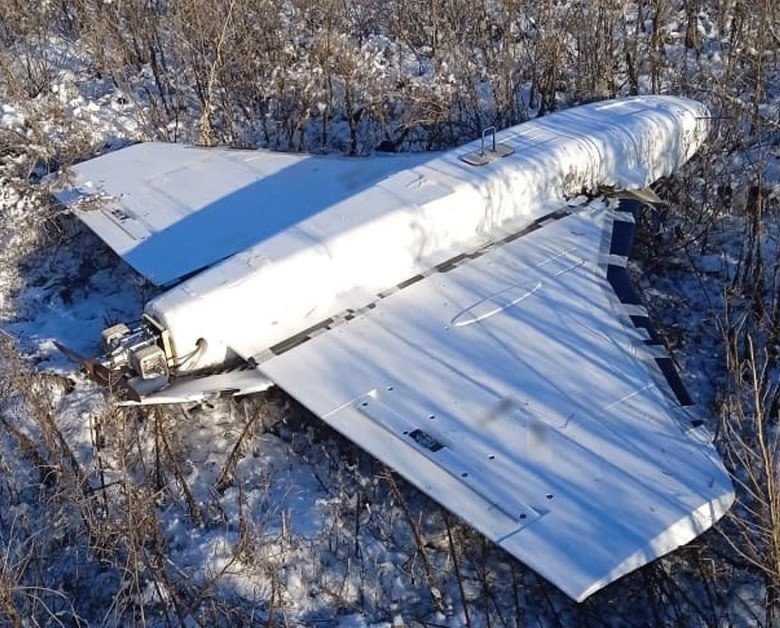 Gerbera downed in Ukraine, 5 January 2025 — whole airframe
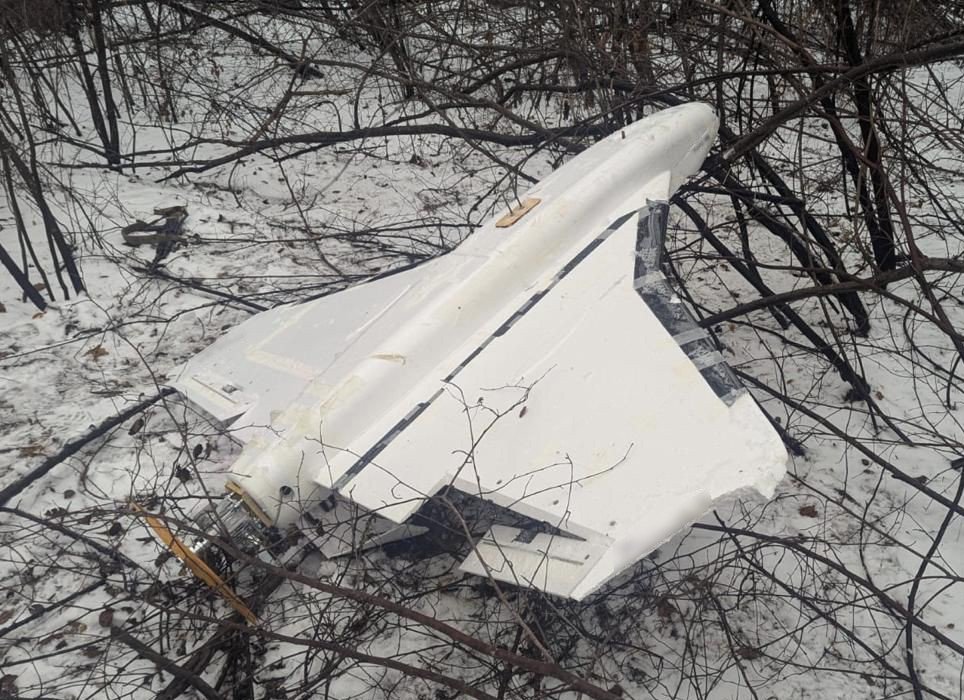 Gerbera downed by Ukrainian border guards in Sumy region, 7 January 2025
 Gerbera found on a frozen lake in Kyiv region, February 2025
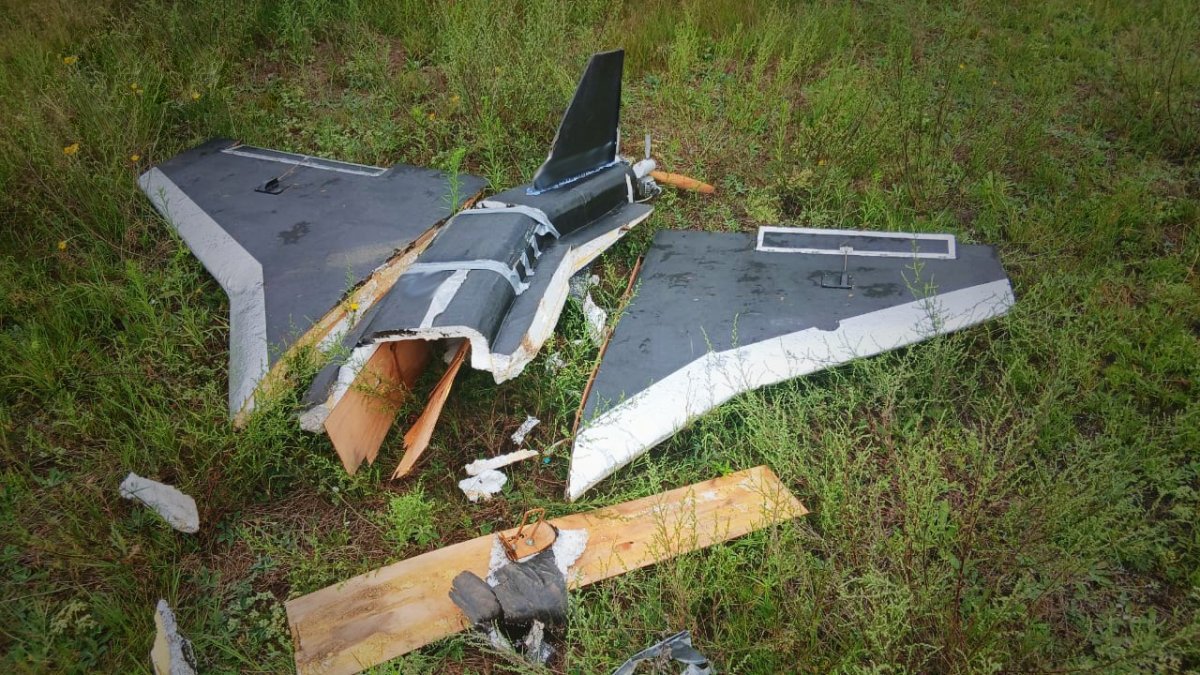 Broken-up Gerbera showing the foam-and-plywood construction
Photos: State Border Guard Service of Ukraine / Wikimedia Commons · State Emergency Service of Ukraine / Wikimedia Commons · State Border Guard Service of Ukraine (dpsu.gov.ua) / Wikimedia Commons
Videos


Overview
The Gerbera (Гербера) is a cheap Russian drone built to look like a Shahed-136. It has a cropped-delta wing about 2 to 2.5 m across, a body of painted foam over a plywood frame, and a 60 cc model-aircraft engine driving a pusher propeller. Russia launches it in large numbers alongside its Geran-2 strike drones. On a radar screen the two look much alike, and each Gerbera that draws an interceptor missile or a gun crew is one fewer threat to a real Geran.
Ukraine’s defence intelligence agency (HUR) estimates its cost at about $10,000, around a tenth of a Shahed. The Institute for Science and International Security (ISIS) reported in December 2024 that Alabuga was producing up to 50 a day in Yelabuga, Tatarstan.
Origins
The first Gerbera was photographed after being downed over Kyiv region on 24 July 2024. The War Zone noted that, unlike the Geran, it has a single central tail fin, and that its wingspan was about 2 m. Russian social-media channels credited an otherwise unknown “Gastello Design Bureau”. HUR gave a different account in November 2024: the drone is based on a Chinese prototype, its original developer is Skywalker Technology Co., Ltd of China, Skywalker makes fuselages and helps route parts to Russia, and final assembly takes place in Yelabuga. The Gerbera does not appear in Skywalker’s public catalogue.
What is inside
HUR’s teardown of downed examples, published on its War&Sanctions portal on 18 November 2024, lists the main parts:
- Engine: a DLE60 60 cc two-stroke from Mile Hao Xiang Technology of China, which the US sanctioned in mid-2024 for supplying Russia. ISIS also found a 70 cc twin from RCGF Stinger in some examples.
- Navigation: an anti-jam satellite-navigation antenna (CRPA) with chips from Analog Devices, Texas Instruments and NXP, plus a flight controller with parts from Texas Instruments, Atmel, STMicroelectronics, u-blox, NXP and China’s XLSEMI.
- Camera: a Topotek KHY10S90 three-axis gimbal camera from China.
- Datalink: a Xingkai Tech XK-F358 mesh-network modem. The same Chinese modem appears on later Geran-2s and on the Molniya-2.
ISIS noted that no Russian-made parts were identified. The first example recovered also carried a SIM-card cellular modem for intermittent video over Ukrainian mobile networks (The War Zone).
Decoy, scout, striker, relay
Russia presented the Gerbera in three versions: decoy, reconnaissance and strike. The decoy version is the most common. HUR said in November 2024 that roughly half of the drones Russia launched were decoys of this kind (Wikipedia). The reconnaissance versions record where Geran-2s hit and locate radars and air-defence sites.
Armed versions became more common in 2025. Ukrainian forces reported warheads of up to 5 kg, and ISIS cites charges of about 10 kg. In August 2025 Ukraine’s State Border Guard Service warned civilians not to approach downed Gerberas because they increasingly carry explosives.
In 2026 the Gerbera took on a new role. On 22 July Serhii Beskrestnov (“Flash”) reported the first case of Russian Molniya strike drones being controlled through a Gerbera. The mesh modems on both drones come from the same Chinese manufacturer and use the same frequency band, but until then a licensing restriction had kept them incompatible. He also gave the defensive answer: shoot down the Gerbera, and the Molniyas relying on it lose their link and fall.
In August 2026 photos of wreckage on Russian channels showed what they called a “Gerbera-2”. Ukrainian channel Victory Drones relayed the description: a larger airframe able to carry 20 to 30 kg, a 63-litre fuel tank, new electronics and an engine “effectively half a Geran-2 engine”. A Russian military-blogger channel also claimed that “Gerbera seeker” drones had hit cargo ships near Odesa. Both are Russian claims that have not been independently confirmed. If accurate, they would make the newest Gerberas resemble early piston-engined Gerans, while Russia moves its main strike drones to jet power.
Over NATO territory
Because it is light and often unarmed, the Gerbera is the Russian drone that most often ends up in NATO countries. Two crossed into Lithuania from Belarus in July 2025. On 9–10 September 2025 Gerberas were among the drones that entered Poland, where one landed on a Territorial Defence base in Nowe Miasto nad Pilicą (Euromaidan Press). Polish and allied aircraft engaged hostile targets over NATO territory for the first time. Later that month a Gerbera tail section washed ashore in Latvia (Kyiv Independent).
For European air-defence planners, the Gerbera is a test of target discrimination as much as of interception. A foam drone costing about $10,000 that looks like a Shahed on radar is designed to make defenders choose between wasting a missile and risking a real warhead getting through.
Combat experience
The Gerbera first appeared in late July 2024, when photos showed an example downed over Kyiv region (The War Zone). It has since flown in almost every large Russian drone raid, mixed in with Geran-2 strike drones. By November 2024 Ukrainian intelligence said roughly half of the drones Russia launched were decoys such as Gerbera and Parodiya.
Gerberas have repeatedly come down in NATO countries. Two entered Lithuania from Belarus in July 2025. On 9–10 September 2025 they were among the drones that crossed into Poland, where one landed on a Territorial Defence base in Nowe Miasto nad Pilicą (Euromaidan Press). A tail section washed up on a beach in Latvia the same month (Kyiv Independent).
Effectiveness
Warhead upgrades
| Warhead | Type | Mass | Since | Notes |
|---|---|---|---|---|
| Small explosive charge | high explosive | ~10 kg reported | 2024 | Some, not all, Gerberas carry a charge of roughly 10 kg; armed versions likely fly much shorter distances source |
| Observed warheads up to 5 kg | high explosive | up to 5 kg | 2025 | Ukrainian forces reported warheads of up to 5 kg; a Gerbera that came down in Lithuania in 2025 carried about 2 kg source |
| Gerbera-2 payload | warhead or equivalent payload | 20–30 kg (claimed) | 2026 | Russian-channel description of the enlarged Gerbera-2, relayed by Ukrainian channel Victory Drones; not independently confirmed source |
Variants
- Decoy2024
Unarmed version that imitates a Shahed on radar to draw fire and saturate air defences source
- Reconnaissance / electronic reconnaissance2024
Camera or electronic-intelligence payload to record strike results and locate radars and air-defence positions source
- Strike (kamikaze)2025
Small warhead with camera guidance by an operator; first documented tactical strike in April 2025 source
- Mesh relay node for Molniya2026
Gerbera mesh modem used to relay control to Molniya strike drones; first case reported 22 July 2026 source
- Gerbera-22026
Larger airframe, 63-litre tank, more powerful engine and 20–30 kg payload, per Russian-sourced wreckage reports in August 2026 source
- Gerbera "seeker"2026
Russian military-blogger channel claims "Gerbera seeker" drones struck cargo ships near Odesa and Chornomorsk on 7 August 2026; seeker type not described source
Countering it
As reported publicly; each line links its source.
- Interceptor drones — Ukraine began using Sting interceptors in October 2024, and the first video of an interceptor downing a Gerbera followed; other interceptor types were shown downing several Gerberas in July 2025 source
- Target the relay — When Gerberas relay control to Molniyas, Serhii Beskrestnov's advice is to shoot down the Gerbera so that the Molniyas lose their link and crash source
- Public warnings — Ukraine's State Border Guard Service warned in August 2025 that Gerberas increasingly carry warheads and that people should not approach downed ones source
- NATO air policing — Gerberas were among more than 19 drones that crossed into Poland on 9–10 September 2025; Polish and allied aircraft shot several down, the first NATO engagement of hostile targets in its own airspace source
Sources
- gur.gov.ua/en/content/herbery-z-fanery-ta-inozemnoi-elektroniky-detali-budovy-cherhovoho-rosiiskoho-drona
- isis-online.org/isis-reports/russian-decoy-drones-that-depend-on-western-parts-pose-a-great-challenge/
- www.twz.com/air/new-russian-long-range-drone-appears-in-ukraine
- en.wikipedia.org/wiki/Gerbera_(drone)
- euromaidanpress.com/2025/09/11/russian-drone-fell-on-a-polish-military-base-near-warsaw-one-of-16-found-on-10-september/
- kyivindependent.com/fragment-of-russian-gerber-drone-found-on-a-latvian-beach/
- en.defence-ua.com/industries/ukrainian_intelligence_reveals_russia_to_build_40000_shahed_drones_and_24000_decoys_in_2025-15334.html
- isis-online.org/isis-reports/a-comprehensive-analytical-review-of-russian-shahed-type-uavs-deployment-against-ukraine-in-2025
- t.me/VictoryDrones/60698
- t.me/VictoryDrones/62516
- t.me/milinfolive/177322