Bulava
Fixed-wing loitering munition with fully autonomous kill-chain — reconnaissance, target detection, strike, and battle-damage assessment in a single platform.
Missile / loitering munitionby DeViRoIntroduced 2023
Photos: www.defensa.com · euromaidanpress.com · www.reuters.com · www.naval.com.br
The Bulava is a fixed-wing loitering munition produced by the Ukrainian defense technology firm DeViRo, designed to provide the Ukrainian Armed Forces with an autonomous, long-range strike capability against high-value Russian targets. Introduced to the public in early 2025, the system represents a convergence of reconnaissance and kinetic strike functions, allowing a single platform to conduct target acquisition, engage the objective, and perform battle-damage assessment without requiring a separate strike asset. The drone was developed in direct response to military requirements for a system capable of penetrating deep into contested airspace while resisting the dense electronic warfare (EW) environment characteristic of the war in Ukraine.
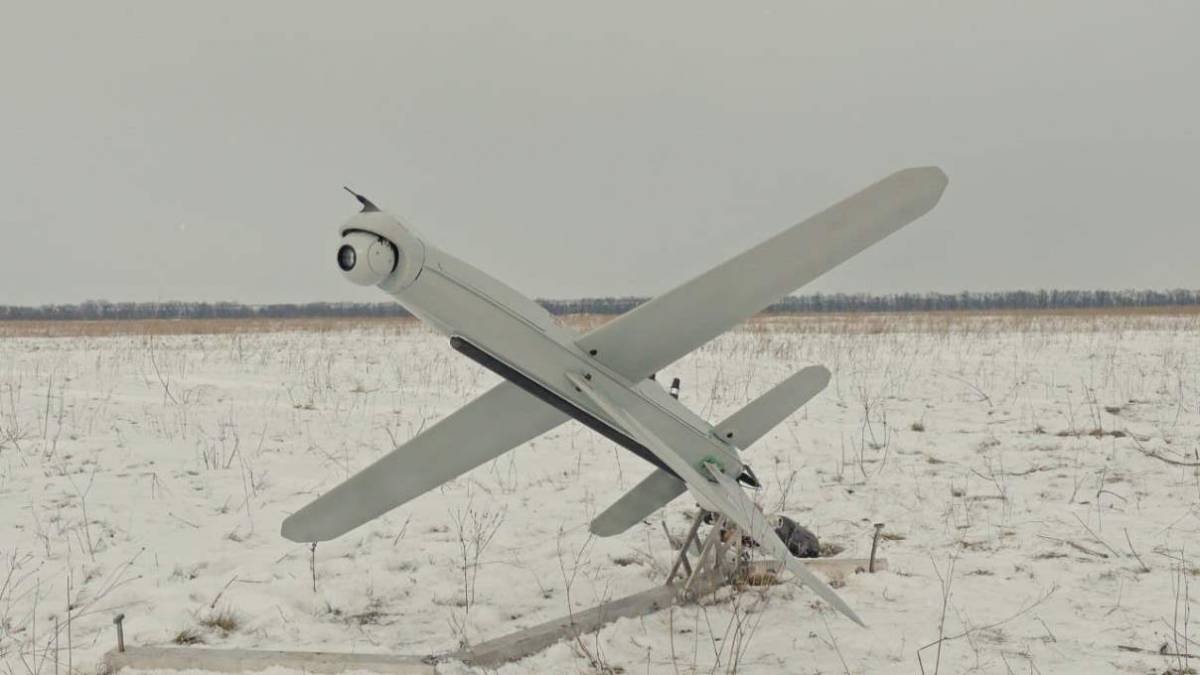
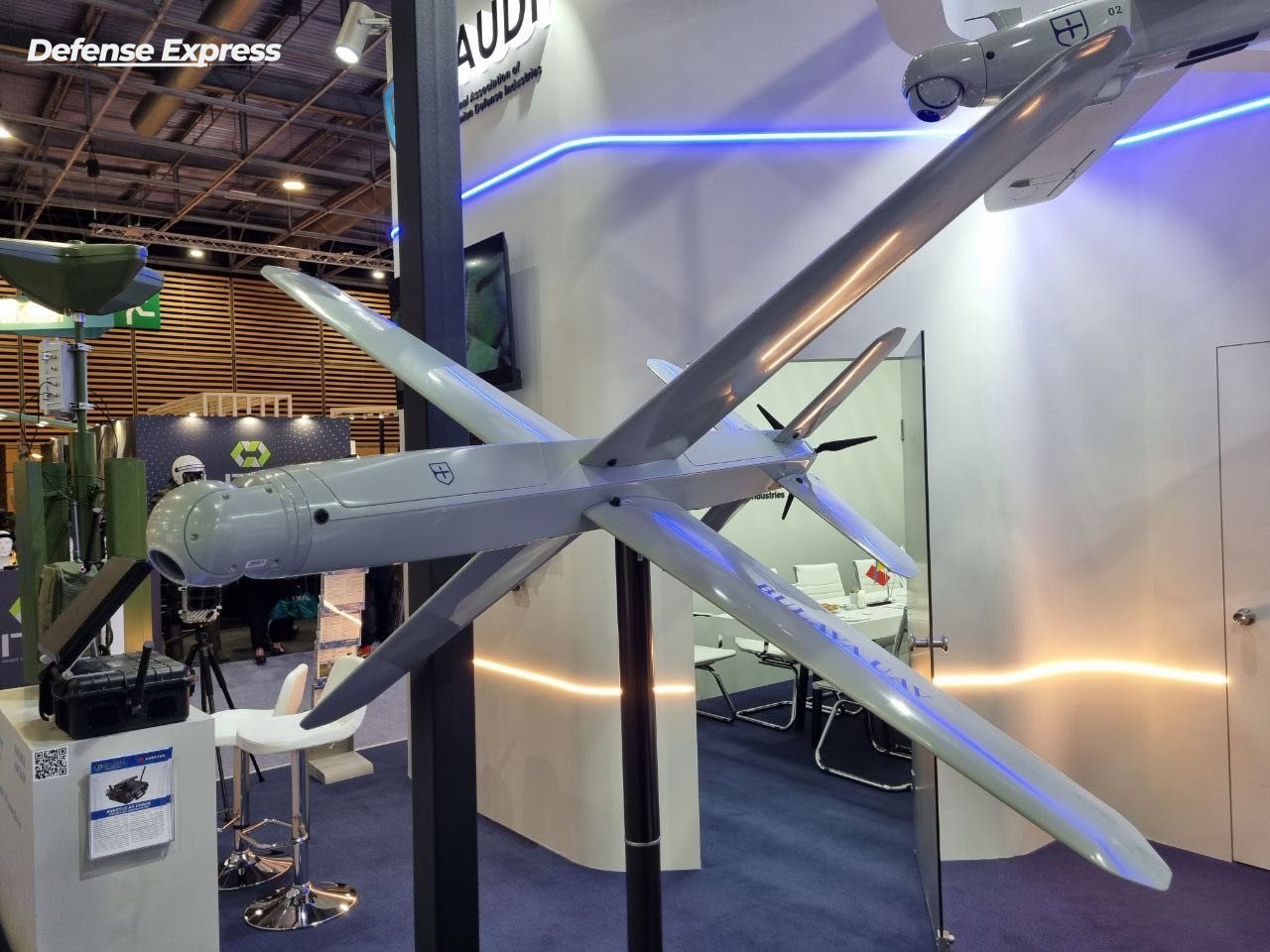
Physically, the Bulava features an X-shaped airframe with a length of 1.5 meters and a wingspan of 1.6 meters, resulting in a total takeoff weight of 11.5 kilograms. It is launched via catapult and propelled by an electric motor, achieving a maximum speed of approximately 100 kilometers per hour. The system is equipped with a 3.6-kilogram warhead, typically utilizing a Ukrainian-made shaped charge-thermobaric configuration, though the manufacturer notes the capacity for various payload types. Navigation and targeting are handled by an optical station integrating both day-time and thermal imaging channels. Crucially, the system is designed to operate without GPS, relying instead on visual navigation and inertial guidance to maintain accuracy in GPS-denied environments.
The Bulava’s most significant technical distinction is its autonomy and communication architecture. According to DeViRo, the drone can be guided to a target defined by an operator independently using a machine vision-based system, effectively closing the kill chain from reconnaissance to strike without continuous human intervention. For extended range, the system utilizes MESH technology to transmit data via a drone repeater, extending its effective combat radius to 55 kilometers. Without a repeater, the range is limited to 35 kilometers, though the manufacturer’s specifications cite a maximum range of 80 kilometers. The system can loiter for up to 50 minutes at altitudes up to 2,000 meters, providing operators with sufficient time to identify and engage moving or stationary targets, including armored vehicles and air defense systems.
Ukrainian Defense Forces have been fielding the Bulava since 2024, with confirmed strikes on Russian targets at distances of 55 kilometers from the launch point. The system is integrated into a broader unmanned aerial system that includes ground control stations and repeaters, enabling fully autonomous crew operations. By combining the reconnaissance heritage of DeViRo’s Leleka-100 UAV with strike capabilities, the Bulava allows for rapid, decentralized targeting of tactical and operational-level assets. The platform’s resistance to electronic warfare suppression and its ability to operate independently in contested airspace make it a distinct tool for Ukrainian forces seeking to degrade Russian logistical and command infrastructure deep behind the front lines.