Brimstone
Air-launched precision strike missile with a millimetre-wave active radar seeker enabling autonomous target discrimination and multi-missile salvo de-confliction.
Missile / loitering munitionby BAE SystemsIntroduced 2005
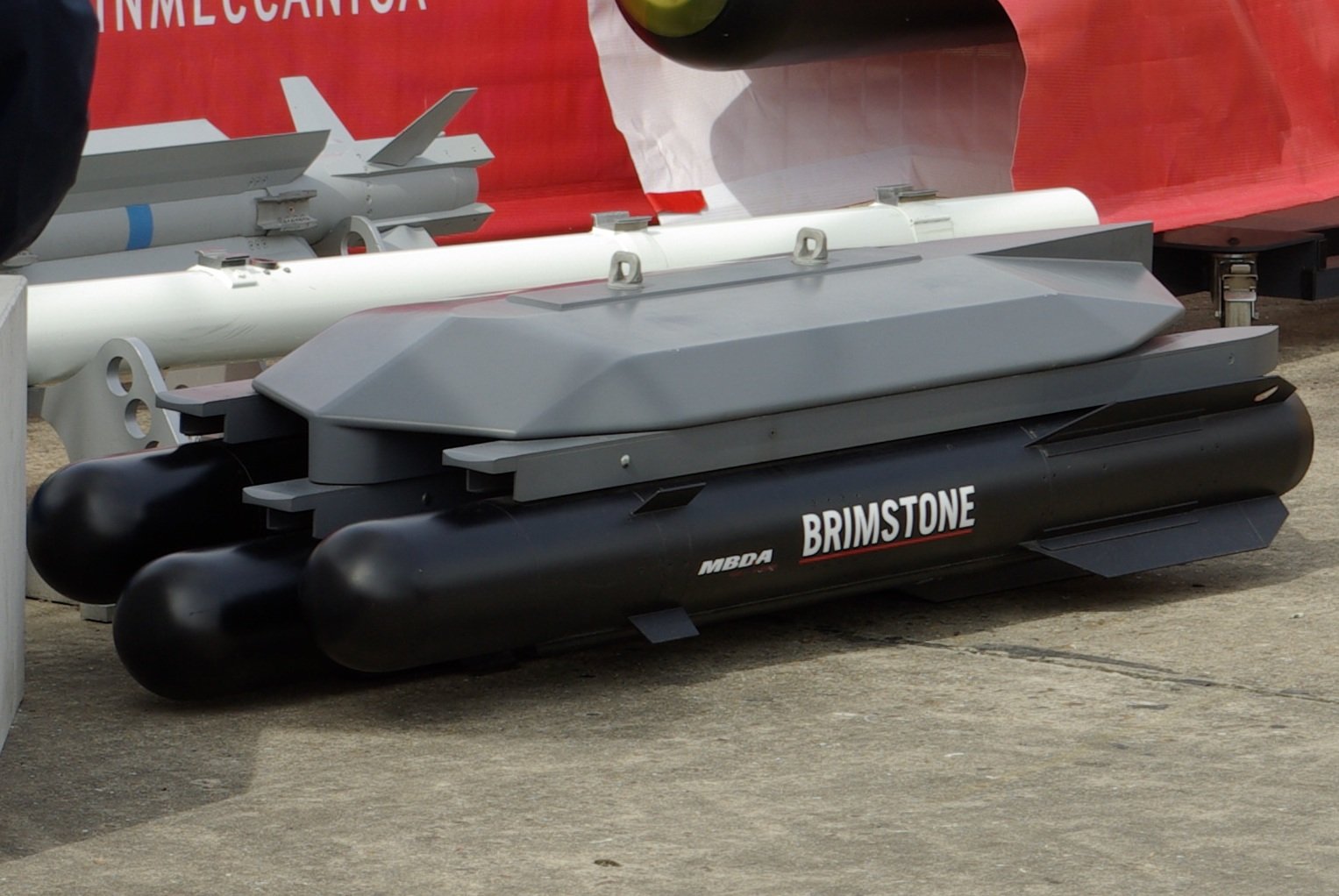
Photo: Wikipedia
Brimstone is an air-launched precision strike missile developed and manufactured by MBDA, the European missile house in which BAE Systems holds a founding 37.5 percent share. The weapon entered service with the Royal Air Force in 2005 as a replacement for the free-fall BL755 cluster bomb, giving Tornado and later Typhoon crews a stand-off means of destroying armour, technicals and small boats without loitering over the target area. Its defining characteristic is a 94 GHz millimetre-wave radar seeker, which the manufacturer describes as capable of identifying vehicle-shaped returns against ground clutter and, in salvo firings, coordinating with other Brimstones in flight so that two missiles do not strike the same target.
At about 50 kg with a 6.3 kg tandem shaped-charge warhead, the missile is small enough to be carried in triples from a single hardpoint. The original variant relied on the millimetre-wave seeker alone; Brimstone 2, cleared for RAF service in 2016, added a semi-active laser channel and — according to MBDA figures — extended the reach to roughly 60 km from a high-altitude release. The two modes can be combined: a forward controller can designate a specific vehicle with a laser to override the seeker’s autonomous discrimination, which the RAF has cited as useful when a target sits inside civilian traffic. The airframe traces its lineage to the American AGM-114 Hellfire, from which the British programme diverged in the late 1990s to make room for the indigenous seeker and rocket motor.
The United Kingdom is the largest operator, followed by Saudi Arabia, which fielded Brimstone on its Tornado fleet during the Yemen campaign. British aircraft used the missile against armoured columns in Libya in 2011 and against Islamic State vehicles across Iraq and Syria, where the RAF’s public strike figures repeatedly credited Brimstone with kills on moving pickup trucks that other in-theatre munitions could not reliably engage.
Ukraine has used Brimstone continuously since April 2022, initially in a ground-launched role from improvised racks welded to Supacat and pickup chassis, later on modified Wolfhound armoured trucks. The UK government has acknowledged transferring “hundreds” of rounds and funding replacement production at MBDA’s Bolton and Stevenage sites. Footage published on Ukrainian channels shows the weapon most often used against Russian armour and river-crossing barges, in single-missile engagements rather than the coordinated salvos the RAF trained for — a pattern that Ukrainian operators say reflects the tighter supply rather than any change in tactics.
MBDA is developing Brimstone 3, described as a further seeker upgrade with insensitive-munition propellant and improved software, intended to keep the missile competitive against the newer generation of Russian and Chinese anti-armour systems.