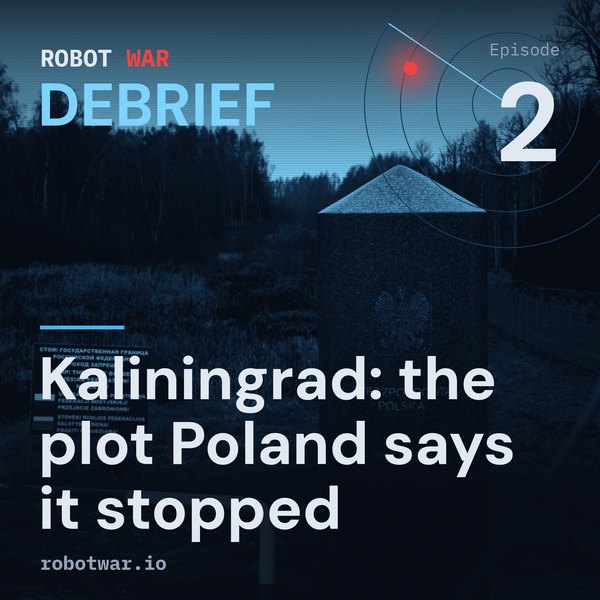
Episode 2 9 min
Kaliningrad: the plot Poland says it stopped
About the special report Russia planned a false-flag attack from Poland into Kaliningrad, Polish sources say
Tap play to start listening
The scoop
0:00 / 9:19
Controls, chapters and transcript
Chapters
Read the transcript
Claire Picture the Polish border with Kaliningrad, on a night in early November. Polish special forces are already in position. On the other side, on Russian soil, flashlights are moving in the dark near a small town called Sępopol. Nobody crosses. And according to a Polish newspaper, that is the night an attack was supposed to happen, blamed on Ukraine, with many casualties expected.
Tom And months of warnings that it was coming.
Claire This is Robot War Debrief. I'm Claire, and with me is Tom, who has been through everything published about this one. In our previous episode we looked at the Kerch Bridge, a Dutch missile and a drone at the embassy. Today, a very different story on NATO's eastern flank: a plot the Polish press says was Russian, and was stopped before it began. Tom, where do we start?
Tom We start with the newspaper, because without one Polish paper we wouldn't be having this conversation.
Tom On 18 November, the Polish daily Rzeczpospolita published a report by its defence correspondent Marek Kozubal. Citing senior people in Poland's uniformed services, he says Russian intelligence planned a sabotage attack on Polish soil close to the Kaliningrad border, with a possible crossing and a simulated attack on a target inside Russia. All of it under a false flag, to blame Kyiv. His sources say, quote, the Russians were preparing a provocation with many casualties. And the goal, they say, was to halt aid to Ukraine.
Claire So the plan was to make it look like Ukraine was attacking Russia from NATO soil, and Poland, somehow, saw it coming.
Tom They say they did. On 2 November Poland launched a police special operation along that border. And the Institute for the Study of War, ISW, picked the report up as a key takeaway of its daily assessment. Its judgement is that the warnings and the Polish deployment, quote, likely deterred, or at minimum disrupted the planned attack.
Claire So that's the broad outline. What I'd like to understand is what the sources told the paper the operation was actually meant to look like.
Tom One source gave a historical comparison, and it's a heavy one. They said it was supposed to resemble the Gleiwitz incident, which is the staged German attack on a radio station that Hitler used as a pretext to invade Poland in 1939. The idea here, as the sources describe it, was that people would cross from Polish soil into Russian territory. Those attackers, quote, would most likely have been shot, or evidence would have been found on them that they were from Ukraine. That's the Russian independent outlet Agentstvo's translation. Who exactly was meant to carry it out isn't known: Ukrainians living in Poland, or people brought in from another country.
Claire And what were they supposed to hit?
Tom Accounts differ. The Telegraph says a border crossing and a facility inside the exclave. The Independent reports civilian targets on both sides of the border. Hromadske quotes a source saying, quote, we had information about specific facilities where an attack was supposed to take place, and that the Russians anticipated a large number of casualties. Rzeczpospolita itself only writes, quote, Russian services. Only The Telegraph names Russia's GRU military intelligence. No unit, no named officer and no weapon has appeared in any report.
Claire You said Warsaw saw this coming. How?
Tom Two channels, according to Rzeczpospolita. Partner intelligence services warned Warsaw, and Polish analysts reached the same conclusion on their own. What alarmed them was Russian intelligence officers coordinating sabotage activity on the Russian side of the border. Lithuania, Latvia and Estonia got similar warnings. And there's a longer run-up here. Back in July, Foreign Minister Radosław Sikorski said publicly, quote, we suspect he is planning to prepare Ukrainian drones and use them to attack a NATO member country or Russia. He added, quote, we know what you are planning, do not do it. And on 10 September, Prime Minister Donald Tusk said he had received, quote, a fairly precise report directly from the CIA regarding possible events in the coming months.
Claire And Ukraine itself had flagged something.
Tom Yes. On 23 October, Ukraine's military intelligence, the HUR, warned that Moscow was preparing false-flag operations to pin on Kyiv, and named the Kaliningrad enclave as one of the possible sites. ISW thinks the CIA report Tusk mentioned, quote, likely refers to this plot, though Tusk himself didn't say so.
Claire So Polish forces moved to the border. What actually happened on the ground?
Tom On 2 November Poland's police chief Marek Boroń launched the operation across the two provinces along the exclave. Around 180 riot police and a counter-terrorist unit went north. The special forces units GROM, NIL and AGAT exercised in the region, and the ABW, Poland's internal security agency, sent extra officers. Units were on full readiness from 2 to 8 November, and the operation was later extended to 15 November. The only visible incident came shortly after midnight on 3 November. Border guards near Sępopol saw people with flashlights on the Russian side, nobody crossed, and the group withdrew. Tusk later said, quote, we managed to prevent an attempted provocation, while adding that he couldn't be certain it was one.
Claire Flashlights, and that's really all anyone saw.
Tom That's really all anyone saw on the ground. No arrests have been made, no suspects named, no prosecution announced. Everything known about the plot itself comes from anonymous sources in one newspaper. The ministers confirm a threat and a response, not the scenario. The head of military counter-intelligence, General Jarosław Stróżyk, told Radio ZET on 19 November, quote, such information certainly existed, but, quote, it is sometimes hard to assess the credibility.
Claire And the other side of all this is what Russia itself has been saying. Have they responded to the Polish report?
Tom Not officially. As of the morning of 20 November, we hadn't found any comment from the Kremlin, the Foreign Ministry or the SVR, Russia's foreign intelligence service. Pro-war Telegram channels called it fabricated. The channel Two Majors wrote, quote, not a single piece of evidence was presented. But there's a pattern worth noting. On 11 November, Poland's Independence Day, the FSB claimed it had broken up a Polish spy network in Kaliningrad. Poland's services called that, quote, yet another provocation and act of disinformation. And on the evening of 18 November, hours after Rzeczpospolita published, a pro-Kremlin channel claimed that Kyiv was preparing more than 100 captured Russian drones to strike Poland and make it look as if they came from Kaliningrad. No evidence was offered.
Claire So Moscow's own version is the same plot, with the roles reversed.
Tom That's the shape of it.
Claire Just so listeners can place where all this is happening, what is Kaliningrad, and what's inside it?
Tom It's a Russian exclave, cut off from the rest of Russia and from Belarus by Poland and Lithuania. And it's armed. It hosts Iskander-M missiles, which are Russia's road-mobile short-range ballistic missiles. We have a page on the Iskander-M on robotwar.io: a single launcher carries two missiles, range around 500 kilometres, and it's one of the hardest weapons for Ukrainian air defence to stop. It also hosts S-400 air defence, and Russia has spread GPS jamming from the exclave across the Baltic. The border itself has been active this autumn. On 23 September a Russian Mi-8 helicopter from Kaliningrad spent 42 seconds in Polish airspace, and Polish jets were scrambled. And in late September Moscow warned NATO it would use, quote, the entire arsenal, including nuclear weapons, if Kaliningrad were blockaded.
Claire So what's still not clear?
Tom Quite a lot. We don't know what the targets actually were, or whether casualties were expected on the Polish side or the Russian side. We don't know which Russian service ran it, because only one outlet names the GRU. We don't know whether the flashlights near Sępopol on 3 November were part of this operation at all, which allied service first raised the alarm, or whether Polish prosecutors have opened a case. And one thing to watch: on 21 November Kaliningrad's governor Alexei Besprozvannykh declared a region-wide drone-danger alert, saying a suspicious object had been detected approaching from Lithuania. Later that day he said specialists had found no threat.
Claire The full report, with the timeline, the photographs and every source, is on robotwar.io. We'll be back with the next episode following the next special report. Tom, thanks for walking us through this one.
Tom Thanks, Claire. Take care, everyone.
Polish sources tell Rzeczpospolita that Russian services planned a false-flag sabotage attack from Poland into Kaliningrad in early November, staged to blame Ukraine. Warsaw moved police and special forces to the border; the only incident was flashlights near Sępopol.
Based on the special report Russia planned a false-flag attack from Poland into Kaliningrad, Polish sources sayCover photo: Quintin Soloviev, via Wikimedia Commons (CC BY 4.0)