Besomar
A Ukrainian fixed-wing UAV maker building the reusable, shotgun-armed Besomar 3210-N anti-drone interceptor.
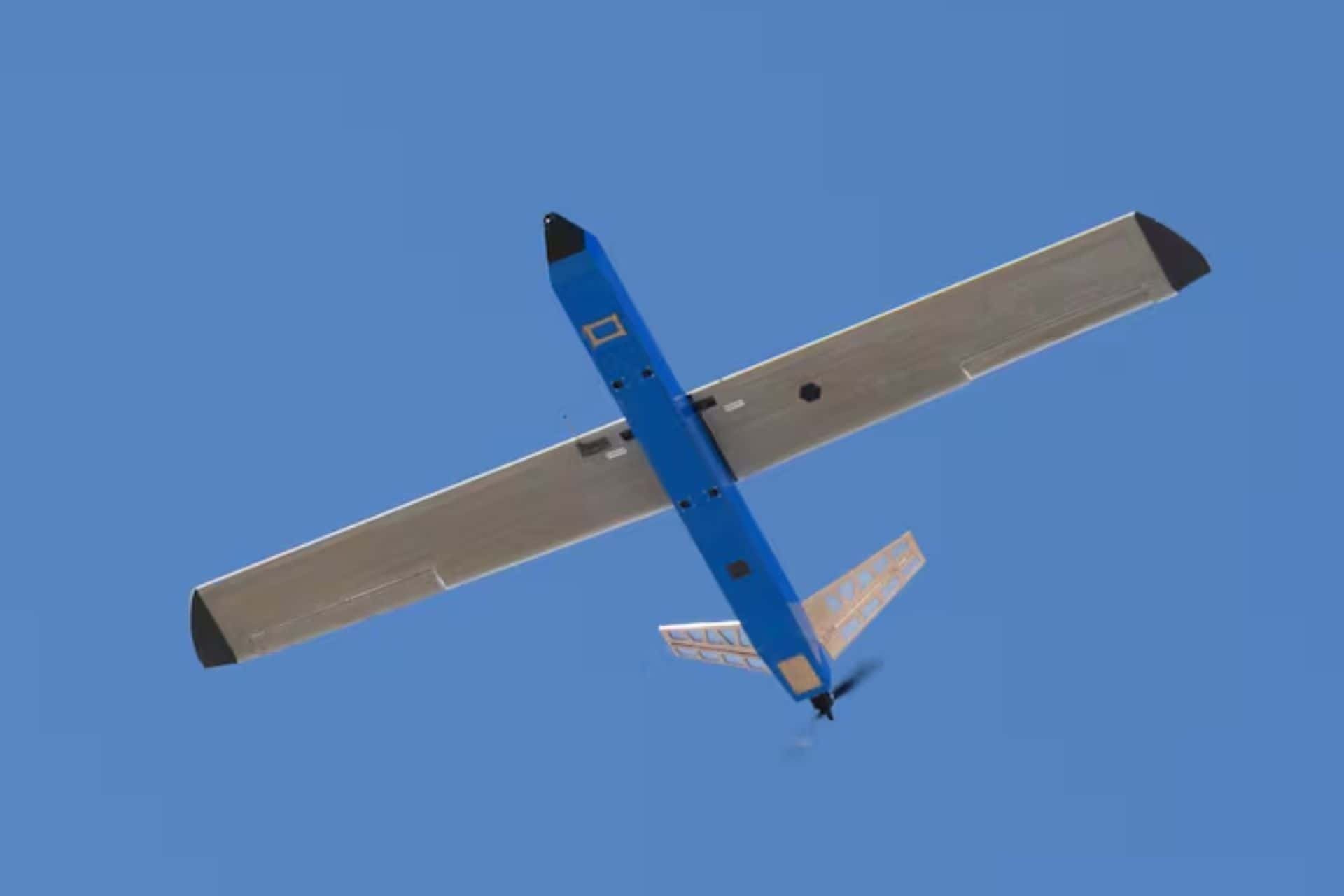
Besomar is a Ukrainian aerospace firm based in Lviv, founded in 2023 and led by CEO Hanna Matsenko. It is one of a wave of small Ukrainian manufacturers that formed after the full-scale invasion to plug a specific hole in the country’s air defences: cheap, fast, reusable platforms that can chase down the Russian reconnaissance and one-way attack drones now saturating the front and the deep rear. The company operates entirely in the fixed-wing niche, and its work is aimed at the drones that neither Patriot nor Gepard is a sensible answer to.
Its flagship is the Besomar 3210, an aircraft-type interceptor UAV built to hunt Orlan-10, Supercam, ZALA, Geran and Shahed airframes. According to the manufacturer, the base 3210 tops out around 175 km/h with a 5,500 m ceiling and glides on a 1:10 ratio, allowing engine-off approaches of up to ten kilometres from a kilometre of altitude. A thermal-imaging variant, the 3210-TN, is marketed as reaching 260 km/h and carrying up to a kilogram of payload with roughly twenty minutes of loiter; Besomar says the terminal engagement uses a remotely detonated warhead triggered by the operator when the interceptor is close to its target. The firm also describes a separate reusable interceptor fitted with a nose-mounted 12-gauge shotgun and an automated fire-control system that engages when a target enters the kill zone, then returns to base for reuse. Two adjacent platforms round out the catalogue: the Besomar 1100, a fixed-wing reconnaissance drone for target identification and battlefield observation, and the Besomar 3310, a logistics UAV the company advertises with roughly two hours of endurance and a 50–60 km range for cargo runs to frontline positions.
Two design threads are worth noting. The airframes are pitched as electronic-warfare resistant, with GPS-independent navigation using radar beacons developed jointly with Sine-Link, whose communication system also supplies the datalink. And several ergonomic touches — an aerodynamic reverse air brake said to shed 40 km/h per second, one-click automatic landing, field-repairable construction — read as lessons from the Ukrainian operator community, where an interceptor that cannot be recovered and turned around quickly costs its unit disproportionately. Besomar states the product line is NATO-codified.
Deployment specifics, unit costs, production volumes and customer identities are not disclosed publicly, which is typical for Ukrainian defence startups operating under wartime secrecy. The company sits in the same broader interceptor space as Wild Hornets and Fire Point, though its fixed-wing, reusable approach differs from the quadcopter interceptors that dominate the field.
The firm has also become a target in its own right. In June 2026, Besomar warned publicly that a site at besomar.org was impersonating the company and distributing malware packaged as fake technical documentation; it attributed the operation to a hostile cyber actor and reiterated that its only official domain is besomar.com.ua. The episode is a small marker of the parallel war the Ukrainian drone industry now fights alongside the physical one.
Products
Drones
Besomar 3210-N
A reusable fixed-wing interceptor with a nose-mounted 12-gauge shotgun and automated fire-control system; uses a thermal camera to find targets and fires at roughly 20 m. Top speed around 200 km/h, endurance over 60 minutes, intended against Geran/Gerbera and reconnaissance UAVs.
Besomar 1100
A reconnaissance UAV for surveillance and target identification.
Besomar 3310
A logistics/delivery UAV for cargo runs to frontline positions, with up to two hours endurance and 50-60 km range.
Besomar 1100
Long-endurance fixed-wing scout with zoom camera for territorial patrol and enemy drone detection.
Introduced 2025
Besomar 3210
Multi-mission fixed-wing UAV for ground strike, air-to-air intercept, and ISR — the base kamikaze/attack variant of the 3210 family.
Introduced 2024
Besomar 3210-TN
High-speed fixed-wing interceptor with thermal camera and EW-resistant comms, designed to destroy Shahed, Geran, Orlan and ZALA drones at night or in fog.
Introduced 2025
Sources
- www.drone-directory.com.ua/profile/besomar/ (2026-06-19) — Ukrainian Drone Ecosystem Directory profile
- united24media.com/latest-news/ukraine-unveils-besomar-3210-the-first-reusable-drone-that-hunts-russias-geran-2-10807 (2026-06-19) — UNITED24 Media — reusable interceptor reveal
- www.armyrecognition.com/news/army-news/2025/ukraine-fields-besomar-3210-first-reusable-interceptor-to-counter-russian-geran-2-drones (2026-06-19) — Army Recognition — Besomar 3210 specs and use