Spies, Lies, and Algorithms
The History and Future of American Intelligence
by Amy Zegart2022Princeton University Press
Amy Zegart is a political scientist at Stanford’s Hoover Institution and the Freeman Spogli Institute, and one of the few academics who has worked across both intelligence policy and the Silicon Valley world now reshaping it. Spies, Lies, and Algorithms, published by Princeton in 2022, is her attempt to explain how American intelligence actually works, how it got that way, and why the technologies arriving now will test it more severely than any adversary has.
The central argument is that the United States Intelligence Community — eighteen agencies organised around secrets gathered by human spies and government satellites — was built for a world that no longer exists. Open-source information, commercial imagery, and machine learning have moved capabilities that were once exclusive to CIA and NSA into the hands of universities, journalists, and teenagers in bedrooms. At the same time, the sheer volume of digital information is overwhelming analysts who still work inside classified compartments cut off from most of it. Zegart frames this as a structural crisis: the IC is losing its monopoly on knowing things first, and has not yet decided what to do about it.
The book walks through intelligence history from the Revolutionary War’s Culper Ring to the Osama bin Laden raid, then turns to the mechanics of modern practice — covert action, counterintelligence, and the seven cognitive pitfalls that produce failures like the Iraq weapons-of-mass-destruction assessment. Separate chapters examine nuclear intelligence, cyber operations, and congressional oversight. One of the sharper sections looks at what Zegart calls spytainment, the Jack Ryan and Jason Bourne version of intelligence that distorts both public expectations and recruiting. The closing chapters focus on the open-source revolution — Bellingcat’s reconstruction of the MH17 shootdown, amateur geolocation of North Korean missile sites, the use of commercial constellations like Planet Labs to track troop movements — and on how China’s fusion of state intelligence with commercial AI firms raises the stakes for Western agencies that cannot simply hire from Google.
Among crowded shelves of books about spying, this one is distinctive for being written as a textbook that reads like trade non-fiction. It is used in Zegart’s Stanford courses and assumes no prior knowledge, which makes it a workable entry point for readers who want to understand what an intelligence agency is actually for before moving on to more specialist work. For working practitioners it will be less revelatory, but the treatment of open-source intelligence and the policy questions around artificial intelligence in collection and analysis is current enough to stand on its own. It is most useful to anyone trying to think seriously about where the balance between secret and open information is heading, and what democracies will need from their intelligence services in the decade ahead.
Read the longer summary
Amy Zegart published Spies, Lies, and Algorithms in early 2022, after two decades studying how America’s intelligence agencies work and, more often, how they fail. She teaches at Stanford, holds a senior fellowship at the Hoover Institution, and has advised everyone from presidential commissions to CIA directors on reform. The book draws on that record and on a strand of research she had been pushing for years: that the United States intelligence community, built for a Cold War adversary and reformed in the aftermath of 9/11, now faces a technological and informational environment it was not designed for and does not yet know how to inhabit. The book arrived at a moment when open-source analysts on Twitter were tracking Russian troop movements toward Ukraine in real time, when commercial satellite imagery was undercutting the exclusivity of national technical means, and when the question of what secret intelligence is actually for had become sharper than at any point since the agency’s founding.
The central argument is that American intelligence sits at an inflection point as consequential as the 1947 National Security Act that created the modern system. Zegart calls the shift an intelligence revolution driven by what she describes as the “seven deadly technologies”: the internet, big data, artificial intelligence, the smartphone revolution, cloud computing, synthetic biology, and quantum computing. Each of them, she argues, breaks assumptions baked into the Cold War intelligence model. Secrets have become harder to keep and in many cases less valuable than publicly available information expertly interpreted. Signals and imagery, once the near-monopoly of agencies with billion-dollar budgets, are now gathered by hobbyists, journalists, and commercial firms. The adversary set has broadened from a handful of state intelligence services to Chinese cyber operations, Russian influence networks, Iranian proxies, non-state hacking groups, and corporate actors harvesting data at planetary scale. In Zegart’s view, the agencies have been slow to notice how much has changed, slower still to restructure around it, and will remain slow unless the public, Congress and the agencies themselves confront a set of myths about what intelligence does and how it works.
The book is organised to march the reader from basics to frontier. Early chapters set the stage, defining what intelligence is, distinguishing information from analysis and secrets from mysteries, and arguing that intelligence is less a product than a process of continuous estimation under uncertainty. A chapter on the history of American intelligence walks from George Washington’s wartime spycraft through the OSS, the creation of the CIA, the Church Committee reforms of the 1970s, and the post-9/11 restructuring that produced the Office of the Director of National Intelligence. Zegart treats that lineage not as a settled institutional story but as a sequence of inherited compromises, each one solving yesterday’s problem while locking in features that would become tomorrow’s. The seventeen-agency structure, the sharp line between foreign and domestic collection, the deference to covert action as a presidential tool: all of them, she argues, carry costs that only become visible in retrospect.
One of the book’s most distinctive chapters is given over to what Zegart calls spy-tainment, the long interaction between American intelligence agencies and American popular culture. She traces how films from the Bond franchise through the Jason Bourne cycle, television from The Americans to Homeland, and video games have shaped what citizens, legislators and even new recruits believe intelligence officers do. She reports on original survey work she conducted with colleagues, measuring Americans’ beliefs about CIA capabilities and ethical limits. The results are striking: large shares of respondents believe the agency routinely engages in assassination, routinely tortures, and routinely operates on domestic soil, often because they have absorbed those depictions from fiction. Zegart’s point is not that entertainment should be scolded. It is that in a secret organisation whose actual record is largely inaccessible, popular culture becomes the primary source of public understanding, with concrete political consequences for oversight and reform.
The analytic chapters are where the book draws most heavily on specific cases. Zegart devotes considerable space to counterterrorism, using the pursuit of Osama bin Laden to walk through the mechanics of all-source analysis — human intelligence from CIA assets, signals intelligence from NSA, imagery from the National Geospatial-Intelligence Agency, and the painstaking integration performed by analysts working on the Abbottabad compound. She uses the case to argue both for the enduring value of the clandestine services and for the limits of certainty: the final decision to raid the compound rested on a probability estimate rather than a confirmed identification, and intelligence that looks decisive in hindsight was deeply contested at the time. She returns repeatedly to the problem of estimative language, the way analysts use words like likely, probably and almost certainly to signal probability bands that policymakers often read as binary assertions.
A long chapter on nuclear intelligence makes a related argument about continuity and change. Zegart describes the Cold War-era arms control infrastructure, the role of national technical means in verifying treaties, and the slow accretion of monitoring techniques that let analysts estimate warhead counts, missile throw weights and reactor outputs from satellites and seismographs. Then she turns to Iran, North Korea and the proliferation networks of the twenty-first century, where state secrecy is layered against open-source analysts, academic physicists, and nuclear-focused NGOs using commercial satellite imagery to publish findings within hours of events. The hunt for A.Q. Khan’s network, the dispute over Iraqi weapons of mass destruction, and the 2007 raid on Syria’s al-Kibar reactor get sustained treatment as cases that reveal both the strengths of the intelligence enterprise and its recurring vulnerabilities to political pressure, mirror imaging and the overweighting of a single confident source.
Counterintelligence receives its own chapter, and here the book is unsparing. Zegart revisits the Aldrich Ames and Robert Hanssen cases, the long-running Chinese penetration of US networks, and more recent episodes including the compromise of the CIA’s covert communications infrastructure in China that led to the arrest or execution of a reported two dozen agency sources around 2010 to 2012. She uses these cases to argue that counterintelligence is systematically underfunded and underprioritised relative to the attention paid to operations and analysis, and that the information age has made the problem worse: insider threats compound with cyber penetrations, cleared personnel are discoverable through social media, and digital tradecraft that works for one year rarely works for the next.
The chapters on cyber and emerging technology bring the argument to its sharpest edge. Zegart lays out how computer network operations have become a central instrument of statecraft, drawing on the Stuxnet operation against the Natanz enrichment facility, Russian GRU operations against Ukrainian infrastructure and the Democratic National Committee, Chinese economic espionage campaigns including the Office of Personnel Management breach that exposed clearance records on more than twenty million Americans, and the SolarWinds supply-chain compromise that quietly implanted itself across US government and corporate networks. She describes the strategic logic of operations below the threshold of armed conflict, the attribution problems that make deterrence difficult, and the mismatch between an intelligence community organised around collection and an environment in which the defence of networks and the shaping of information environments are themselves intelligence missions. On artificial intelligence specifically, she is careful to avoid the hype register. She points to concrete applications — image classification for geospatial analysis, pattern of life inference, machine translation, open-source feed triage — while flagging what she sees as the harder questions of brittleness, adversarial manipulation, and the challenge of integrating probabilistic systems into estimative products that policymakers already struggle to read.
Through all of this, Zegart returns to a set of institutional problems she sees as the binding constraint on reform. She argues that the intelligence community has a talent problem: the people it most needs — software engineers, data scientists, computational linguists, machine learning researchers — are the hardest to recruit and retain under the clearance regime, pay structure, and employment lifecycle that the agencies offer. She argues that it has a culture problem: open-source intelligence remains a second-class citizen inside organisations whose status hierarchy still rewards access to classified streams, even as the signal in those streams becomes a smaller share of what matters. She argues that it has an oversight problem: Congress’s intelligence committees, chronically understaffed and whipsawed by partisan rotation, cannot keep pace with agencies that have grown in complexity and classification density. And she argues that it has a public problem: a citizenry that misunderstands what intelligence does, in part because the agencies have never found a stable language for explaining themselves, cannot support the reforms that would make them effective.
Reception of the book has been shaped by its position between genres. Reviewers in national-security circles have treated it as the clearest textbook-style introduction to the American intelligence community in years, suitable for the undergraduate courses Zegart herself teaches as well as for mid-career officials entering the policy world. Former intelligence officials, including Michael Hayden and Robert Gates, have endorsed the diagnosis if not every prescription. Academic readers in intelligence studies have placed it alongside the work of Richard Betts, Loch Johnson and Mark Lowenthal as a canonical overview, while noting that Zegart’s willingness to range across history, popular culture and policy sometimes comes at the cost of the depth that a monograph on any one chapter would offer. Push-back has clustered around her treatment of open-source intelligence, which some reviewers see as overweighting the Bellingcat-style exemplars without reckoning with the quality control and verification problems that still make clandestine sources distinctive, and around her prescriptions for structural reform, which others have called under-specified relative to the clarity of her diagnosis. The book has also been read closely in allied intelligence circles in Britain, Canada, Australia and continental Europe, where its arguments map onto parallel debates about the fitness of national services for the current threat environment.
For a reader working through the literature on artificial intelligence in warfare and national security, Spies, Lies, and Algorithms sits as the intelligence-side companion to the growing shelf of books on autonomous weapons, military AI and defence innovation. It pairs well with Paul Scharre’s work on autonomy, with Christian Brose’s The Kill Chain on acquisition and force structure, with Jacquelyn Schneider and other scholars on cyber conflict, and with the Chinese-focused analytic work of Elsa Kania and Tai Ming Cheung. It is less useful as a technical handbook on any single capability. The specific details of modern collection systems, cryptographic breakthroughs and sensor fusion architectures are not its subject, and would in any case be unavailable to an unclassified book. It is most useful as a map of why the pieces fit together the way they do, why they fail in the ways they do, and what will have to change if the United States and its allies are to preserve an intelligence advantage into a decade in which Chinese and Russian services are investing heavily in the same technologies, often with fewer legal and ethical constraints and sometimes with greater institutional agility.
Several threads of the book are likely to age well. The historical chapters are durable because they are history. The spy-tainment analysis has already been borne out in the way subsequent public debates about intelligence, from drone strikes to signals interception, have been argued in terms borrowed from fiction. The structural diagnosis — too many agencies, too much classification, too little room for open sources, too little attention to counterintelligence — has only grown more pointed as subsequent breaches and compromises have arrived. Other threads will date faster. The specific case studies drawn from the previous decade’s cyber incidents will be overtaken by new ones, and the treatment of AI, written just before the public release of large language models reset expectations in the field, now reads as a snapshot of the moment before the next shift rather than a map of the terrain to come. Zegart would almost certainly welcome that. The book’s argument is that the environment is moving faster than the institutions, and a summary written five years from now, drawing on the next tranche of leaks, breaches, and reorganisations, will have the same shape and different examples. That recurrence is itself the point.
Publisher's description
Publisher data is pending — Google Books quota deferred until 2026-10-20T02:30:46.387443+00:00.
Watch & listen


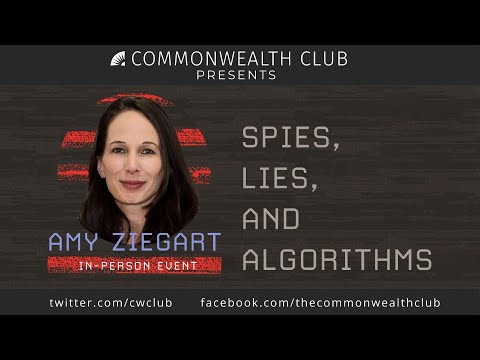


Podcasts
Amy Zegart, "Spies, Lies, and Algorithms"
Q&A · apple · 2023-10-16
219 | Amy B. Zegart: Spies, Lies, and Algorithms: The Future of U.S. Intelligence After Ukraine
The Realignment · apple · 2022-03-22
#217 - Amy Zegart on SPIES, LIES, AND ALGORITHMS
The Sport of Life: Chats w/ Comedians, Filmmakers, Sports Figures, Musicians, & Intellectuals · apple · 2022-02-25
Ep. 128: Spies, Lies, and Algorithms: The History and Future of American Intelligence with Amy Zegart
Talking Beats with Daniel Lelchuk · apple · 2022-02-08
Spies, Lies and Algorithms with Amy Zegart
World Class · apple · 2022-02-01
Last researched .