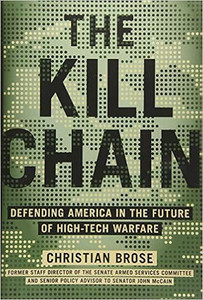
The Kill Chain
Defending America in the Future of High-Tech Warfare
by Christian Brose2020Hachette Books
Christian Brose spent years as staff director of the Senate Armed Services Committee under John McCain, and before that as a speechwriter and policy advisor at the State Department. The Kill Chain, published in 2020, is his argument that the United States has built the wrong military for the war it is most likely to face, and that the window to fix it is closing.
The book’s central claim is that American defence has fixated on expensive, exquisite platforms — aircraft carriers, fifth-generation fighters, large nuclear submarines — while losing sight of what actually wins a fight. Brose frames warfare as a competition between kill chains: the loop of understanding what is happening, deciding what to do, and acting on it, faster than the other side. China, he argues, has studied the American way of war for three decades and built precisely the systems needed to break those chains. The result is a force designed to be seen, targeted, and destroyed before it can bring its firepower to bear.
Much of the book is a tour of the gap between what Washington buys and what the battlefield rewards. Brose examines China’s anti-access and area-denial strategy around the first and second island chains, the vulnerability of forward bases and surface ships to long-range precision strike, and the way large manned platforms absorb budget that could buy swarms of cheaper autonomous systems. He walks through the Pentagon’s acquisition machinery, the committee politics that keep legacy programmes alive, and the cultural resistance to software, to attritable drones, and to artificial intelligence inside the services. He draws on his years working for McCain to describe specific battles over the F-35, the Littoral Combat Ship, and the Ford-class carrier, and he sketches what a different force might look like: distributed, networked, software-defined, built around closing the kill chain rather than around the platforms that currently carry it.
The book also takes a hard look at the industrial base. Brose argues that defence contracting has consolidated into a handful of primes optimised for cost-plus mega-programmes, and that the commercial technology sector — where the actual advances in machine learning, autonomy, and space are happening — remains largely outside the tent. He names Silicon Valley firms working on defence applications, discusses the role of venture capital in a new generation of defence startups, and traces how allied militaries, Ukraine’s included in later readings, have begun to demonstrate what a cheaper, faster kill chain looks like in practice.
Among books on American defence strategy, The Kill Chain stands out for its specificity about process. It is less a treatise on grand strategy than a working insider’s account of why the Pentagon buys what it buys, and what would have to change for that to be different. It reads most usefully for anyone trying to understand why defence reform is so hard, and why the people pushing hardest for it come from both inside the building and from the companies trying to sell into it.
Read the longer summary
Christian Brose wrote The Kill Chain from a position few outsiders occupy. For most of the 2010s he served as staff director of the Senate Armed Services Committee under John McCain, which placed him inside the room where America’s defense budget was shaped and where the uncomfortable questions about where that money actually went were asked out loud. Brose later moved to Anduril Industries, the defense start-up building autonomous systems and sensor fusion software, which gives the book its second vantage point: a Washington insider who then went to work in the Silicon Valley wing of the industry he had been overseeing. The book, published by Hachette in 2020, lands at the moment the United States officially pivoted to great-power competition. The 2018 National Defense Strategy had already named China and Russia as the pacing threats, pushing counterterrorism down the priority list for the first time in a generation. Brose’s book is the long-form argument for why that pivot, even once made on paper, had not yet translated into the force the United States actually fielded, and why time was shorter than most policymakers believed.
The central argument is deceptively simple. Military power, Brose insists, is not a matter of counting platforms. It is a matter of completing what the US military calls the kill chain: understand what is happening, decide what to do, act on that decision. In older language, this is find, fix, track, target, engage, assess. Everything else — ships, aircraft, satellites, submarines, soldiers — is only useful insofar as it helps close that loop faster and more reliably than the adversary can close its own. For roughly thirty years after the Cold War ended, the United States closed its kill chain against weaker opponents in a world of its own design, and it did so with a small number of extraordinarily expensive, long-lived, individually powerful platforms: carrier strike groups, stealth bombers, fifth-generation fighters, armored brigades, nuclear submarines. The platforms became the point. Brose argues this was a category error, concealed by the fact that nobody could contest the arrangement, and that China has spent the last two decades building a military whose entire purpose is to break the American kill chain while keeping its own intact.
The book’s framing is that the United States is not losing a competition over hardware; it is losing a competition over information. The adversary that first fields a battle network capable of sensing across every domain, moving the resulting data at machine speed, and translating it into timely action will have decisive advantages against an adversary that still routes everything through staff officers, PowerPoint briefings, and radios tuned to proprietary waveforms that cannot talk to each other. Brose uses the phrase “military Internet of Things” to describe what he thinks is coming — a mesh of cheap sensors, autonomous craft, resilient communications, and software that can take raw observations and present commanders, or in time the machines themselves, with a usable picture of the fight. He is clear that the physical weapons still matter. What has changed is that the physical weapons are increasingly the easy part. Winning will depend on the software layer that commands them, and on the industrial and bureaucratic habits that produce or fail to produce it.
Structurally the book moves from diagnosis to prescription in roughly a dozen chapters. The opening chapters trace what Brose calls the lost decade. He describes the “revolution in military affairs” promoted in the 1990s by figures such as Andrew Marshall at the Pentagon’s Office of Net Assessment, which anticipated a shift from mass to precision and from attrition to information. The precision-strike regime of the Gulf War seemed to confirm that revolution, and for a decade after 9/11 the United States used those tools against insurgencies while shelving the harder question of what to do when a peer competitor copied them. Brose then turns to what China did while America was busy elsewhere, drawing on open-source writings from the People’s Liberation Army about “Assassin’s Mace” weapons and the concept of systems destruction warfare. The DF-21D and DF-26 anti-ship ballistic missiles, long-range air-launched cruise missiles, hardened and dispersed air bases on reclaimed reefs, integrated air defenses, cyber and counter-space capabilities, and above all a doctrine of attacking the enemy’s reconnaissance-strike complex before it can function — these are not matched capabilities but asymmetric answers to the specific American way of war.
A middle section of the book is devoted to the organizational pathologies that keep the United States from responding. Brose writes with the frustration of someone who sat through the hearings. The requirements process, he argues, is designed to produce platforms that are perfected over fifteen to twenty years for threats defined at the beginning of that cycle. The acquisition system rewards cost-plus programs that favor the handful of incumbent primes that know how to navigate them, and it is structured in ways that make it very hard for a new entrant with a cheaper, software-defined product to break in. He is careful not to turn this into a simple government-versus-Silicon-Valley morality tale; many of the book’s sharpest observations are about Silicon Valley’s own reluctance to work with the Pentagon, exemplified by the employee revolt at Google that led the company to withdraw from Project Maven, the Defense Department effort to apply computer vision to full-motion drone video. Brose takes the technologists’ moral objections seriously but argues that they are, in effect, deciding that America’s adversaries should have better software than its own forces. Alongside Maven he discusses the aborted Joint Enterprise Defense Infrastructure cloud contract and the Defense Innovation Unit, the Pentagon’s outpost in Mountain View, as early and imperfect attempts to drag the department into a different procurement rhythm.
The examples and evidence are where the book earns its argument. Brose anchors each general point in concrete programmes, systems, and episodes. He returns repeatedly to the gap between the Ford-class aircraft carrier — a thirteen-billion-dollar platform that will serve for half a century and that an adversary now has multiple credible ways to range — and the much smaller sums that would buy fleets of attritable unmanned surface and underwater vehicles, long-range autonomous aircraft, and the sensors needed to find targets at scale. He discusses the Navy’s XQ-58 Valkyrie and the general concept of loyal wingmen, the Air Force’s Advanced Battle Management System and its cross-service descendant Joint All-Domain Command and Control, hypersonic programmes on both sides of the Pacific, the Space Development Agency’s proliferated low-earth-orbit architecture, and the slow, painful attempt to retire legacy systems whose congressional patrons will not let them die. He walks through the fate of the F-35 as a case study in what happens when a single programme becomes too big to fail and too complicated to fix. He discusses the Army’s Future Combat Systems and its cancellation, the Zumwalt-class destroyers, the Littoral Combat Ship, and the general tendency of ambitious transformation efforts to end as expensive object lessons rather than as deployed capability. The point is not that platforms are bad. The point is that the United States has forgotten how to field things quickly and in volume, which is the only mode of competition that will matter once mass production of smart, cheap systems becomes the pacing variable.
Running through the examples is a careful treatment of autonomy and the question of how far to let machines close the loop themselves. Brose does not argue for taking humans out of lethal decisions. He argues that the current fixation on keeping humans “in the loop” at every step of every engagement has become a way of refusing to think about tempo. If an incoming salvo of hypersonic weapons arrives in minutes, a kill chain that requires half an hour of staff coordination is already lost. The honest conversation, he contends, is not whether to delegate authority to machines but which decisions, under which rules, in which contexts, with what oversight. He points to existing autonomous defensive systems — the Aegis Combat System’s Phalanx close-in weapon mode, Patriot, Iron Dome — as evidence that the United States has been comfortable with narrow machine autonomy for decades when the physics required it. He also notes that adversaries operating under fewer legal and ethical constraints will not wait for Western consensus on where the line should be drawn, and that the choice is therefore not between autonomy and no autonomy but between autonomy guided by democratic militaries and autonomy guided by others.
Reception of the book in the two years after publication was broadly favorable in the defense policy community, where it quickly joined the small shelf of texts that senior officers assigned to their staffs. Reviewers in Foreign Affairs, War on the Rocks, and the professional military journals treated it as the most accessible articulation of the kill-chain framing then available, and Brose’s post-McCain move to Anduril gave the arguments a practical referent that purely academic treatments lacked. Pushback has come from several directions. Analysts closer to the traditional primes argue that Brose underestimates the integration challenges of fielding mass autonomous systems at the scale he describes, and that his critique of exquisite platforms is easier to make from outside the services that depend on them. Scholars working on autonomous-weapons ethics, including those around the Campaign to Stop Killer Robots and in the United Nations Convention on Certain Conventional Weapons discussions in Geneva, push back on the implicit assumption that competitive pressure justifies accelerated delegation to machines. Others have noted that the book is explicitly a China book, and that it says comparatively little about Russia, Iran, North Korea, or the possibility of simultaneous demands on an American force that is already stretched. The Ukraine war that began in February 2022, after the book was out, has in many ways confirmed Brose’s thesis about cheap mass, software, and the fragility of exquisite legacy equipment, which has helped the book’s standing considerably; the war has also complicated the picture by showing how far traditional artillery, mines, and old-fashioned attrition still matter.
For a reader working through the current literature on AI and warfare, The Kill Chain sits as the policy-and-institutions book of the group. It pairs naturally with Paul Scharre’s Army of None, which does the ethics and technology history that Brose takes as understood, and with Scharre’s later Four Battlegrounds, which extends the great-power framing into the specifics of the AI race. It pairs with Elsa Kania’s work for the Center for a New American Security on the People’s Liberation Army’s own thinking about intelligentized warfare, with Michèle Flournoy’s writings on how to reorganize the Pentagon, and with Robert Work’s speeches and papers as the originator of the Third Offset Strategy that Brose extends. It is not a technical book. Readers wanting detail on specific algorithms, autonomy stacks, or the engineering of swarming behavior will need to look elsewhere, as will readers wanting a careful treatment of nuclear stability under AI-enabled conventional forces. Nor is it a European book; it says little directly about NATO modernization, the European defense industrial base, or the particular challenges of fighting a continental war on the alliance’s eastern flank — gaps that look sharper now than they did on publication. What the book offers is a clear vocabulary and a short list of institutional targets, both of which have shaped how a generation of staffers, officers, and defense entrepreneurs now talk about the problem.
What is likely to age well is the central framing. Treating military power as the ability to close an information loop, rather than as a count of hulls and tails, has already become the default language of American defense planning, and the Replicator initiative announced by the Deputy Secretary of Defense in 2023 to field thousands of attritable autonomous systems within two years reads as a direct descendant of Brose’s chapters on mass. The emphasis on fixing the acquisition system, on breaking the primes’ lock on new programmes, on taking software seriously as the medium of competition, and on treating China as a pacing threat whose own doctrine must be studied in its own words — all of this has moved from contrarian to consensus in a very short time. What has aged less well, or at least needs updating, is the book’s relative silence on how the United States will actually produce the hardware for the force it describes, in a decade when shipyard capacity, missile stockpiles, and semiconductor supply chains have become the binding constraints that Washington is only now beginning to confront. Brose’s book is a diagnosis and a theory of victory. The industrial-policy sequel it implies — how to make the things, at the price, in the quantities, in the years available — is the conversation the field has moved on to, and it is a conversation that The Kill Chain, more than any other single book, made possible.
Publisher's description
Publisher data is pending — Google Books quota deferred until 2026-10-18T02:30:17.044480+00:00.
Watch & listen



Podcasts
Reimagining The Kill Chain with Christian Brose
Village Global's Solarpunk · apple · 2022-10-06
Reimagining The Kill Chain with Christian Brose
Village Global Podcast · apple · 2022-10-06
(Knowledge Wins) The Kill Chain | Defending America
Pineland Underground · apple · 2021-06-18
The Kill Chain | Christian Brose
State of the World · apple · 2021-03-29
The Kill Chain: Defending America in the Future of High-Tech Warfare | Chris Brose
Hidden Forces · apple · 2020-10-19
Last researched .