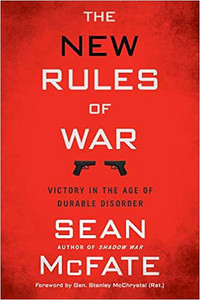
The New Rules of War
Victory in the Age of Durable Disorder
by Sean McFate2019William Morrow
Sean McFate writes from an unusual vantage point: a former 82nd Airborne paratrooper who went on to work as a private military contractor in Africa before becoming a professor at Georgetown and the National Defense University. The New Rules of War, published by William Morrow in 2019, is his argument that the Western way of war is broken, and that the United States and its allies keep losing because they are fighting a kind of conflict that has largely ceased to exist.
McFate’s central claim is that conventional interstate warfare — tanks, fleets, uniformed armies clashing on a defined battlefield — has become the exception rather than the rule. What has replaced it is a condition he calls durable disorder: persistent, low-intensity, deniable conflict waged by states, proxies, mercenaries, and criminal networks across the gaps in the international system. In this world, victory does not look like Normandy. It looks like Crimea in 2014, where Russian soldiers without insignia walked onto a peninsula and absorbed it before anyone could decide what had happened.
The book works through ten rules McFate uses to describe this new terrain. Technology, he argues, does not win wars and rarely has. He examines the resurgence of mercenaries — Russia’s Wagner Group, the industry built around Erik Prince’s Blackwater, the contractors who now outnumber uniformed American troops in several theatres — and traces how private force has moved from the margins back toward the centre of modern conflict. He treats information and influence operations as campaigns in their own right, drawing on cases from the Donbas, from Chinese activity in the South China Sea, and from the Islamic State’s media apparatus. He is sharply critical of the Pentagon’s attachment to expensive platforms like the F-35 and the Ford-class carrier, arguing that the money produces capability unsuited to the wars actually being fought. He examines Russia’s hybrid toolkit, Iran’s use of proxy militias, and the way weak states and non-state actors exploit the Western habit of declaring peace whenever the shooting formally stops.
The book sits in a crowded field of post-2014 writing on hybrid warfare and great-power competition, but it is distinct in two ways. McFate’s own history inside the contractor industry gives him access most academic authors lack, and he is willing to recommend uncomfortable responses, including a reorganised American posture that embraces irregular warfare, special operations, and the strategic use of private force. It will be most useful to readers trying to understand why Western militaries, extraordinarily well-funded and technically advanced, keep producing political outcomes that resemble defeat — and to anyone looking for a framework that connects Crimea, Syria, the Sahel, and the long shadow conflict with China into a single, coherent picture.
Read the longer summary
Sean McFate wrote The New Rules of War in the aftermath of two decades of American military frustration and in the shadow of Russia’s seizure of Crimea, the rise of ISIS, and the industrial-scale privatisation of post-9/11 conflict. Published by William Morrow in 2019, the book arrived during a period when the United States was formally pivoting away from counterinsurgency and back toward great-power competition, as framed in the 2018 National Defense Strategy. McFate’s position in that debate is unusual. A former 82nd Airborne paratrooper who later worked as a private military contractor for DynCorp in Africa, he teaches at Georgetown University and the National Defense University and sits as a senior fellow at the Atlantic Council. His earlier academic book, The Modern Mercenary, mapped the return of the private force; his novel Shadow War dramatised it. The New Rules of War is the trade-press distillation of a career spent at the frictional edge of what the US military considers legitimate warfare, and it joined a growing shelf of books — Frank Hoffman on hybrid warfare, David Kilcullen on the dragons and snakes of modern conflict, Peter Singer and Emerson Brooking on information war — arguing that the Pentagon was training for a war that would never come.
The core argument is blunt. Conventional war, by which McFate means force-on-force clashes between the uniformed armies of recognised states that end with a surrender ceremony and a treaty, is already dead or dying, and the United States keeps mistaking it for the only kind of war worth preparing for. In its place he describes a condition he calls “durable disorder”: a permanent, low-intensity, mostly-undeclared global contest in which states, proxies, mercenaries, criminal syndicates, and transnational movements fight for influence through sabotage, bribery, disinformation, lawfare, cyber intrusion, and limited violence calibrated to stay below the threshold that would trigger a conventional response. In this world, winning does not look like Berlin in 1945. It looks like Crimea in 2014 — a bloodless annexation accomplished by unmarked troops, denial, and a tempo of fait accompli that the West could not match. The United States, in McFate’s reading, has built the wrong army, bought the wrong weapons, and trained the wrong officers for the environment it actually operates in. The book is organised around ten claims, each framed as a “rule” and each argued across its own chapter.
The first rule — that conventional war is dead — opens with the claim that the last conflict resembling what Western militaries plan for was the First Gulf War, and that the long tail of American adventures since has delivered no durable strategic victory despite overwhelming firepower. The second rule attacks the belief that technology will save the United States. McFate is particularly caustic about the F-35 as a cultural artefact of a procurement system that produces exquisitely expensive platforms designed for a style of combat that will not occur, while the actual decisive weapons of the Ukraine war, the Syrian war, and the Nagorno-Karabakh war of 2020 — cheap drones, commercial satellite imagery, hacked logistics apps, Telegram channels — are developed outside the defence industrial base. The third rule rejects the familiar dichotomy of war and peace; between them lies the “gray zone” where most contemporary violence actually happens, and where America has few tools. The fourth rule, phrased deliberately to provoke, is that hearts and minds do not matter. McFate’s argument is not that civilian suffering is unimportant but that the counterinsurgency doctrine encoded in FM 3-24 — the field manual rewritten by David Petraeus and others in Iraq — proved unable to translate tactical rapport-building into political outcomes in Baghdad or Kabul, and that assuming otherwise is itself a kind of ethnocentrism.
The fifth rule — that the best weapons do not fire bullets — is where the book becomes most expansive. Information operations, financial pressure, cultivation of political fronts, legal warfare in international courts, bribery of local elites, and the orchestration of migration flows are presented as more decisive instruments than any kinetic capability. Russia is the recurring case study. McFate walks through the use of RT and Sputnik as narrative platforms, the Internet Research Agency’s social-media operations around the 2016 US election, the hybrid campaign that preceded the Crimea annexation, and the deployment of Wagner Group fighters to Syria, Libya, the Central African Republic, and Sudan. He treats these not as isolated outrages but as a coherent, cost-effective strategy that has repeatedly achieved its aims. China receives shorter but parallel treatment through the construction and militarisation of artificial islands in the South China Sea, the Belt and Road Initiative as an instrument of political leverage, and the long-horizon cultivation of overseas Chinese communities and university research pipelines.
The sixth rule — mercenaries will return — is the author’s most contested, and he knows it. Having fought as a contractor himself, McFate neither moralises nor romanticises. He argues instead that the market for private force never actually disappeared after the Thirty Years War, merely went underground, and that the post-Cold War contraction of state armies, combined with the appetite of resource-rich fragile states for deniable violence, has already rebuilt a global mercenary industry. Blackwater and its successors are only the American wing of a sector that includes South Africa’s Executive Outcomes, Britain’s Sandline, Russia’s Wagner, and a growing bench of smaller firms selling training, logistics, close protection, and occasionally direct action to anyone who will pay. He is sharp on the implications: that private force fights the fights states will not formally own, that it tilts the balance toward whichever actor is most willing to spend, and that attempting to ban it is futile because the demand is structural. His policy prescription — that the United States should regulate and employ mercenaries openly rather than pretend they do not exist — is the position most reviewers reject.
The seventh rule argues that new types of world powers will rule, by which McFate means that superpowers in the old sense of territorial, treaty-based great states are being joined and in places displaced by non-state actors with state-like capabilities: multinational corporations that outspend defence ministries, drug cartels like Mexico’s Sinaloa and the former CJNG that govern provinces in all but name, insurgent movements like Hezbollah that run social services and run cross-border forces, and transnational tech firms whose decisions on content moderation shape political outcomes. The eighth rule — that there will be wars without states — extends this to conflicts in which no recognised government is actually a party. The civil wars in Libya and the eastern Democratic Republic of Congo, the long collapse of Somalia, and the fragmented war in Syria are the running examples, and the point is that the Westphalian frame of “country A declares war on country B” is unavailable in them.
The ninth rule — shadow wars will dominate — ties the preceding threads together. Deniable operations, run through proxies and private forces, under the cover of plausible deniability and amplified by information operations, are the normal case rather than the exceptional one. McFate uses Russia’s little green men in Crimea, Iran’s cultivation of the Hashd al-Shaabi in Iraq and the Houthis in Yemen, and American drone campaigns in Pakistan and Yemen as examples of how all the major players already operate this way even while insisting publicly that they do not. The tenth rule — that victory is fungible — rejects the Clausewitzian insistence on a single decisive outcome. In durable disorder, victory is cumulative, provisional, and achievable at scales smaller than the toppling of a regime: a plebiscite tilted, a pipeline rerouted, a government quietly replaced, an election narrative seeded, a competitor’s industrial base starved of capital. The United States, trained to seek the clean win, repeatedly declines these partial victories or does not notice when its adversaries have taken them.
The evidence base is deliberately eclectic. McFate draws on his own tours and consultancies in Burundi, Liberia and the Niger Delta, on interviews with mercenaries, special-operations officers and intelligence analysts, and on open-source reporting about Russian operations in Ukraine from 2014 onward. He uses the Spartan hegemony and the Thirty Years War to argue that durable disorder is not new but normal, with the postwar Pax Americana as the historical anomaly. The procurement critique leans on specific programmes — the Zumwalt-class destroyer, the Littoral Combat Ship, the F-35 — as cases of a defence industrial base building for a war that is not coming. The treatment of Russia names the Gerasimov article in Voyenno-Promyshlennyi Kurier that gave Western analysts their vocabulary for hybrid war, while cautioning that Valery Gerasimov was describing what he thought the West was doing to Russia, not a Russian doctrine. The treatment of China tracks the Nine-Dash Line claim, the construction at Mischief and Fiery Cross reefs, and Beijing’s refusal to accept the 2016 Permanent Court of Arbitration ruling.
Reception has split along predictable lines. Officers and analysts who already believed the US was over-invested in platforms and under-invested in influence tended to welcome the book as a punchy restatement of their case. Reviewers in the political-science mainstream pushed back on two fronts. The first was definitional: Michael Mazarr and others argued that most of what McFate labels new is better captured by the existing literatures on gray-zone competition, hybrid warfare and political warfare, and that announcing the death of conventional war is premature when Russia has since conducted precisely such a war in Ukraine from February 2022 onward. The second was prescriptive: the recommendation that the United States embrace mercenaries drew sustained criticism, including from scholars like Deborah Avant who have mapped the accountability problems of the private military industry in detail, and from officers who argued that outsourcing political violence erodes civilian control. Hoffman, who originated the hybrid-warfare terminology McFate largely bypasses, has written that durable disorder usefully names a mood but does not replace the analytical categories it borrows from. The invasion of Ukraine in 2022 reopened the question in a way the book did not anticipate: a very conventional armoured offensive, with battalion tactical groups, air defence duels and artillery exchanges on a scale not seen in Europe since 1945, running alongside the drone, cyber and information wars McFate had focused on. Readers can draw either conclusion from this — that conventional war is not dead, or that the Russian army’s convulsive failures in the opening weeks vindicated his critique of conventional capability as a predictor of outcome.
For a reader working through the literature on artificial intelligence in warfare, The New Rules of War occupies a particular slot. It is not a book about autonomous weapons, military AI programmes, or algorithmic command. It is a book about the environment in which those systems will be used, and that environment is messy, deniable, fought at the political and informational layer at least as much as the kinetic one, and populated by actors who do not wear uniforms. It pairs naturally with Singer and Brooking’s LikeWar, which treats the social-media battlefield in more detail, with Kilcullen’s The Dragons and the Snakes, which covers much of the same ground with more operational texture, and with Christopher Paul and Miriam Matthews’s RAND work on Russian firehose-of-falsehood propaganda. It does not pair well with books looking for a careful, numeric treatment of specific weapons programmes; the F-35 passages are polemic rather than audit, and readers who want the inside of procurement will need to go elsewhere. Its blind spots are visible. There is relatively little on Chinese military-civil fusion as an industrial strategy, almost nothing on the specifically European predicament of a continent whose defence industrial base is a fraction of what it needs, and the treatment of information warfare is strong on symptoms and lighter on the technical and platform dynamics that drive them. The mercenary chapter will remain the lightning rod; the gray-zone chapter will remain the one most frequently quoted.
What is likely to age well is the broader claim that the strategic environment is one of continuous, undeclared competition in which the decisive instruments are often not military and the decisive actors are often not states, and that Western political systems have trouble generating responses at the tempo and ambiguity level the environment rewards. What has already dated is the implication that major-power conventional war has receded as a possibility; three years after publication, Europe watched tanks roll toward Kyiv, and the book’s title has had to be read with that caveat ever since. McFate’s instinct, that durable disorder would persist underneath and around any such war, has held up better than the specific claim that the war itself was obsolete. The book remains useful as a provocation and as a map of the terrain between declared peace and declared war, which is where most contemporary conflict actually lives, and where the next generation of weapons — including the autonomous ones — will mostly be fought with.
Publisher's description
Publisher data is pending — Google Books quota deferred until 2026-10-20T02:30:46.387443+00:00.
Watch & listen


Podcasts


223 | Sean McFate: The New Rules of War for the Age of Durable Disorder
The Realignment · apple · 2022-03-28
The New Rules of War: Victory in the Age of Durable Disorder, with Sean McFate
Carnegie Council Video Podcast · apple · 2019-03-26
The New Rules of War: Victory in the Age of Durable Disorder, with Sean McFate
Carnegie Council Podcasts · apple · 2019-03-19
More Democrats and The New Rules of War (with Sean McFate)
Pantsuit Politics · apple · 2019-03-05
The New Rules of War: A Conversation with Sean McFate
SpyCast · apple · 2019-02-19
Last researched .